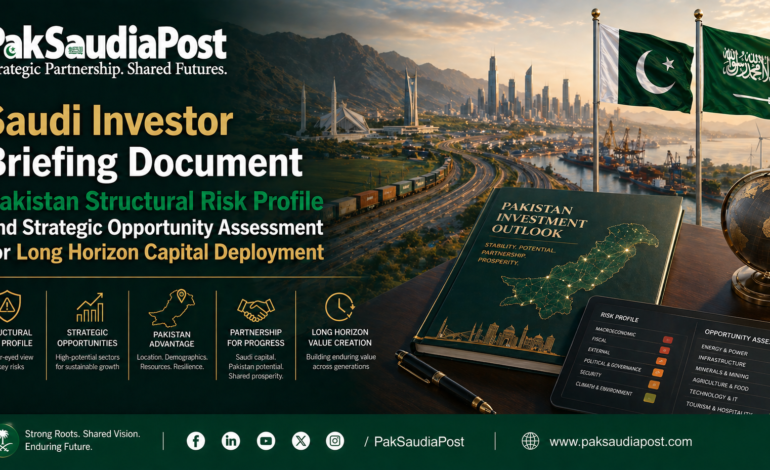
Saudi Investor Briefing Document Pakistan Structural Risk Profile and Strategic Opportunity Assessment for Long Horizon Capital Deployment

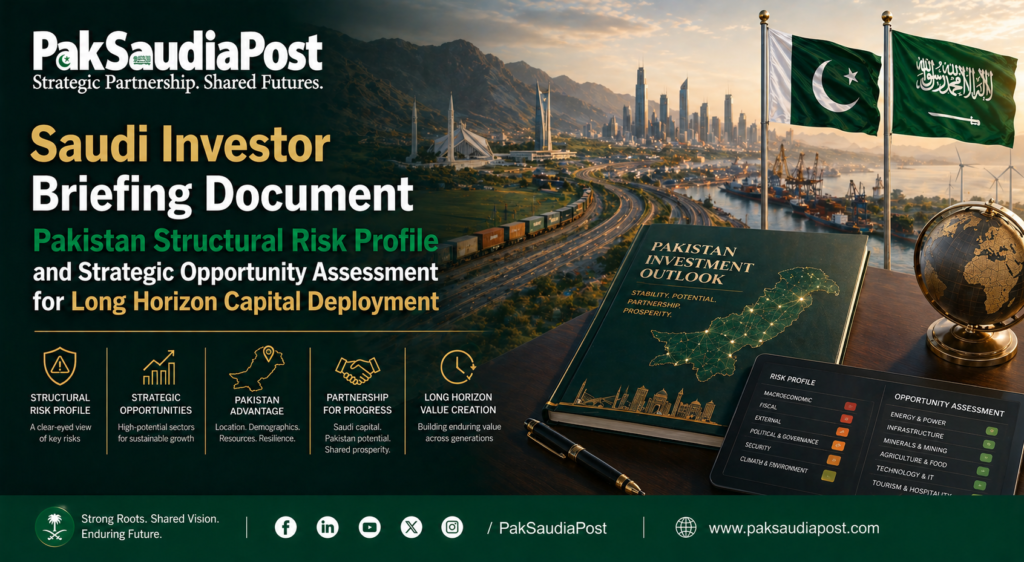
Saudi Arabia’s evolving investment doctrine, shaped by its ongoing economic transformation agenda and sovereign wealth diversification strategy, is increasingly defined by a selective and disciplined approach to external capital deployment. The era in which sovereign funds were primarily instruments of geopolitical liquidity redistribution is gradually giving way to a more calibrated investment logic anchored in return predictability, institutional reliability, and policy continuity in recipient economies. Within this shifting paradigm, Pakistan occupies a complex position that is simultaneously attractive and constrained, promising and problematic, strategically relevant yet institutionally fragmented.
From a Saudi investor’s standpoint, Pakistan is not evaluated as a conventional emerging market alone but as a multi layered strategic environment where economic opportunity intersects with political volatility, demographic scale intersects with governance inconsistency, and long-term structural potential intersects with short term macroeconomic fragility. This duality defines the core tension in Saudi capital assessment of Pakistan.
At the macro structural level, Pakistan offers three categories of strategic attractiveness that remain persistent despite cyclical instability. The first is demographic scale, with a large and youthful population that provides both labor supply and consumption potential. The second is geographic positioning at the intersection of South Asia, Central Asia, and the Arabian Sea corridor, which creates latent value in logistics, transit trade, and energy connectivity. The third is the cultural and political depth of Saudi Pakistan relations, which provides an additional layer of strategic comfort in bilateral engagement compared to other frontier markets.
However, these advantages are offset by structural constraints that are central to Saudi investment calculus. The most significant among these is governance predictability. For sovereign capital institutions, predictability is more valuable than short term yield. Pakistan’s governance environment is characterized by frequent policy reversals, overlapping institutional mandates, and inconsistent regulatory enforcement. This creates a high variance environment where future outcomes cannot be reliably projected. In sovereign investment terms, high variance environments are systematically discounted regardless of nominal growth potential.
A second major constraint is macroeconomic volatility. Pakistan’s recurring balance of payments pressures, reliance on external financing cycles, and susceptibility to currency fluctuations create an investment environment where long horizon capital becomes exposed to external shocks. Saudi sovereign funds, particularly under a diversification framework that emphasizes stability of returns, are increasingly cautious about exposure to economies where macroeconomic cycles are externally dependent rather than internally stabilized.
A third constraint is institutional fragmentation. Investment decisions in Pakistan require navigation through multiple layers of federal and provincial authority, often without clear delineation of jurisdiction. This creates delays, increases transaction costs, and introduces legal ambiguity. For Saudi investors accustomed to centralized decision making ecosystems, this fragmentation is not merely inefficient but structurally incompatible with large scale capital deployment frameworks.
A fourth consideration is energy sector distortion. Pakistan’s energy market is structurally burdened by pricing inefficiencies, circular debt accumulation, and subsidy driven distortions. From an investor perspective, this reduces the financial viability of energy intensive projects and creates uncertainty regarding long term tariff stability. Saudi Arabia’s own energy sector transformation strategy, which emphasizes efficiency, diversification, and downstream value addition, requires counterpart systems that can absorb capital into rationalized pricing structures.
Despite these constraints, Pakistan remains strategically relevant in several emerging investment domains that align with Saudi Arabia’s diversification agenda. Infrastructure development, particularly in logistics corridors and port connectivity, presents long term value creation potential. Agricultural modernization offers opportunities for food security linked investment strategies. Digital infrastructure and fintech ecosystems provide early stage entry points into a large but under monetized consumer base. Energy transition projects, particularly in renewables and grid modernization, also align with both countries’ long term structural needs.
A key dimension of Saudi investor evaluation is not only sectoral opportunity but institutional absorptive capacity. Pakistan’s ability to effectively deploy, regulate, and sustain foreign capital determines whether investment translates into productive assets or becomes trapped in administrative inefficiencies. In this regard, execution capacity is as important as policy intent.
Another critical factor is reputational signaling. In global sovereign investment ecosystems, decisions are heavily influenced by perception networks involving credit rating agencies, multilateral institutions, and regional financial media narratives. Pakistan’s reputation is shaped by recurring cycles of stabilization programs and external financing dependencies, which generate a perception of structural fragility. Saudi investment decisions are therefore not isolated financial calculations but embedded within broader reputational ecosystems that influence risk assessment.
Importantly, Saudi Arabia’s own strategic transition under its economic transformation framework has introduced a new investment discipline that prioritizes co investment ecosystems where governance alignment, transparency standards, and execution reliability are present. This means that Pakistan is not evaluated in isolation but relative to competing destinations in Asia, Africa, and the broader Islamic economic sphere.
Within this comparative framework, Pakistan’s competitive advantage lies in relational proximity, strategic alignment potential, and demographic scale. Its competitive disadvantage lies in institutional inconsistency, macroeconomic instability, and regulatory fragmentation. The interaction between these opposing forces determines the actual investment trajectory.
A further dimension shaping Saudi perception is the evolving nature of labor and human capital flows. Pakistan’s workforce remains a significant contributor to Gulf labor markets, but the narrative is shifting from low skill labor export to service based and technical contribution. Saudi Arabia’s modernization agenda increasingly values skill upgrading, digital integration, and service economy expansion. Pakistan’s ability to reposition its labor exports within this new framework will significantly influence broader investment perceptions.
Energy diplomacy also plays a central role. Saudi Arabia’s position as a global energy leader provides both opportunity and leverage in its engagement with Pakistan. Energy financing, deferred payment mechanisms, and downstream collaboration are not merely economic instruments but strategic tools of bilateral stability. However, the sustainability of these instruments depends on reciprocal reforms in Pakistan’s energy governance system.
In the long horizon view, Saudi Arabia is likely to adopt a portfolio-based engagement strategy with Pakistan rather than a singular large scale exposure model. This implies diversified exposure across energy, infrastructure, agriculture, and human capital sectors rather than concentrated sovereign stakes. Such a model reduces risk while maintaining strategic presence.
The central conclusion from a Saudi investor briefing perspective is that Pakistan represents a high potential, high friction investment environment. The determining variable is not opportunity scarcity but execution reliability. If Pakistan can reduce institutional fragmentation, stabilize macroeconomic cycles, and improve regulatory predictability, it could transition into a core destination for Saudi diversified sovereign capital. If not, engagement will remain limited to episodic liquidity support and narrowly defined strategic projects.
In essence, Saudi Arabia does not face a question of whether Pakistan is important. It faces a more precise question of whether Pakistan is investable at scale under modern sovereign capital standards. The answer to that question will define the next decade of Pakistan Saudi economic relations.
A Public Service Message