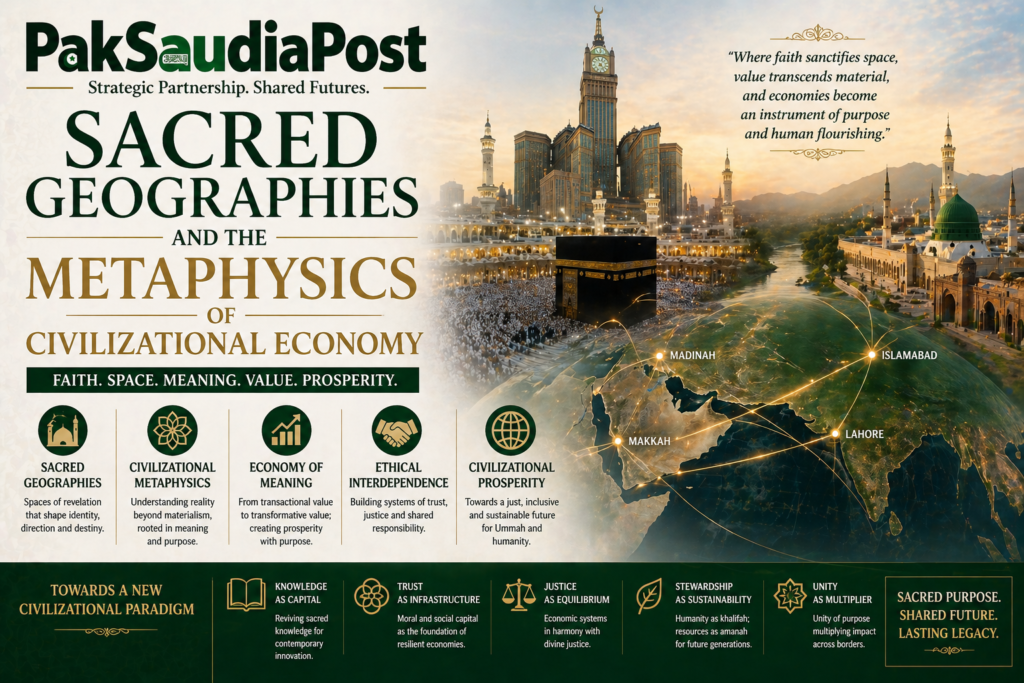
Sacred Geographies and the Metaphysics of Civilizational Economy

The contemporary Saudi Arabian condition, when observed through the analytical aperture of civilizational theory rather than the conventional lexicon of political economy, discloses an intricate fusion of the sacred and the managerial, the metaphysical and the infrastructural, the archaic and the hypermodern. It is insufficient to describe this transformation as merely developmental or transitional, for such terminology presumes a linearity of historical progression that fails to apprehend the recursive entanglement of sacred geography with state rationality. The Arabian Peninsula, historically conceptualized as a liminal expanse of deserts and sanctified sites, is increasingly reconstituted as an epistemic field in which the ontology of space is being recalibrated through the interpenetration of pilgrimage, petrocapital accumulation, and post oil futurism.
At the heart of this transformation lies a paradox that demands philosophical attention. The sacred cities of Makkah and Madinah, long understood as immutable nodes of religious gravity, are now enveloped within an expanding architecture of logistical modernity, where transportation corridors, hospitality megastructures, financial circuits, and digital governance systems converge upon the ritual economy of pilgrimage. This convergence does not diminish the sacred; rather it refracts it through the prism of infrastructural intensification. The question that emerges is not whether the sacred is being commodified, but whether commodification itself is being sacralized through a deliberate fusion of religious legitimacy and economic rationality.
Mircea Eliade’s conception of sacred space as qualitatively distinct from profane space becomes insufficient when confronted with a landscape in which the sacred is operationalized as an economic engine and simultaneously preserved as an ontological absolute. The Kaaba, for instance, remains the axis mundi of Islamic cosmology, yet its accessibility is mediated through highly sophisticated systems of mobility, regulation, and technological surveillance. This mediation does not constitute secularization in the classical Weberian sense; rather it signals the emergence of a hybrid regime in which transcendence is facilitated by technocratic precision. The sacred is no longer external to systems of governance; it is embedded within them as both legitimizing principle and operational logic.
Within this evolving configuration, the notion of moral economy assumes renewed significance. E.P. Thompson’s articulation of moral economy as a system of normative expectations governing economic behavior acquires a distinct resonance when applied to the Saudi context, where economic diversification is not merely a fiscal necessity but a moral project. Vision 2030, in its architectural ambition, is not reducible to a neoliberal restructuring agenda. It is simultaneously an attempt to redefine the ethical boundaries of wealth, labor, and national identity in a post oil era. The economy is thus not simply a mechanism of production and distribution, but a terrain of ethical inscription where value is continuously reconstituted through reference to sacred custodianship.
The custodial role of the Saudi state over the two holy mosques introduces a theological dimension into the architecture of sovereignty. Sovereignty here is not exclusively grounded in territorial control or military capacity, but in the stewardship of sacred geography. This stewardship confers upon the state a form of metaphysical legitimacy that transcends conventional political authority. It is this legitimacy that enables the integration of vast economic projects with religious symbolism without generating ontological rupture. The desert, once perceived as an empty or adversarial environment, becomes a canvas upon which civilizational ambition is projected as both divine mandate and developmental necessity.
In this context, the transformation of the desert into zones of economic experimentation and urban innovation is not merely a material process but an epistemic reordering. The desert is no longer a void to be overcome; it is a medium through which futurity is articulated. Megaprojects such as NEOM, while often analyzed in terms of technological ambition, must also be interpreted as metaphysical statements regarding the malleability of space under conditions of visionary governance. They propose not only alternative urban forms but alternative ontologies of habitation, where human existence is reconfigured in accordance with predictive intelligence systems and ecological recalibration.
Yet to interpret this transformation as unidirectional modernization would be to overlook its internal tensions. The coexistence of sacred immutability and hypermodern fluidity generates a dialectic that is neither resolved nor resolvable within conventional developmental paradigms. The sacred resists total instrumentalization even as it is operationalized within economic frameworks. Pilgrimage, for instance, remains an act of devotion, yet it is simultaneously embedded within global logistics networks that regulate flows of bodies, capital, and information. The pilgrim becomes both a spiritual actor and an economic participant within a vast circulatory system that sustains the ritual economy of Islam.
Pakistan’s position within this evolving configuration introduces an additional layer of interpretive complexity. As a state whose ideological foundation is partially anchored in Islamic identity, Pakistan occupies a reflective position in relation to Saudi Arabia’s civilizational experiment. The relationship between the two states is not merely strategic or transactional; it is epistemic. Pakistan’s developmental aspirations, institutional vulnerabilities, and socio religious dynamics interact with Saudi Arabia’s attempt to synthesize tradition and futurity in ways that reveal the broader tensions within contemporary Islamic modernity.
In Pakistan, the discourse of development is often framed within secular institutional categories, yet it is continuously inflected by moral and religious sensibilities that resist full secularization. Saudi Arabia, by contrast, is engaged in an inverse process whereby religious legitimacy is being integrated into highly rationalized systems of economic and technological governance. The juxtaposition of these trajectories suggests the emergence of a broader Islamic modernity that cannot be adequately understood through binary oppositions of secular and sacred, traditional and modern, or East and West.
The philosophical implications of this convergence extend into the realm of political theology. The Saudi state, by embedding sacred custodianship within its sovereign identity, challenges classical distinctions between temporal authority and spiritual legitimacy. This fusion produces a form of governance in which policy decisions are implicitly endowed with theological resonance. Economic diversification, infrastructural expansion, and technological adoption are not merely administrative choices; they are articulated as components of a divinely aligned national trajectory.
Such alignment raises profound questions regarding the nature of authority in post secular contexts. If legitimacy is derived not solely from popular consent or constitutional frameworks but also from custodial responsibility over sacred geography, then the epistemological foundations of governance are fundamentally altered. Authority becomes distributed across multiple registers of meaning, encompassing religious symbolism, economic rationality, and technological efficacy. The resulting structure is neither theocratic in the traditional sense nor secular in the modern sense, but something structurally hybrid and analytically elusive.
Within this hybridity, the concept of transformation itself undergoes redefinition. Transformation is no longer a linear movement from tradition to modernity, but a recursive process in which tradition is continuously rearticulated through modern forms and modernity is continuously revalidated through traditional references. The Saudi experience illustrates this recursive dynamic with particular clarity, as ancient rituals coexist with futuristic architectures, and spiritual pilgrimage intersects with algorithmic governance.
The moral economy that emerges from this configuration is therefore not static but dynamically self adjusting. Value is continuously negotiated between sacred obligation and economic opportunity. Labor, capital, and mobility are infused with symbolic significance that exceeds their material functions. The worker in a pilgrimage related industry is simultaneously an economic agent and a participant in a sacred economy. The investor in infrastructural megaprojects is simultaneously engaging in financial speculation and contributing to a nationally framed vision of civilizational renewal.
This entanglement complicates conventional critiques of commodification. To describe the sacred as commodified within the Saudi context is to assume a separation between sacred and economic spheres that no longer holds analytically. Instead, what is observable is a process of mutual constitution, wherein economic systems derive legitimacy from sacred narratives while sacred narratives are operationalized through economic infrastructures. The result is a form of sacralized modernity in which the distinction between value and virtue becomes increasingly porous.
Technological integration further intensifies this dynamic. Digital governance systems, artificial intelligence frameworks, and data driven urban planning mechanisms are not merely instruments of efficiency but components of a broader epistemic shift in which knowledge production itself becomes aligned with state defined visions of futurity. The management of pilgrimage flows, urban mobility, and environmental sustainability is increasingly mediated through algorithmic systems that encode both practical and normative assumptions about order, efficiency, and sanctity.
In this sense, technology does not displace the sacred but reconfigures its modalities of expression. The sacred becomes computationally legible, yet not reducible to computation. It is translated into data streams, regulatory frameworks, and infrastructural protocols without losing its metaphysical charge. This paradoxical coexistence of transcendence and computation defines the distinctive character of contemporary Saudi transformation.
The broader Islamic world observes this transformation with a mixture of aspiration, ambivalence, and interpretive uncertainty. For some, it represents a pioneering model of post oil adaptation that preserves religious identity while embracing global modernity. For others, it raises concerns about the dilution of spiritual authenticity under the pressures of economic spectacle and infrastructural gigantism. Pakistan, situated within this discursive field, must navigate these competing interpretations while articulating its own developmental trajectory.
Ultimately, the significance of the Saudi transformation lies not merely in its material scale but in its conceptual implications. It forces a reconsideration of foundational categories such as economy, sovereignty, modernity, and the sacred. It suggests that these categories are not stable analytical domains but mutable constructs that evolve through historical interaction and philosophical reconfiguration. The desert, once imagined as an absence, becomes a site of epistemic density where new forms of civilizational imagination are being tested.
In this emergent landscape, the question is not whether the sacred survives modernity, but how modernity is itself reconstituted through sacred logics. The answer is neither simple nor singular. It resides in the continuous negotiation between tradition and innovation, between transcendence and infrastructure, between memory and projection. Saudi Arabia, in this sense, does not merely represent a national transformation; it embodies a civilizational inquiry into the possibility of sanctified modernity, where economy becomes an extension of metaphysical order and geography becomes a medium of spiritual futurity.
The implications of this inquiry extend beyond the Arabian Peninsula. They invite a reconsideration of how Islamic societies conceptualize development, legitimacy, and progress in a world increasingly defined by technological acceleration and epistemic fragmentation. Pakistan’s engagement with this horizon will depend not only on strategic alignment but on intellectual capacity to interpret the evolving grammar of sacred modernity. The future, in this frame, is not a rupture from tradition but a rearticulation of it through novel institutional and technological forms.
Thus, the transformation underway is neither purely economic nor exclusively religious. It is civilizational in the deepest sense, insofar as it reconfigures the relationship between meaning, space, and power. It proposes a world in which deserts are no longer margins of absence but centres of imaginative possibility, where the sacred is not preserved against modernity but expressed through its most advanced forms.
A Public Service Message