

Red Sea Chaos Drives Gwadar into Strategic Focus

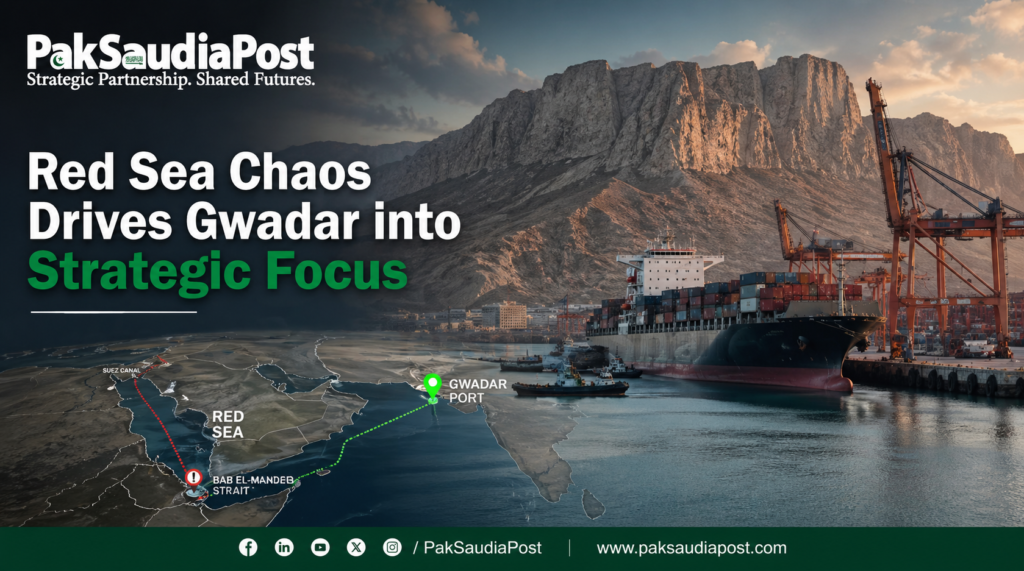
The map of maritime commerce is being redrawn by missiles fired from neglected coastlines. What once appeared a peripheral insurgent disruption in Yemen has evolved into a strategic shock for global trade, Gulf energy security and Asian supply chains. The repeated attacks by the Houthis on commercial shipping in and around the Red Sea have exposed the fragility of one of the world’s most critical maritime arteries. For Saudi Arabia, whose prosperity remains deeply tied to stable export routes and secure sea lanes, and for Pakistan, whose coastline sits at the hinge of the Arabian Sea, the crisis presents both warning and opportunity. If managed with strategic seriousness, the turbulence stretching from Bab el Mandeb to Suez could elevate Gwadar from an underused port into a component of a wider Pakistan Saudi maritime architecture.
The Red Sea is not merely a body of water. It is an economic bloodstream. Roughly 12 percent of global trade and a significant share of container traffic passes through the Suez Canal corridor in normal times. When armed groups acquire the ability to threaten that route with drones, anti ship missiles and asymmetric harassment, they do not merely challenge naval patrols. They challenge the assumptions of globalization itself. Every delay, insurance surcharge and rerouted vessel raises freight costs, lengthens delivery schedules and feeds inflationary pressures from Europe to Asia.
For Saudi Arabia, the strategic significance is immediate. The kingdom’s western coastline opens onto the Red Sea, where major industrial, tourism and logistics ambitions are central to Vision 2030. Jeddah remains a vital commercial gateway. NEOM and associated mega projects depend upon confidence in secure maritime movement. The kingdom’s ambition to become a logistics and investment hub cannot rest on vulnerable corridors alone. The old model, in which energy rents compensated for geopolitical risk, is being replaced by a new model in which geopolitical resilience is itself an economic asset.
Pakistan enters this equation not as a sentimental partner but as a geographic fact. Its coastline faces the Arabian Sea near the mouth of the Gulf energy system. Karachi remains a large commercial center. Gwadar, despite years of underperformance and bureaucratic delay, occupies a location of undeniable strategic potential. It sits outside the narrowest congestion points of the Gulf while remaining proximate to Gulf shipping lanes, western China and South Asia. In an age of disrupted chokepoints, redundancy matters as much as capacity. Ports once dismissed as secondary can become strategic insurance.
That logic creates a serious case for Pakistan Saudi maritime cooperation. The relationship between the two states has historically leaned on remittances, political solidarity, occasional financial support and defence symbolism. Those pillars still matter, but symbolism is no longer enough. The next phase must be institutional and practical. Maritime security offers precisely that terrain. It combines hard security, economic interest, infrastructure logic and regional relevance.
The first requirement is a shared understanding of threat. Houthi attacks have shown that modern maritime disruption is no longer the preserve of great navies. Relatively low-cost drones, anti-ship missiles, cyber interference and intelligence enabled harassment can unsettle billion-dollar logistics systems. Traditional convoy models remain useful, but they are insufficient. Ports, undersea cables, satellite links, logistics software and fuel storage networks are now part of the battlespace. Pakistan and Saudi Arabia should therefore conceptualize maritime security broadly, not narrowly.
A bilateral maritime framework could begin with intelligence fusion. Pakistan’s military and naval institutions possess long experience in regional monitoring, operational planning and sea lane awareness. Saudi Arabia has rapidly expanded surveillance, procurement and strategic planning capabilities. A combined maritime intelligence cell focused on Arabian Sea and Red Sea developments would allow earlier warning, faster coordination and joint scenario planning. Such a mechanism would be more valuable than ceremonial exercises whose media value often exceeds their operational depth.
The second requirement is port resilience. Ports are no longer mere loading zones. They are strategic nodes vulnerable to sabotage, cyber intrusion and supply interruption. Saudi capital paired with Pakistani geography could finance modernized security architecture at Gwadar and related facilities. This would include integrated radar networks, anti-drone systems, container scanning, digital customs systems, emergency fuel reserves and cyber hardened operating platforms. If Gwadar is to matter, it must be reliable before it is busy.
Third, naval logistics cooperation deserves urgent attention. Saudi Arabia increasingly seeks flexible options for sustainment, repair and regional deployment. Pakistan’s naval infrastructure, training establishments and repair experience can complement Saudi modernization efforts. Joint maintenance arrangements, training exchanges and pre positioned support capabilities would create strategic depth without requiring dramatic treaty announcements. Quiet capability often matters more than loud communiqués.
Critics will note that Gwadar has been promised much before. They are correct. For years the port has symbolized unrealized ambition. Connectivity gaps, local grievances, security concerns, limited commercial throughput and policy inconsistency have constrained progress. Yet strategic assets sometimes mature late because the environment around them changes. Red Sea disruption, intensifying great power competition and Gulf diversification have altered the context. Gwadar may not have changed enough, but the world around Gwadar certainly has.
There is also a wider geo economic case. Saudi Arabia is actively diversifying beyond crude dependence into logistics, mining, industry, tourism and sovereign investment. Pakistan urgently needs foreign direct investment that creates productive capacity rather than short term balance sheet relief. A focused maritime compact could align these needs. Saudi investment in coastal logistics zones, warehousing, petrochemical storage and transport links would not simply aid Pakistan. It would give Riyadh optionality in an uncertain region.
Optionality is the key strategic word of this decade. Middle powers no longer seek singular dependencies. They seek multiple routes, multiple suppliers, multiple security partners and multiple hedges. Saudi Arabia has demonstrated this through balancing relations with America, China, Russia and regional rivals. Pakistan, despite domestic turbulence, also increasingly navigates a world where no single patron can solve structural problems. A maritime partnership centered on resilience rather than ideology fits the age.
India’s rise sharpens the relevance of this conversation. New Delhi has expanded naval reach, cultivated Gulf ties and positioned itself as a logistics and connectivity partner from the Gulf to Europe. Saudi Arabia will continue engaging India heavily, and rationally so. Pakistan should not expect exclusivity. But it can still offer differentiated value through military familiarity, geographic adjacency and strategic responsiveness. In competitive diplomacy, value matters more than nostalgia.
China’s presence adds another layer. Beijing’s Belt and Road investments helped bring Gwadar into strategic discourse, yet Chinese financing alone cannot ensure commercial viability or regional legitimacy. Saudi participation would diversify Gwadar’s ownership narrative and reduce the perception of a single power enclave. For Pakistan, that broadening would be healthy. For Saudi Arabia, it would offer access without overcommitment.
Iran cannot be ignored either. Any Arabian Sea architecture exists beside Iran’s coastline and within a region shaped by fluctuating Saudi Iranian relations. Recent détente between Riyadh and Tehran lowers immediate tension but does not erase rivalry or mistrust. A Pakistan Saudi maritime framework should therefore be defensive and commercial, not theatrically anti Iranian. Pakistan, which maintains important ties with Tehran, is well placed to encourage de escalatory framing.
Media narratives around the Red Sea crisis have often been simplistic. Western outlets tend to frame it primarily as a test of American naval credibility or a supply chain headache for Europe. Regional media often present it as resistance politics or another chapter in proxy war. Both lenses miss a larger truth. The deeper story is the weaponization of chokepoints in an age when non state actors can impose macroeconomic costs. That reality affects food prices in Cairo, insurance in London, exports in Jeddah and manufacturing schedules in Karachi.
Pakistani and Saudi media could help construct a more strategic public discourse. Instead of reducing bilateral ties to pilgrim quotas, aid packages or ceremonial visits, they should debate shipping security, port modernization, cyber resilience and maritime law. Public expectations shape policy bandwidth. If societies discuss only symbolic brotherhood, governments often deliver only symbolic brotherhood.
There are, however, reasons for caution. Pakistan’s governance deficits remain severe. Investors confront regulatory uncertainty, tax inconsistency and bureaucratic friction. Security gains against militancy are real but uneven. Energy shortages and macroeconomic fragility constrain implementation. Saudi policymakers know this. They will not commit large strategic capital merely based on friendship narratives. They will demand enforceable timelines, credible guarantees and measurable returns.
That demand should be welcomed, not resented. Pakistan’s chronic challenge has not been lacking of opportunity but lack of execution. If external partners insist on discipline, they may indirectly help create it. Gwadar especially needs governance clarity, local inclusion and commercial realism. Ports succeed when hinterlands connect, customs function and communities’ benefit. Without those basics, grand strategy remains PowerPoint.
Saudi Arabia too faces tests. Vision 2030 is ambitious, but ambitious states can overextend. Mega projects compete for capital. Regional diplomacy requires balance. Oil revenues fluctuate. Domestic transformation absorbs administrative energy. Riyadh must therefore prioritize external commitments carefully. A Pakistan maritime partnership would need to be lean, phased and commercially grounded rather than extravagantly announced.
The practical path forward is incremental. Begin with annual maritime dialogues involving defence, transport, customs and investment officials. Establish a joint task force on port security technology. Expand naval training and search rescue exercises. Create a framework for Saudi participation in selected coastal logistics assets. Integrate private sector shipping firms into planning. Encourage academic and media exchanges on maritime strategy. None of this requires a dramatic alliance treaty. All of it builds substance.
The stakes extend beyond two countries. If Muslim major economies cannot cooperate on securing trade routes that directly affect their prosperity, they will remain price takers in systems designed elsewhere. Pakistan and Saudi Arabia together possess geography, capital, manpower and strategic location. What they have often lacked is sustained institutional imagination.
The Red Sea crisis may prove temporary. Shipping routes will adapt. Naval patrols may suppress attacks. Diplomacy may cool the conflict. But even if the immediate threat recedes, the lesson should endure. The era of frictionless maritime globalization is over. Chokepoints can be politicized. Insurance can become strategy. Ports can become leverage. Nations that prepare for recurring disruption will gain advantage over those waiting for a return to old normality.
Gwadar will not become Singapore, nor should that fantasy guide policy. It need only become useful. Useful as a redundancy hub. Useful as a logistics node. Useful as a site of Saudi Pakistani cooperation. Useful as evidence that strategic geography can be translated into economic relevance. Sometimes usefulness is more valuable than grandeur.
For Pakistan, success would signal that it can move beyond aid dependency toward asset-based partnerships. For Saudi Arabia, it would demonstrate that Vision 2030 extends beyond domestic skylines into regional systems building. For both, it would show that bilateral relations can evolve from episodic warmth to functional strategy.
Missiles launched from Yemen have reminded the world that narrow waterways can shake vast economies. The answer is not panic, nor rhetorical coalition building alone. It is resilient networks, diversified routes and trusted partnerships. Somewhere between Bab el Mandeb and the Makran coast lies a chance for Pakistan and Saudi Arabia to think strategically together. Whether they seize it will depend less on speeches than on ships, software, cranes, contracts and political patience.
A Public Service Message


