

Corridor Dreams Need Pakistan and Saudi Arabia Together

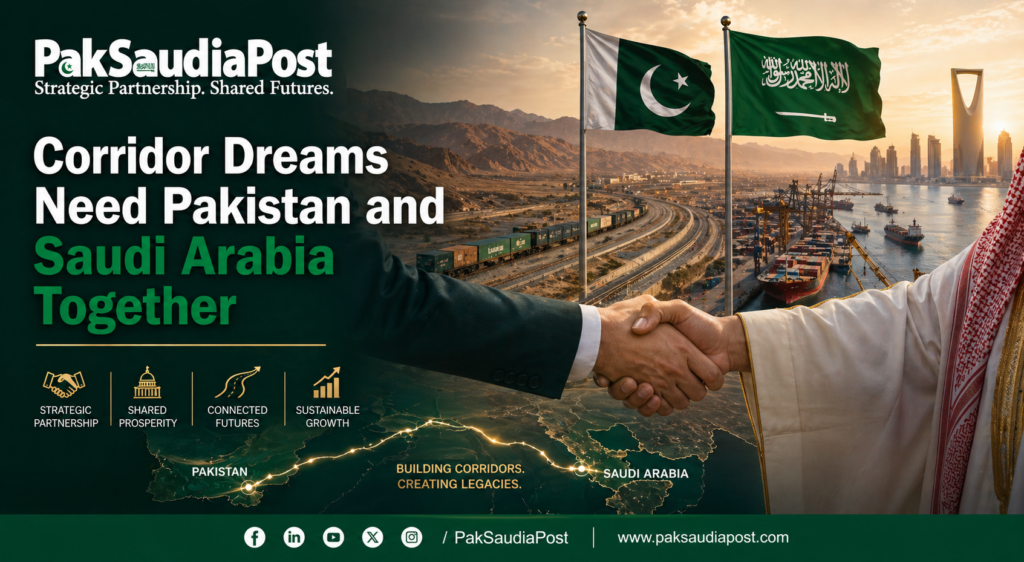
The twenty first century is witnessing a return of geography. For a generation, many believed digitalization, containerization and financial globalization had diluted the importance of territory. Yet wars, sanctions, disrupted canals, weaponized chokepoints and fractured supply chains have restored an old truth. Nations still rise or stagnate according to routes, access and logistics. In that altered landscape, the possibility of a new corridor linking Saudi capital with Pakistani geography deserves serious examination. What may be called a Muslim Middle Corridor is no romantic civilizational slogan. Properly designed, it could become a pragmatic commercial network connecting Gulf markets with Central Asia, western China and broader Eurasian demand.
Recent years have accelerated interest in alternative routes. Russia’s war in Ukraine damaged confidence in certain northern transit lines. Houthi attacks in the Red Sea exposed vulnerability in maritime passageways once assumed secure. Tensions between America and China have pushed firms to diversify manufacturing and sourcing risk. Europe’s search for resilient supply chains has widened attention toward middle powers. Meanwhile Gulf states, led by Saudi Arabia, are seeking post oil futures in logistics, industry and investment. The result is a strategic moment in which corridors are no longer abstract infrastructure fantasies. They are instruments of national resilience.
Saudi Arabia enters this decade with money, ambition and urgency. Vision 2030 aims to transform the kingdom into a diversified economic hub. Ports, free zones, aviation, data centers, tourism and industrial platforms are central to that project. Riyadh increasingly understands that wealth in the future may come less from extracting resources and more from moving goods, processing materials, financing trade and controlling nodes of value creation. Yet capital alone does not create corridors. Corridors require geography, labour, throughput and political will across borders.
Pakistan, despite chronic economic instability, offers geography in abundance. It sits at the intersection of South Asia, the Gulf, Central Asia and western China. Its coastline opens onto the Arabian Sea. Its land routes can potentially connect seaborne Gulf cargo with inland Eurasian markets. Gwadar and Karachi provide maritime access. Road and rail links, if modernized, could form arteries toward Afghanistan, Xinjiang and beyond. Pakistan’s challenge has never been location. It has been converting location into policy.
This is where Saudi capital and Pakistani geography could theoretically align. Saudi sovereign investment funds, industrial groups and logistics firms possess the financial scale to support port expansion, warehousing, cold chains, petrochemicals, dry ports and transport modernization. Pakistan possesses underused strategic space, labour pools and route potential. One side needs productive external deployment. The other needs long term investment that generates activity rather than temporary balance of payments relief.
The phrase Muslim Middle Corridor may sound rhetorical, but it captures a strategic logic. Existing trade narratives often revolve around China’s Belt and Road Initiative, India Middle East Europe Corridor plans, the Trans Caspian route, Turkish connectivity ambitions or Western reshoring strategies. Muslim majority states are frequently markets within these designs rather than architects of them. A Saudi Pakistan corridor would not need to exclude others. It would simply assert agency within an increasingly competitive logistics order.
The first component would be maritime. Saudi exports and imports already depend heavily on sea routes. Pakistani ports could serve as complementary nodes for selected cargo handling, storage, reprocessing and onward distribution. Gwadar, often discussed more than utilized, could become valuable if integrated into real commercial flows rather than symbolic speeches. Karachi, with its existing scale and business ecosystem, would remain essential. Successful corridors rarely rely on a single glamorous port. They use networks of specialized nodes.
The second component would be inland transport. Pakistan’s road improvements under earlier infrastructure programs created partial foundations, but rail remains underdeveloped and customs inefficiencies remain severe. Saudi backed modernization of freight rail, intermodal terminals and digital border management could materially reduce transit time. In corridor economics, reliability can matter more than speed. A shipment that predictably arrives in ten days is often more valuable than one that might arrive in six or sixteen.
The third component would be industrial clustering. Corridors succeed when goods are transformed, not merely moved. Special economic zones near ports and transport hubs could host food processing, minerals refining, packaging, pharmaceuticals, light manufacturing and data services. Saudi Arabia is seeking food security, mining partnerships and industrial diversification. Pakistan offers agricultural potential, workforce depth and proximity to multiple markets. If managed properly, both sides could capture value beyond transport tolls.
The fourth component is digital trade infrastructure. Too many developing states discuss roads while ignoring software. Modern corridors require e customs, trusted trader systems, cargo tracking, interoperable payments, digital documentation and data security. Saudi Arabia has rapidly upgraded administrative technology. Pakistan has talent in software and fintech but uneven state implementation. Combining these strengths could create an unexpectedly modern platform.
Skeptics will immediately raise Afghanistan. They should. Any overland route toward Central Asia confronts Afghan instability, governance uncertainty and sanctions complications. Yet geography does not disappear because politics is difficult. Multiple states continue exploring transit possibilities through or around Afghanistan because demand for Eurasian access remains real. Pakistan and Saudi Arabia need not bet everything on one passage. A smart corridor strategy would be modular, using maritime links, domestic industrial zones, western China access where feasible, and Central Asian routes when conditions permit.
Western China itself is significant. Xinjiang sits closer to Pakistan’s coast than to many eastern Chinese seaports. While China has invested heavily in alternate logistics through Pakistan, commercial scale remains below strategic headlines. Saudi participation could add financing diversity and commodity flows. The kingdom’s growing energy, petrochemical and industrial ties with China provide commercial reasons to consider westward logistics complements. Such moves would need careful diplomacy, but the logic is visible.
Comparison with the India Middle East Europe Corridor is unavoidable. That initiative attracted attention because it links rising India, wealthy Gulf states and European demand. Yet implementation faces its own geopolitical complications, financing burdens and route complexities. Pakistan should not respond with insecurity. Instead it should offer differentiated value. It provides direct adjacency to the Arabian Sea, established links with China, proximity to Afghanistan and shorter access to certain inland markets. Corridors are not winner takes all games. The world economy can sustain multiple pathways.
There are also domestic political obstacles inside Pakistan. Provincial tensions, center province mistrust, land disputes and elite fragmentation often delay infrastructure decisions. Regulatory inconsistency frightens investors more than dramatic headlines do. Tax regimes change abruptly. Contracts are politicized. Bureaucratic layers multiply transaction costs. Saudi decision makers understand these risks. They will not deploy billions merely because speeches invoke brotherhood. They will demand clarity, guarantees and dispute resolution mechanisms.
That is healthy. Pakistan has too often treated foreign investment as diplomatic charity rather than commercial partnership. Serious Saudi participation would likely come with performance expectations. Those expectations could help discipline domestic governance if political leaders choose to use them wisely. The real contest is not between Pakistan and rival corridors abroad. It is between Pakistan’s potential and Pakistan’s own administrative habits.
Saudi Arabia also faces constraints. Vision 2030 requires immense capital at home. NEOM, industrial projects, tourism infrastructure and social transformation all compete for attention. Oil revenues, while strong at times, are cyclical. Riyadh must prioritize where overseas commitments generate strategic return. A corridor through Pakistan would need to show credible economics, not merely sentimental appeal.
Media narratives in both countries often obscure this reality. Pakistani commentary frequently reduces Saudi relations to aid packages, pilgrim quotas or labour opportunities. Saudi commentary can sometimes portray Pakistan primarily through security or manpower lenses. Both frames are outdated. The real frontier is productive co development. If media ecosystems continue privileging ceremony over commercial detail, publics will misunderstand where opportunity lies.
Social media adds another distortion. Hashtag diplomacy creates waves of excitement after each high level visit, followed by silence when implementation stalls. Memorandums of understanding are celebrated as finished achievements. Announced numbers are repeated without scrutiny. Few ask whether land was acquired, regulations simplified, power supplied or contracts enforced. Corridors fail not because of lack of announcements but because of lack of boring execution.
There is a broader civilizational question too. Can major Muslim economies build integrated systems in an age of fragmentation. The Islamic world spans energy producers, labour exporters, strategic waterways, youthful populations and large consumer markets. Yet economic integration remains shallow. Tariff barriers, weak logistics, rivalries and institutional underdevelopment persist. A successful Saudi Pakistan corridor would not solve these structural issues, but it would demonstrate possibility.
Security cannot be ignored. Routes through Pakistan require stable internal order, especially in Balochistan and along transport corridors. Local communities must benefit materially through jobs, services and revenue sharing. Security enforced only through force rarely sustains commerce. Stability built through inclusion does. Saudi investors will watch this closely. They know that warehouses cannot thrive where populations feel excluded.
Environmental realities matter as well. Climate stress is reshaping logistics. Heatwaves damage infrastructure, floods destroy roads and water scarcity affects industry. Pakistan’s recent climate disasters were warnings. Any corridor strategy must therefore integrate resilient design, renewable energy where possible, water management and insurance planning. Twenty first century infrastructure built with twentieth century climate assumptions is already obsolete.
What then should be done. First, both governments should create a joint corridor commission staffed not by ceremonial diplomats alone but by logistics experts, financiers, customs officials and provincial representatives. Second, select a few commercially viable pilot projects rather than announce sprawling visions. Third, prioritize digital customs reform and rail freight efficiency. Fourth, guarantee investor protection through transparent arbitration mechanisms. Fifth, align training programs so Pakistani labour and management capacity can support new industrial zones.
The private sector must lead more than states. Governments can clear obstacles, but businesses create flows. Saudi retailers, food companies, petrochemical firms, mining investors and logistics operators should be engaged directly with Pakistani manufacturers, exporters and technology firms. Chambers of commerce matter more than gala banquets.
None of this guarantee’s success. Many corridors remain maps on conference screens. Yet dismissing the idea would also be shortsighted. The global system is searching for redundancy, diversification and middle power connectivity. Pakistan and Saudi Arabia together possess many ingredients others would envy: capital, coastline, market access, strategic depth and demographic scale.
The essential question is whether they can replace nostalgia with competence. Their bilateral relationship is warm but under institutionalized. Too often it has depended on leaders, crises or emotion. Corridors require spreadsheets, standards, maintenance and patience. They reward discipline rather than drama.
If they succeed, Pakistan could evolve from aid seeker to transit and production partner. Saudi Arabia could deepen its transformation from oil exporter to logistics strategist. Central Asian states could gain another southern outlet. Western China could access supplementary routes. Consumers across the region could benefit from lower costs and diversified supply.
If they fail, another decade will pass in declarations, with competitors building the systems that shape trade while Pakistan and Saudi Arabia celebrate intentions. Geography is patient, but markets are not.
The return of geography gives both countries a rare second chance. Pakistan still sits where continents meet. Saudi Arabia still commands capital and strategic reach. The world still needs reliable routes. A Muslim Middle Corridor will not emerge from slogans about brotherhood. It will emerge from cranes, rails, code, customs reform and contracts honoured on time. In the age of disrupted globalization, that would be a far more meaningful form of solidarity.
A Public Service Message


