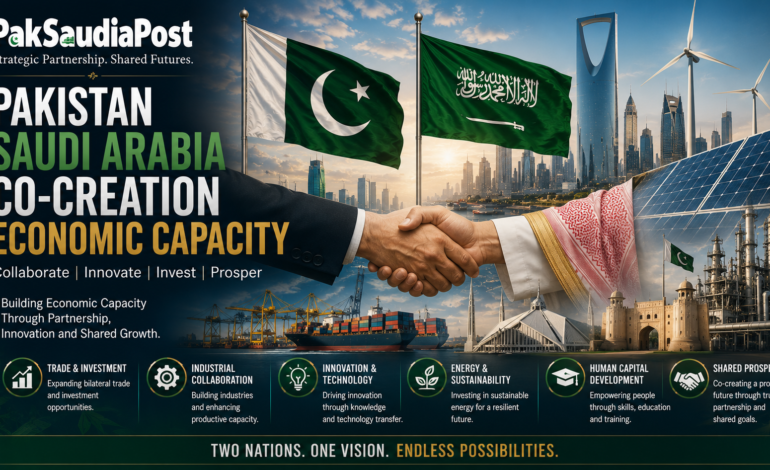
Pakistan Saudi Arabia Co Creation Economic Capacity

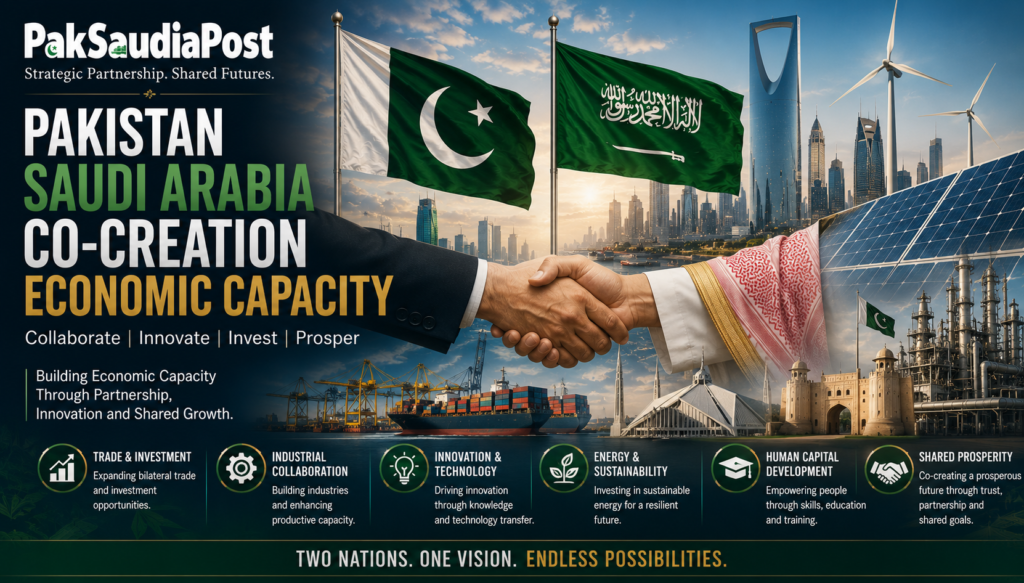
The economic relationship between Pakistan and Saudi Arabia is entering a phase where capital inflows alone are no longer sufficient to define strategic depth. The earlier architecture of cooperation, largely centered on deposits, energy financing, labor remittances, and episodic investment announcements, is gradually giving way to a more complex demand structure in which both states are seeking durable productive capacity. The shift is subtle but consequential. It is no longer about how much capital moves between the two economies, but about what kind of economic systems are jointly constructed and whether those systems generate autonomous capability over time.
Saudi Arabia’s ongoing economic diversification agenda, shaped by long term fiscal recalibration and non oil sector expansion, is increasingly oriented toward knowledge intensive production systems, advanced manufacturing clusters, logistics integration, renewable energy value chains, and food import substitution. Pakistan, by contrast, is navigating the constraints of external account pressure, industrial stagnation, agricultural inefficiencies, and export concentration in low complexity sectors. The asymmetry between the two economies creates both opportunity and tension. Opportunity arises from complementarity, while tension emerges from institutional capacity gaps and uneven execution environments.
The emerging question is whether both sides can move beyond transactional engagement into what can be described as co creation of strategic economic capacity, a model in which investments are not isolated financial transfers but embedded within shared production ecosystems, joint governance structures, and interoperable industrial policy frameworks. This requires a shift in mindset from project based financing to system based integration.
Historically, bilateral economic cooperation has been episodic and liquidity driven. Saudi financial support has often stabilized Pakistan’s external accounts during balance of payments stress, while Pakistani labor exports have contributed to remittance inflows that sustain domestic consumption cycles. However, this model has limited impact on structural transformation. It stabilizes but does not necessarily modernize. It sustains but does not fundamentally upgrade productivity. The current global economic environment, defined by fragmented supply chains, technological consolidation, and intensified competition for critical inputs, makes this model increasingly insufficient.
A more forward leaning framework would require both countries to identify sectors where joint capability creation is not only possible but strategically necessary. Advanced manufacturing is one such domain. Saudi Arabia’s industrial diversification requires localized production of machinery components, energy equipment, and intermediate goods. Pakistan’s industrial base, though constrained, retains a large labor force and an underutilized engineering and technical education network. A structured industrial partnership could involve joint manufacturing zones where Saudi capital and Pakistani labor and technical capacity are integrated with shared standards, joint ownership structures, and synchronized export strategies.
Food systems represent another domain of convergence. Saudi Arabia’s structural dependence on food imports is unlikely to diminish in the near term due to climatic limitations. Pakistan possesses significant agricultural potential but suffers from low yield efficiency, fragmented supply chains, and post harvest losses. A co creation model would involve Saudi investment in cold chain logistics, agri processing technology, and precision irrigation systems within Pakistan, coupled with guaranteed procurement agreements that stabilize Pakistani farmer incomes while securing Saudi supply chain resilience. This is not simply agricultural trade, but agricultural system integration.
Critical minerals and resource processing offer another layer of strategic alignment. Global demand for industrial minerals, battery materials, and rare earth inputs is increasing, driven by energy transition dynamics and industrial electrification. Pakistan’s geological profile suggests untapped potential in several mineral categories, though exploration remains underdeveloped. Saudi Arabia’s financial capacity and strategic interest in diversifying into mineral based industrial assets could support joint exploration ventures, data mapping initiatives, and downstream processing facilities. The key shift here would be from extraction oriented engagement to value chain participation.
Logistics and connectivity infrastructure also form a foundational pillar of co created economic capacity. Saudi Arabia’s ambition to position itself as a global logistics hub intersects with Pakistan’s geographic positioning as a transit corridor between South Asia, Central Asia, and the Arabian Sea. However, infrastructure alone does not create integration. Institutional harmonization is required. This includes customs digitization, regulatory synchronization, port efficiency upgrades, and the establishment of integrated logistics data systems. Without these, physical infrastructure risks underperforming relative to its strategic potential.
Digital industries represent a more recent but increasingly important dimension. Both economies are experiencing rapid digital adoption, yet institutional digitalization remains uneven. Joint investment in fintech infrastructure, digital identity systems, cross border payment frameworks, and cybersecurity architecture could generate a shared digital economic layer. This would not only facilitate trade but also enable new categories of services export, particularly from Pakistan’s emerging freelance and IT services workforce into Saudi corporate and public sector ecosystems.
However, the transition toward co creation is not primarily a financial challenge. It is an institutional and governance challenge. The primary constraint lies in execution capacity, regulatory predictability, and project continuity. Pakistan’s policy environment has historically suffered from discontinuity across administrative cycles, while large scale projects often face delays due to fragmented decision making structures. Saudi Arabia, while possessing stronger execution discipline, requires partner ecosystems that can match long term policy consistency. Without alignment in governance architecture, even well funded initiatives risk underperformance.
One potential institutional innovation could be the establishment of a Pakistan Saudi Economic Capability Council, structured not as a ceremonial body but as an operational platform with delegated authority over selected strategic sectors. Such a council would include sovereign representatives, industrial planners, private sector operators, and technical experts tasked with identifying, executing, and monitoring joint projects. Its mandate would extend beyond consultation into implementation oversight, with measurable performance benchmarks and time bound deliverables.
Another mechanism could involve the creation of sector specific joint venture frameworks where ownership structures are balanced not only financially but operationally. For example, in agro industrial parks or mineral processing zones, Saudi entities could provide capital and global market access while Pakistani institutions provide regulatory facilitation and labor integration. The governance of such ventures would need to be insulated from short term political fluctuations through contractual safeguards and arbitration based dispute resolution systems.
Human capital development is another critical axis. Co creation of economic capacity cannot occur without aligned skill development systems. Technical training institutes, joint certification programs, and industry aligned curricula would be required to ensure that workforce capabilities match industrial requirements. Saudi Arabia’s investment in vocational training ecosystems could be linked with Pakistani educational institutions to create a transnational skills pipeline.
Risk management remains a central consideration. Both economies face different but interconnected vulnerabilities. Pakistan’s exposure to external financing cycles and fiscal instability contrasts with Saudi Arabia’s exposure to hydrocarbon price volatility and long term energy transition risks. A co created economic framework would need to incorporate stabilization mechanisms that allow both sides to absorb shocks without disrupting joint ventures. This could include sovereign backed guarantee structures or multi layered insurance frameworks for strategic projects.
Ultimately, the transition from transactional investment to co creation of economic capacity is not a rhetorical shift but a structural transformation. It requires redefining the purpose of capital itself. Capital is no longer merely a resource to be deployed, but a mechanism to construct shared economic architectures that persist beyond individual projects or political cycles.
The central test for both Pakistan and Saudi Arabia will be whether they can institutionalize this transition in a way that survives administrative turnover, economic volatility, and sectoral disruption. If successful, the relationship will evolve from episodic support mechanisms into a sustained system of mutual capability formation. If not, it will remain anchored in cyclical financial exchanges with limited structural transformation.
The opportunity window is open, but not indefinite. Global economic realignments are increasingly rewarding integrated production systems over fragmented bilateral exchanges. In this context, the ability to design and execute co created economic capacity will determine not only the future trajectory of bilateral relations, but also the resilience of each economy within a rapidly reordering global economic environment.
A Public Service Message