Pakistan Saudi Arabia and Emerging Security Compact Architecture


The strategic relationship between Pakistan and Saudi Arabia has long been anchored in historical affinity, defence cooperation, labour mobility, and financial interdependence. Yet the current phase of international security evolution is reshaping the assumptions under which bilateral ties have traditionally operated. The security environment stretching from the Gulf to the western reaches of South Asia is no longer defined by linear interstate competition alone. Instead, it is increasingly characterised by overlapping domains of hybrid contestation, cyber intrusions targeting critical infrastructure, precision drone incidents in maritime corridors, and the steady diffusion of non state actors operating with transnational reach and technological adaptability. Within this environment, both Islamabad and Riyadh are confronted with a shared policy question that is no longer theoretical but operational in nature, whether their historical partnership can be translated into a structured strategic security compact capable of addressing distributed threats without compromising sovereign decision making or entangling either state in external alignments that dilute strategic autonomy.
The foundational logic of a renewed security architecture rests on the recognition that traditional defence cooperation, while still relevant, is insufficient to address the layered complexity of present risks. Military exercises, training exchanges, and bilateral consultations remain important instruments, but they operate within a paradigm designed for conventional deterrence. The current threat spectrum extends beyond battlefield scenarios into domains where attribution is difficult, response timelines are compressed, and the distinction between peace and conflict is increasingly blurred. Cyber intrusions against energy grids, port management systems, and financial networks can generate strategic disruption without a single kinetic event. Maritime incidents involving unmanned systems or proxy actors can influence insurance costs, shipping reliability, and energy pricing without formal declarations of hostility. In such a setting, Pakistan and Saudi Arabia face the necessity of conceptualising security as an integrated continuum rather than a series of isolated defence responses.
A potential strategic security compact between the two countries would therefore require a structural shift from episodic coordination to institutionalised integration. This does not imply the formation of a rigid alliance system, nor does it suggest alignment within competing geopolitical blocs. Rather, it points toward the development of a multi domain security framework that integrates intelligence sharing, cyber defence coordination, maritime situational awareness, and rapid crisis response protocols under a shared operational architecture. Such a framework would need to be designed with sufficient flexibility to accommodate evolving threat categories while maintaining the sovereignty and independent strategic calculus of both states.
Intelligence fusion stands at the core of this prospective arrangement. Both Pakistan and Saudi Arabia possess distinct but complementary intelligence capabilities shaped by their regional experiences. Pakistan’s institutional exposure to asymmetric conflict environments has generated expertise in counter insurgency intelligence, border monitoring systems, and urban threat mapping. Saudi Arabia’s security apparatus has increasingly focused on counter terrorism financing, regional surveillance, and infrastructure protection across energy and industrial sectors. A structured intelligence coordination mechanism could enable real time exchange of threat indicators related to transnational militant networks, cyber threat signatures, and maritime risk assessments. However, the success of such a mechanism would depend on the establishment of trust frameworks that ensure data protection, classification discipline, and mutually agreed thresholds for operational disclosure.
Cyber defence constitutes another critical pillar of a modernised security compact. The digitisation of governance systems, financial transactions, energy distribution networks, and port operations in both countries has significantly expanded the attack surface available to hostile actors. Cyber operations are increasingly conducted by non-state entities, state linked proxies, and ideologically motivated hacker collectives operating across jurisdictions. A bilateral cyber coordination centre could be envisaged to monitor intrusion attempts, share forensic analysis, and develop joint response protocols for incidents targeting critical infrastructure. Such a centre would not only serve defensive purposes but could also function as a training and capacity building hub, enhancing resilience across governmental and semi-governmental institutions.
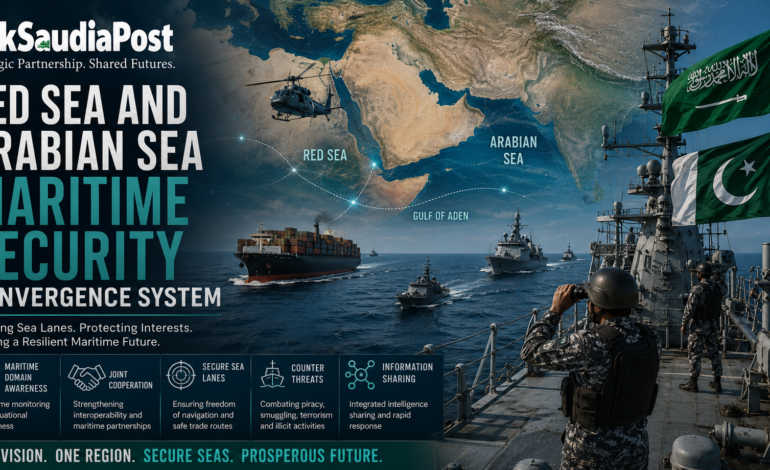
Maritime security represents an equally significant domain of convergence. The Arabian Sea and the Red Sea are increasingly interconnected in terms of strategic flow, particularly about energy shipments, container logistics, and undersea communication infrastructure. Disruptions in these waters have demonstrated their capacity to generate global economic ripple effects. For Pakistan, the security of its western maritime approaches and port infrastructure is directly linked to national economic stability. For Saudi Arabia, uninterrupted energy exports and maritime trade routes are central to economic diversification strategies. A joint maritime domain awareness framework could integrate satellite surveillance, coastal radar systems, and vessel tracking technologies to create a shared operational picture of maritime activity. This would enable early detection of anomalous behaviour, coordination in search and rescue operations, and more efficient responses to incidents involving commercial or strategic vessels.
Beyond surveillance, the protection of underwater infrastructure such as fibre optic cables and energy pipelines introduces a relatively under examined dimension of maritime vulnerability. These systems form the backbone of global digital connectivity and energy transmission, yet they remain difficult to secure due to their geographic dispersion and technical opacity. A bilateral initiative focused on underwater infrastructure monitoring, including joint research and technological investment in detection systems, would significantly enhance resilience in this domain. Such cooperation would require collaboration not only between defence institutions but also between telecommunications regulators, energy ministries, and private sector operators.
Critical infrastructure protection more broadly offers another avenue for structured cooperation. Both Pakistan and Saudi Arabia are undergoing extensive economic transformation programmes that rely on the stability of industrial zones, logistics hubs, and energy complexes. These assets represent high value targets for both physical sabotage and cyber disruption. A coordinated framework for infrastructure resilience could include joint risk assessments, shared emergency response protocols, and coordinated training programmes for rapid response units. The emphasis would be on prevention and continuity rather than reactive containment.
Crisis forecasting mechanisms represent an emerging necessity in this context. Traditional security planning often relies on reactive intelligence assessments, but the increasing velocity of regional incidents requires anticipatory analytical models capable of identifying escalation trajectories before they fully materialise. A bilateral strategic forecasting unit could integrate data analytics, behavioural modelling, and regional monitoring to identify potential flashpoints across maritime routes, border regions, and digital networks. This would enable both states to adopt calibrated responses that reduce the likelihood of escalation while preserving decision making autonomy.
The institutional architecture of such a compact would require careful calibration to avoid perceptions of bloc formation. Both Pakistan and Saudi Arabia operate within complex external relationships involving multiple global actors. Any security arrangement must therefore be designed with transparent scope limitations and clearly defined operational boundaries. The objective is not to construct an exclusive alliance but to build a functional coordination mechanism that enhances stability and reduces vulnerability to shared threats. This distinction is essential in maintaining diplomatic flexibility and avoiding unnecessary entanglement in external rivalries.
At the policy level, implementation would require the establishment of a joint strategic coordination council composed of senior defence, intelligence, cyber, and maritime officials. This council would not function as a command structure but as a policy harmonisation body responsible for synchronising threat assessments and coordinating joint initiatives. Beneath this level, specialised working groups could be formed to address specific domains such as cyber resilience, maritime surveillance, and infrastructure protection. These groups would ensure technical depth while maintaining strategic coherence at the higher level.
A significant consideration in this framework is the question of technological capability. Both countries would need to invest in advanced surveillance systems, data analytics platforms, and secure communication networks. Partnerships with external technology providers may be necessary, but such engagements would need to be structured in a manner that preserves data sovereignty and prevents external dependency. Joint research initiatives could also be established to develop indigenous capabilities in areas such as unmanned systems, encryption technologies, and sensor integration.
Financial sustainability is another dimension that cannot be overlooked. The development of integrated security systems requires long term investment and institutional commitment. A joint security development fund could be established to finance priority projects, particularly those related to maritime security and cyber defence. Contributions to this fund could be structured in a proportionate manner, with oversight mechanisms ensuring transparency and efficiency in resource allocation.
Human capital development would play a decisive role in determining the effectiveness of any security compact. Training programmes, officer exchange initiatives, and joint simulation exercises would help build operational familiarity and institutional trust. Academic institutions and defence universities in both countries could collaborate on research programmes focused on emerging security challenges, including artificial intelligence driven threat detection and hybrid warfare dynamics. Such intellectual collaboration would ensure that the partnership evolves beyond operational coordination into a shared analytical framework.
The broader strategic implication of these potential compact lies in its capacity to stabilise a critical geographic continuum linking South Asia with the Arabian Peninsula. However, the objective should not be framed in geographical terms alone. The more significant dimension is functional, the ability to create a resilient security ecosystem capable of absorbing shocks without systemic disruption. In this sense, the partnership would function less as a traditional alliance and more as an adaptive security architecture responsive to multi domain risks.
For policymakers in both Islamabad and Riyadh, the central challenge is not conceptual justification but institutional execution. The history of international cooperation demonstrates that strategic alignment often falters at the level of implementation due to bureaucratic fragmentation, resource constraints, and divergent operational priorities. Overcoming these limitations will require sustained political commitment, clear allocation of responsibilities, and the development of measurable performance indicators for each component of the compact.
Ultimately, the evolving security landscape demands frameworks that are both adaptive and grounded in practical cooperation. A Pakistan Saudi Arabia strategic security compact, if carefully constructed, could serve as a stabilising mechanism in an increasingly complex threat environment. Its success would depend not on rhetorical alignment but on the quiet construction of interoperable systems, shared analytical capacities, and institutional trust that can withstand the pressures of a rapidly shifting security terrain.
A Public Service Message