Demographic Pressure Institutional Absorption Crisis

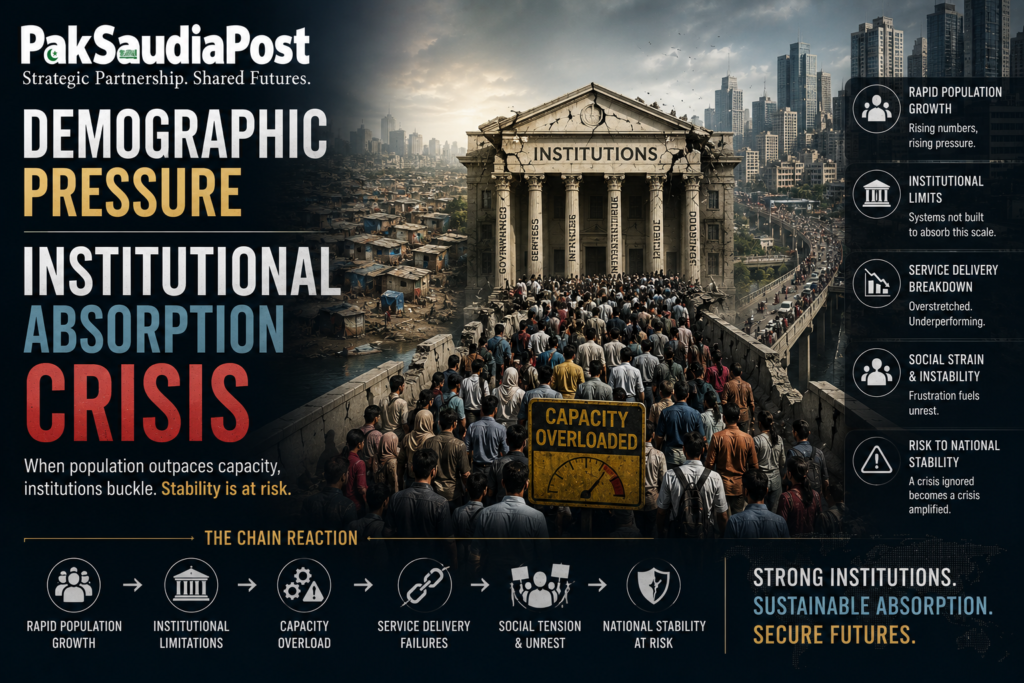
Across much of the developing world, demographic expansion is increasingly encountering a structural ceiling defined not by population size itself, but by the limited absorptive capacity of institutions tasked with translating human capital into economic productivity, social stability, and political coherence. This widening asymmetry between population acceleration and institutional integration is emerging as a long-term structural stressor, one that operates gradually yet persistently beneath the surface of visible governance indicators. It is not a crisis of numbers alone, but of systems unable to metabolize those numbers into stable developmental outcomes.
The classical development paradigm assumed that demographic growth, particularly in youthful populations, would naturally translate into economic dynamism through labour force expansion and productivity gains. However, this assumption is increasingly invalid under contemporary conditions where industrial absorption capacity, technological transformation, and educational relevance are unevenly distributed. In such environments, population growth without structural economic alignment produces surplus labour that is neither fully employed nor productively integrated into formal economic systems. This surplus does not remain inert; it disperses into informal economies, underemployment cycles, and fragmented income structures that lack institutional protection and long-term stability.
Employment scarcity is therefore not merely a labour market issue but a systemic indicator of institutional saturation. When economies fail to generate sufficient formal employment pathways, the resulting demographic pressure is redistributed across urban informal sectors, migration channels, and digital gig economies that often operate outside regulatory frameworks. This fragmentation of economic participation weakens fiscal stability, reduces tax base expansion, and increases dependency on volatile income streams. Over time, this creates a structural imbalance between population expectations and institutional delivery capacity.
A parallel constraint emerges within educational systems, which are increasingly producing credentialed populations without corresponding labour market absorption. The expansion of higher education access, while socially positive in principle, has not been matched by equivalent expansion in high-value economic sectors capable of absorbing graduates. This creates a condition of credential inflation, where educational attainment no longer guarantees economic mobility or institutional integration. The result is a growing cohort of educated individuals whose expectations of social advancement are structurally misaligned with available opportunities.
Digital connectivity intensifies this mismatch by exposing populations to global comparative benchmarks in real time. Unlike previous generations, contemporary youth populations are embedded within transnational information ecosystems that continuously recalibrate perceptions of success, mobility, and quality of life. This produces what may be described as aspirational compression, where expectations accelerate faster than institutional reform cycles can respond. The psychological consequence is a widening gap between perceived potential and actual opportunity structures.
The concept of institutional absorption capacity is therefore central to understanding the emerging demographic challenge. It refers to the ability of state systems to integrate expanding populations into productive, stable, and socially coherent frameworks. This capacity is not limited to employment generation but extends to education systems, urban infrastructure, health services, governance accessibility, and social mobility mechanisms. When absorption capacity weakens, demographic expansion ceases to function as a developmental asset and instead becomes a multiplier of systemic stress.
Urban systems represent the most visible site of this absorption deficit. Cities across South Asia are expanding rapidly, yet infrastructural development is not keeping pace with demographic inflows. Housing shortages, transport congestion, water stress, and informal settlement growth are symptomatic of deeper structural constraints. Urban governance systems are increasingly required to manage not only planned populations but also continuous inflows of economically displaced and climate-affected individuals. This dual pressure overwhelms planning capacities that were designed for slower demographic transitions.
The labour market implications of this urban expansion are equally significant. As rural populations migrate toward cities, competition intensifies for low-skill and semi-skilled employment, leading to wage compression and job insecurity. Informal employment becomes the dominant mode of economic participation, yet it offers limited pathways for upward mobility or institutional integration. Over time, this contributes to a stratified urban economy characterized by high variability in income security and limited structural mobility.
From a governance perspective, the critical issue is not demographic growth itself but the lag between population dynamics and institutional adaptation. Institutions evolve at a significantly slower pace than demographic change, creating a temporal mismatch that accumulates into systemic strain. Administrative systems designed for relatively stable population structures struggle to respond effectively to rapidly shifting demographic realities, particularly when compounded by economic volatility and technological disruption.
Political systems are also affected by this imbalance. When large segments of the population remain economically under-integrated, expectations of state intervention increase while fiscal and administrative capacity remains constrained. This generates a governance pressure cycle in which demands on the state expand faster than its ability to respond. If unmanaged, this cycle can erode institutional legitimacy and contribute to political volatility over time.
The digital dimension further amplifies these dynamics by reshaping perceptions of inequality and opportunity. Social media ecosystems create continuous visibility of global consumption patterns and lifestyle benchmarks, intensifying relative deprivation even in contexts where absolute living standards may be improving. This perceptual divergence between lived reality and observed global standards contributes to social dissatisfaction that is not always directly correlated with economic conditions.
Policy response must therefore move beyond conventional population management frameworks and toward integrated institutional expansion strategies. Employment generation alone is insufficient unless accompanied by structural reforms in education, urban planning, and economic diversification. The focus must shift toward aligning demographic expansion with productivity-enhancing sectors, particularly in technology, manufacturing, and services with high absorptive potential.
Education systems require fundamental recalibration to reduce the gap between academic output and labour market demand. This involves strengthening vocational training ecosystems, integrating digital skills into mainstream curricula, and aligning higher education outputs with emerging economic sectors. Without such alignment, educational expansion risks producing systemic underemployment rather than economic empowerment.
Urban planning must also be reconfigured to accommodate long-term demographic inflows rather than short-term migration cycles. This requires flexible housing strategies, decentralized infrastructure development, and expanded public service capacity. Cities must be conceptualized not as fixed administrative units but as adaptive systems capable of scaling with demographic pressure.
At the strategic level, demographic absorption capacity must be integrated into national planning frameworks as a core indicator of stability. This includes linking population data with economic forecasting, security assessments, and fiscal planning to ensure that demographic pressures are anticipated rather than reactively managed. Early identification of absorption deficits can enable pre-emptive policy intervention before systemic stress accumulates.
For establishment-level strategic planning, the implications are particularly significant. Demographic pressure intersects directly with internal security stability, economic resilience, and long-term governance coherence. A failure to address absorption deficits can result in gradual institutional overstretch, where governance systems remain formally intact but functionally strained across multiple domains.
Ultimately, demographic expansion in developing states is entering a phase where its impact is defined less by size and more by systemic integration capacity. Population growth can no longer be assumed to generate automatic developmental dividends. Instead, it must be actively managed through coordinated institutional expansion, economic restructuring, and governance innovation.
The central challenge is not to control demographic growth, but to enhance institutional elasticity to absorb it productively. States that succeed in this recalibration will transform demographic pressure into a structured developmental advantage. Those that fail risk entering a prolonged condition of systemic imbalance, where population dynamics consistently outpace institutional response, generating persistent governance stress that unfolds not as crisis but as continuous structural strain.
A Public Service Message