Evolving Eurasian Influence Maps Redraw Strategic Equilibrium

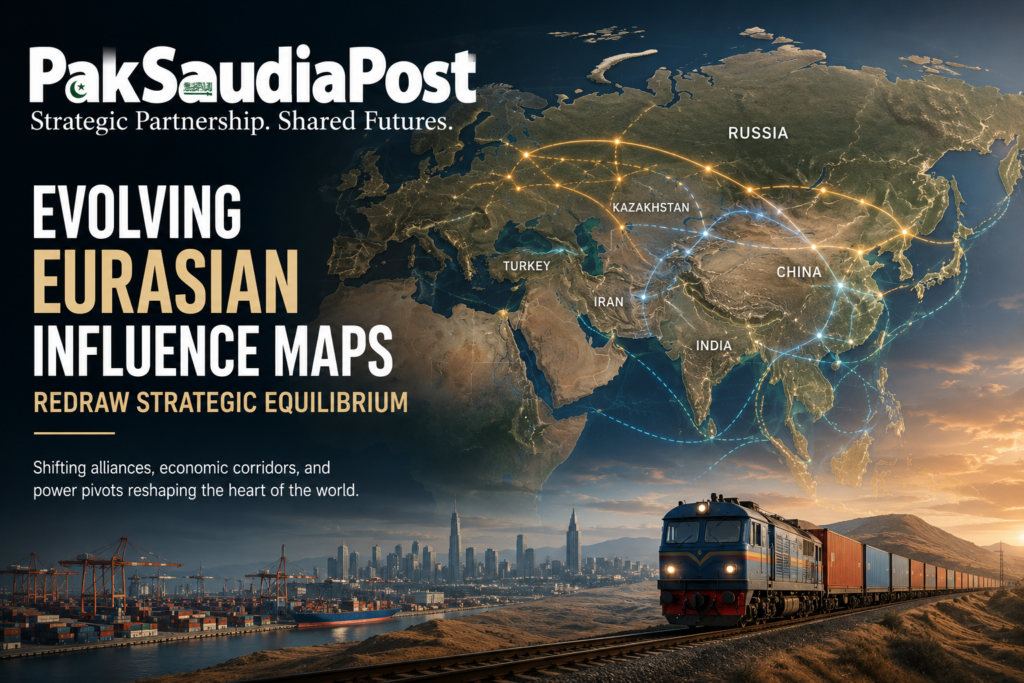
The contemporary Eurasian theatre is increasingly defined by an intricate layering of financial currents, infrastructural ambitions, and recalibrated diplomatic behaviours that together are reshaping the contours of influence beyond conventional geopolitical imagination. What is unfolding is not a linear redistribution of power but a complex re-encoding of connectivity, where capital, security, and technology intersect in constantly shifting configurations. Within this environment, Pakistan is being repositioned not as a peripheral passageway but as a negotiative interface where competing strategic ecosystems intersect, adjust, and occasionally collide.
Beijing’s continental outreach continues to evolve through long horizon infrastructural engagements, yet its operational environment is no longer structurally predictable. The expansion of overland connectivity networks is now accompanied by a heightened sensitivity to financial diversification pressures, regulatory fragmentation across partner states, and the increasing politicisation of supply chain corridors that were once treated as purely developmental instruments. At the same time, Gulf capital is undergoing its own transformation, moving away from passive liquidity deployment toward strategically curated investment behaviour shaped by sovereign wealth optimisation, energy transition hedging, and geopolitical insurance logic.
Central Asia, meanwhile, is no longer a passive buffer zone between larger powers but an increasingly assertive actor recalibrating its external alignments. The region’s policy elites are engaging in multi vector diplomacy that avoids rigid bloc affiliation while maximising infrastructural and financial inflows from competing sources. This has introduced a condition of calibrated ambiguity into Eurasian connectivity planning, where commitments are deliberately structured to preserve optionality rather than enforce dependency.
Western strategic engagement in parts of Eurasia has become more selective, marked by episodic re-entry into specific domains such as critical minerals, digital governance standards, and security cooperation frameworks. This selective posture has created intermittent vacuums that are rapidly filled by alternative financing and development models, further intensifying the pluralisation of influence architectures across the region.
Within this shifting matrix, Pakistan’s position acquires a more complex analytical dimension. It is no longer sufficient to describe its role in terms of transit economics. Instead, it operates as a spatial negotiator of overlapping strategic logics. Chinese infrastructural continuity requirements, Gulf investment diversification imperatives, and Central Asian market expansion aspirations all converge within Pakistan’s economic and logistical landscape. This convergence produces both leverage and exposure, depending on the state’s capacity to regulate inflows, sequence infrastructure development, and maintain macroeconomic stability under external volatility.
Energy systems constitute a critical axis of this emerging cartography. The Gulf’s transition strategies, including renewable diversification and downstream industrial investment, are reshaping traditional hydrocarbon export relationships. Simultaneously, Eurasian states are experimenting with hybrid energy models that combine legacy fossil fuel dependencies with emerging green infrastructure investments. Pakistan’s energy positioning is thus increasingly embedded within a multi directional flow of capital, technology, and strategic expectation.
In parallel, financial architecture is undergoing subtle but consequential transformation. Sovereign wealth funds are no longer operating purely as return maximising entities but as instruments of geopolitical calibration. Investment decisions are increasingly influenced by corridor security, political stability forecasts, and technological compatibility considerations. This has introduced a form of conditional liquidity, where capital availability is tightly linked to governance predictability and infrastructural coherence.
Against this backdrop, Pakistan’s policy challenge is not merely to attract investment but to architect absorptive capacity that prevents structural overload. Fragmented project execution, inconsistent regulatory signalling, and macroeconomic discontinuities risk reducing strategic inflows into episodic rather than transformative engagements. In contrast, coordinated planning frameworks aligned with long term infrastructural sequencing could reposition Pakistan as a stabilising node within Eurasian connectivity systems.
China’s parallel challenge lies in maintaining infrastructural continuity across increasingly complex political terrains. The shift from bilateral project execution to multi stakeholder environments introduces new forms of negotiation friction, particularly where local political economies intersect with transnational financing structures. This requires a recalibration of project diplomacy, where technical feasibility must be continuously reconciled with evolving domestic political conditions in partner states.
Gulf actors, particularly sovereign investment institutions, are emerging as decisive intermediaries in this system. Their ability to deploy capital across divergent geographies, sectors, and risk profiles allows them to function as balancing forces within Eurasian investment ecosystems. However, this also exposes them to heightened exposure in environments where geopolitical tensions can rapidly reprice assets and recalibrate risk assumptions.
The resulting influence map is therefore neither hierarchical nor stable. It is a dynamic field of intersecting vectors in which states simultaneously cooperate and compete across different domains without necessarily achieving full alignment. This produces a condition of structured uncertainty, where predictability is replaced by managed volatility.
For Pakistan, this condition necessitates a shift in strategic thinking from corridor facilitation to equilibrium management. The state must increasingly position itself as an institutional mediator capable of harmonising divergent investment logics while maintaining macroeconomic coherence. This requires strengthening regulatory predictability, enhancing financial governance architecture, and ensuring that infrastructural projects are embedded within broader economic transformation strategies rather than isolated development initiatives.
For China, the emerging environment underscores the importance of adaptive engagement frameworks that can accommodate heterogeneous political economies without compromising long term strategic objectives. This involves greater emphasis on financial flexibility, risk diversification across multiple corridors, and enhanced integration of digital infrastructure governance into physical connectivity planning.
For Gulf states, the challenge is to convert liquidity advantage into durable structural influence without overexposing capital portfolios to geopolitical discontinuities. This requires a more sophisticated balance between return optimisation and strategic positioning, particularly in regions where infrastructure development intersects with political volatility.
At the systemic level, Eurasia is moving toward a condition in which influence is measured less by territorial reach and more by the ability to stabilise complex interaction networks. Connectivity itself is becoming a strategic asset, but only insofar as it can absorb shocks, accommodate policy divergence, and maintain operational continuity under stress conditions.
In this evolving environment, Pakistan occupies a uniquely sensitive position. Its geographic centrality is now accompanied by functional centrality within overlapping economic and strategic systems. The extent to which it can translate this position into sustainable advantage will depend on institutional discipline, policy consistency, and the ability to integrate external inflows into coherent national development pathways.
The broader implication is that Eurasian influence is no longer a function of singular dominance but of distributed coordination. Power is exercised through infrastructure, finance, technology, and diplomacy in ways that are increasingly interdependent. The states that adapt most effectively will be those capable of navigating this complexity without attempting to reduce it to simplistic hierarchies or outdated strategic templates.
In this sense, the emerging Eurasian cartography is not a map of fixed positions but a continuously evolving configuration of relationships, dependencies, and negotiated equilibriums. It rewards adaptability, penalises rigidity, and privileges those actors capable of sustaining coherence in environments defined by structural fluidity and strategic simultaneity.
A Public Service Message