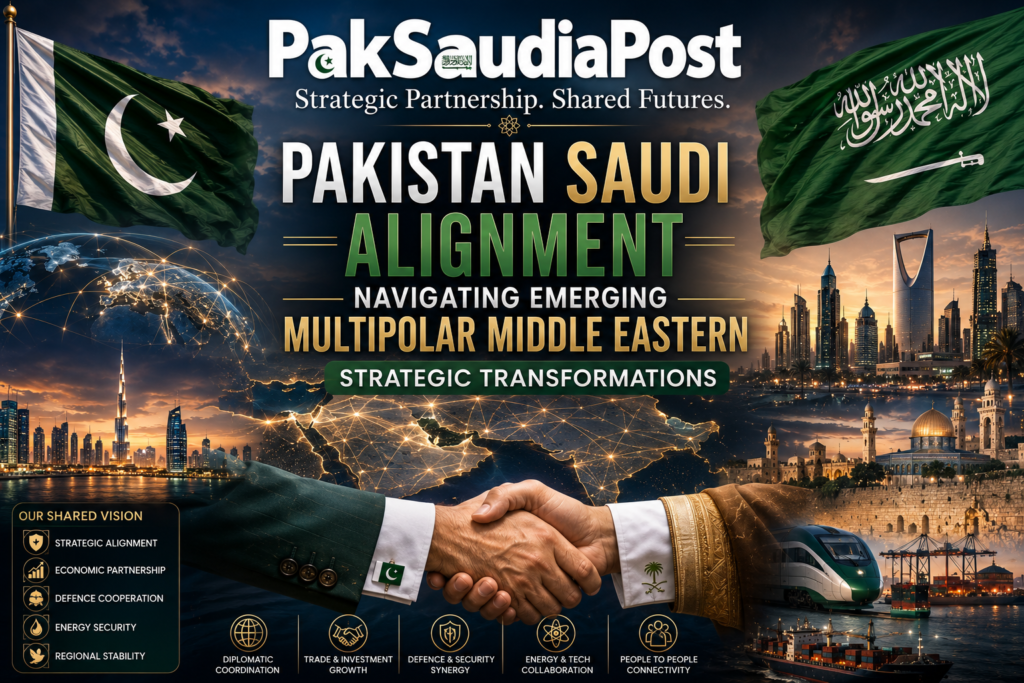
Pakistan Saudi Alignment Navigating Emerging Multipolar Middle Eastern Strategic Transformations

The Middle East is entering an era defined not by the collapse of power but by its diffusion. The age in which a singular external hegemon could unilaterally dictate the political, economic, and security architecture of the region is steadily receding beneath the pressures of multipolar fragmentation, technological disruption, energy transition anxieties, and the accelerated rise of Asian influence. Within this transforming landscape, Pakistan and Saudi Arabia are recalibrating their strategic behavior in ways that reveal the emergence of a new geopolitical consciousness among influential Muslim middle powers. Their evolving convergence reflects neither ideological romanticism nor temporary diplomatic convenience. It is instead a calculated response to the restructuring of the international order itself.
For decades the Middle East functioned within a relatively predictable strategic framework dominated by American military primacy, Western financial influence, and hydrocarbon centered economic interdependence. Gulf monarchies relied heavily upon American security guarantees while Washington depended upon the uninterrupted flow of energy resources and regional military partnerships. Pakistan meanwhile balanced its relations between Gulf allies, China, and the West while largely remaining positioned at the margins of broader Middle Eastern strategic decision making. That architecture is now experiencing profound destabilization.
The contemporary regional environment is characterized by overlapping transitions occurring simultaneously. China has emerged not merely as an economic actor but as a diplomatic and infrastructural force with expanding influence across the Gulf. Russia despite the constraints of sanctions and geopolitical confrontation continues to exercise significant leverage through energy diplomacy and strategic opportunism. Türkiye pursues increasingly autonomous regional activism while Iran maintains resilient networks of influence across multiple theatres despite sustained external pressure. Simultaneously, American strategic attention is progressively shifting toward Indo Pacific competition, generating uncertainty regarding the permanence and intensity of future Western commitments within the Middle East.
Saudi Arabia has responded to this environment through one of the most ambitious foreign policy recalibrations in its modern history. Riyadh no longer seeks to operate solely within the parameters of exclusive Western alignment. Instead, it is constructing a multidirectional diplomatic framework designed to maximize strategic autonomy while minimizing vulnerability to external coercion. This transformation reflects a deeper realization within Saudi strategic circles that dependence upon any singular power center carries long term risks in an increasingly unstable international system.
Vision 2030 forms the economic foundation of this recalibration. Saudi Arabia’s modernization ambitions require diversified partnerships capable of supporting technological innovation, industrial transformation, logistical connectivity, and investment expansion. China naturally emerges as an indispensable actor within this equation because of its economic scale, infrastructural capabilities, and growing appetite for Gulf energy integration. Russia remains relevant through coordinated energy management and strategic balancing mechanisms. Yet Pakistan occupies a distinct strategic category because it combines military credibility, geographic centrality, demographic scale, and expanding integration into emerging Eurasian connectivity networks.
Pakistan’s significance within the emerging multipolar order derives largely from geography. Islamabad sits at the intersection of South Asia, Central Asia, the Arabian Sea, and western China. In an age where trade corridors, maritime routes, digital infrastructure, and logistical connectivity increasingly shape geopolitical influence, Pakistan’s territorial position acquires extraordinary strategic relevance. The China Pakistan Economic Corridor has amplified this reality by embedding Pakistan within Beijing’s broader westward strategic ambitions linking East Asia to the Arabian Sea.
Saudi Arabia increasingly recognizes that future regional influence will depend not solely upon military strength or energy exports but upon participation in transregional connectivity architectures. Pakistan therefore becomes more than a bilateral partner. It emerges as a potential strategic bridge connecting Gulf economies with South Asia, Central Asia, and Chinese commercial ecosystems. This perception has intensified discussions regarding investment cooperation, logistics integration, port development, and economic corridor coordination between Riyadh and Islamabad.
The rise of Chinese mediation diplomacy has further accelerated these transformations. Beijing’s approach to Middle Eastern engagement differs substantially from the interventionist traditions historically associated with Western powers. China prioritizes economic stabilization, infrastructure development, and conflict de escalation over ideological conditionality or regime transformation agendas. This diplomatic style has gained increasing appeal among regional states exhausted by prolonged instability and external intervention.
The normalization of diplomatic engagement between rival regional actors reflects this evolving environment. Pragmatic coexistence is gradually replacing absolute ideological confrontation as the dominant strategic logic. Saudi Arabia’s recalibrated diplomacy toward regional rivals indicates recognition that perpetual polarization imposes unsustainable economic and security costs. Pakistan strongly supports such de escalation because regional fragmentation directly threatens its own economic and strategic interests.
Within this emerging order Islamabad seeks to position itself as a flexible balancing state rather than a rigidly aligned actor. Pakistan’s strategic calculations are shaped by the necessity of simultaneously maintaining relations with China, the United States, Saudi Arabia, Türkiye, and neighboring Iran. This balancing doctrine reflects a broader pattern visible among contemporary middle powers attempting to navigate multipolarity without becoming trapped within exclusive geopolitical blocs.
An important narrative currently being constructed across regional media ecosystems portrays multipolarity as an opportunity for strategic emancipation from historical dependency structures. China is increasingly framed as a developmental stabilizer focused upon infrastructure and commerce. Russia is often presented as an energy balancer capable of challenging Western monopolization of global markets. Middle powers such as Saudi Arabia and Pakistan are simultaneously portrayed as autonomous actors capable of shaping regional dynamics rather than functioning merely as subordinate clients of larger powers.
This narrative engineering possesses immense strategic significance. Modern geopolitics increasingly operates through perception management and informational influence. States seek legitimacy not only through military power but through the ability to project images of stability, modernization, sovereignty, and strategic independence. Saudi Arabia’s transformation campaign and Pakistan’s connectivity discourse are therefore deeply intertwined with broader efforts to reshape international perceptions regarding the Muslim world.
The evolving Pakistan Saudi relationship is central to this discourse because it symbolizes the possibility of an Islamic strategic partnership grounded in pragmatism rather than ideological populism. Both states increasingly emphasize themes of economic modernization, technological advancement, moderated diplomacy, and strategic equilibrium. This narrative seeks simultaneously to counter extremist interpretations of Islamic politics and external portrayals of perpetual Muslim fragmentation.
Yet the transition toward multipolarity is neither smooth nor inherently stabilizing. The diffusion of power often generates intensified competition rather than harmonious balance. Regional actors now operate within a crowded strategic environment where overlapping partnerships produce both opportunities and contradictions. Saudi Arabia deepens economic engagement with China while preserving critical defense relations with the United States. Pakistan strengthens its strategic partnership with Beijing while attempting to avoid excessive confrontation with Western institutions. Such multidirectional diplomacy requires extraordinary strategic calibration.
Economic vulnerability remains a major structural challenge. Pakistan’s recurring financial crises constrain its capacity to fully capitalize upon its geopolitical potential. Saudi Arabia despite immense financial resources confronts pressures related to economic diversification, technological dependence, and fluctuating energy markets. Multipolarity may expand diplomatic flexibility, but it also intensifies exposure to competing external pressures and global economic volatility.
Technological dependency represents another critical issue. The future international order will increasingly be shaped by control over artificial intelligence, semiconductors, cyber infrastructure, digital finance, satellite systems, and advanced manufacturing capabilities. Middle powers unable to develop indigenous technological ecosystems risk remaining strategically subordinate despite rhetorical commitments to autonomy. Pakistan and Saudi Arabia therefore face the challenge of converting economic cooperation into genuine technological capacity building.
The militarization of connectivity corridors further complicates the emerging order. Infrastructure projects once viewed primarily through commercial lenses are now increasingly interpreted as instruments of strategic influence. Ports, railways, energy pipelines, digital networks, and logistics hubs have become arenas of geopolitical competition. The Arabian Sea, the Red Sea corridor, and broader Indian Ocean routes are consequently evolving into contested spaces where economic cooperation intersects with military calculations.
India’s expanding engagement with Gulf monarchies introduces additional complexity. New Delhi’s economic rise and growing strategic partnerships with Western powers position it as a significant competitor within regional connectivity politics. Saudi Arabia therefore attempts to balance relations with both India and Pakistan while avoiding excessive entanglement in South Asian rivalries. Islamabad meanwhile seeks to ensure that emerging transregional trade architectures do not bypass Pakistani territory and diminish its strategic relevance.
Iran also remains a critical variable within the broader equation. Pakistan maintains complex relations with Tehran shaped by border security concerns, sectarian sensitivities, and regional diplomacy. Saudi Arabia’s historical rivalry with Iran continues influencing Gulf security calculations despite recent diplomatic recalibration. The sustainability of any future Pakistan Saudi strategic framework will therefore depend significantly upon the ability of both states to manage regional rivalries without reigniting destabilizing polarization.
The media dimension of multipolarity deserves particular attention. Information ecosystems across the Middle East are increasingly fragmented and competitive. State aligned media networks, digital influencers, think tanks, and transnational information campaigns collectively shape public perceptions regarding regional alignments and global power transitions. Pakistan and Saudi Arabia are actively participating in this narrative contest by promoting discourses centered upon sovereignty, modernization, connectivity, and strategic moderation.
These narratives also serve domestic political purposes. Saudi Arabia’s leadership seeks to associate modernization with national pride and strategic independence. Pakistan similarly attempts to project itself as a resilient state capable of navigating global transformation despite economic and political challenges. The construction of a shared discourse regarding Islamic middle power cooperation therefore enhances both external diplomacy and internal legitimacy.
However, there remains a significant risk that multipolarity could produce fragmented instability rather than balanced order. As major powers compete for influence across the Middle East, regional states may become arenas of proxy competition, technological dependency, and economic coercion. The challenge for Pakistan and Saudi Arabia lies in leveraging multipolarity for strategic diversification without becoming instruments within larger geopolitical rivalries.
For policymakers in Islamabad and Riyadh several urgent priorities emerge. First, both states must institutionalize strategic dialogue mechanisms capable of coordinating long term economic, technological, and diplomatic planning. Ad hoc diplomacy is insufficient within an increasingly volatile international environment.
Second, economic cooperation should focus upon sectors capable of generating genuine structural transformation rather than temporary financial dependency. Renewable energy, digital infrastructure, artificial intelligence, logistics modernization, food security, and advanced manufacturing should become central pillars of bilateral engagement.
Third, both states should invest heavily in strategic research institutions and intellectual ecosystems capable of producing indigenous geopolitical analysis independent of imported paradigms. Multipolarity requires intellectual autonomy as much as diplomatic flexibility.
Fourth, Pakistan and Saudi Arabia must deepen cooperation in cyber security, digital governance, and technological education to reduce vulnerability to external technological monopolies. Future sovereignty will depend increasingly upon control over digital ecosystems.
Fifth, both countries should advocate inclusive regional diplomacy emphasizing economic stabilization, maritime security, and conflict de escalation rather than rigid bloc politics. Middle powers acquire influence not through ideological absolutism but through the capacity to mediate, connect, and stabilize fragmented regions.
Ultimately the evolving Pakistan Saudi relationship represents more than bilateral coordination. It reflects the broader transformation of the Middle East from a region defined by external dominance into one increasingly shaped by multidirectional balancing, economic pragmatism, and strategic diversification. Whether this transformation produces durable stability or intensified fragmentation will depend largely upon the ability of regional middle powers to convert geopolitical fluidity into institutional resilience.
Pakistan and Saudi Arabia appear increasingly aware that the future international order will not reward passive dependency. It will instead favor states capable of strategic adaptability, narrative sophistication, and economic integration across multiple spheres of influence. Their emerging convergence therefore symbolizes not merely diplomatic adjustment but a deeper attempt to redefine the role of Muslim middle powers within the architecture of twenty first century global transformation.
A Public Service Message