Arabian Maritime Corridors Transforming Pakistan Saudi Strategic Security Cooperation Framework

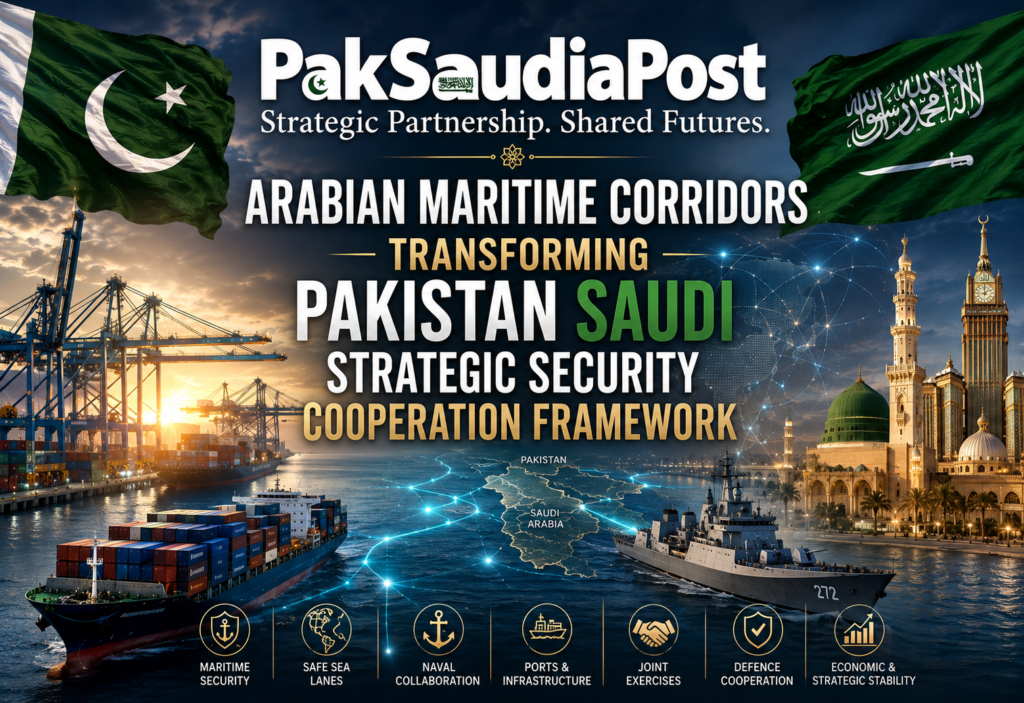
The Arabian Sea is no longer merely a commercial expanse connecting energy producers with global consumers. It is increasingly emerging as one of the most contested strategic theatres of the twenty first century where maritime insecurity, technological militarization, economic competition, and great power rivalry are converging with extraordinary intensity. The evolving relationship between Pakistan and Saudi Arabia must therefore be interpreted not simply through traditional diplomatic or economic paradigms but through the wider restructuring of maritime power within the Indian Ocean and Red Sea corridors. A new strategic consciousness is visibly developing in both Islamabad and Riyadh, one that recognizes maritime geography not as peripheral to statecraft but as the central determinant of future security, economic resilience, and regional influence.
For decades the Gulf security architecture was constructed upon the assumption that external naval powers, particularly the United States, would indefinitely guarantee the safety of sea lanes, hydrocarbon transportation networks, and regional chokepoints. That assumption is now encountering severe structural erosion. The persistence of attacks upon commercial vessels, disruptions in the Red Sea, escalating tensions around the Strait of Hormuz, and the proliferation of low cost asymmetric warfare technologies have collectively demonstrated that maritime security can no longer be outsourced entirely to external actors. The era of uncontested naval supremacy is fading into a fragmented order where non state actors, drones, cyber sabotage, and proxy warfare increasingly threaten global shipping systems.
Saudi Arabia perceives these transformations with growing urgency. Vision 2030 is fundamentally dependent upon uninterrupted maritime commerce. The kingdom’s aspirations for economic diversification, tourism expansion, logistics modernization, industrial transformation, and global investment integration require stable shipping corridors connecting the Gulf to Europe, Africa, and Asia. Maritime instability therefore threatens not only Saudi energy exports but the broader credibility of Riyadh’s modernization project itself. The Red Sea corridor has consequently acquired immense strategic significance within Saudi calculations because it constitutes one of the principal arteries through which economic transformation must flow.
Within this emerging environment Pakistan’s geographic position becomes extraordinarily consequential. Islamabad occupies a unique maritime location adjacent to the Arabian Sea while simultaneously functioning as a gateway between South Asia, Central Asia, western China, and the Gulf. Historically Pakistan’s strategic thinking remained heavily continental and India centric, focused primarily upon territorial deterrence and land based security calculations. Yet recent developments are gradually compelling Pakistani planners to recognize the transformative geopolitical significance of maritime strategy.
Gwadar symbolizes this transition. International discourse frequently reduces Gwadar to a narrow narrative centered exclusively upon Chinese strategic expansion. However, within evolving Gulf strategic circles a more complex interpretation is emerging. Gwadar is increasingly viewed not merely as a port but as a future maritime node capable of linking Gulf economies with Eurasian connectivity corridors. Saudi Arabia’s interest in Gwadar therefore transcends commercial investment. It reflects a deeper strategic awareness that future influence in the Indian Ocean order will depend upon access to diversified maritime infrastructures capable of supporting trade resilience and logistical flexibility.
The strategic value of Gwadar intensifies further when viewed against the backdrop of competitive corridor politics. The Middle East is entering an era in which infrastructure itself has become an instrument of geopolitical power. Competing trade routes, logistics frameworks, and port alliances are now central components of international rivalry. India’s growing engagement with Gulf states and the emergence of alternative economic corridor projects have accelerated competition over maritime influence and regional connectivity. Riyadh and Islamabad both recognize the strategic danger of exclusion from emerging transregional trade ecosystems dominated by rival powers.
Consequently, maritime cooperation between Pakistan and Saudi Arabia increasingly reflects a convergence of long term strategic interests. Riyadh requires reliable regional partners capable of supporting diversified shipping and logistical frameworks, while Pakistan seeks economic integration and maritime relevance within the evolving Indian Ocean architecture. This convergence is gradually generating discussions regarding coordinated port development, shipping security cooperation, naval modernization, and maritime intelligence synchronization.
The transformation of warfare itself further reinforces this trajectory. The Middle East has become a laboratory for hybrid maritime conflict. Drone attacks upon energy facilities, anti shipping operations conducted by irregular actors, cyber interference targeting logistics systems, and electronic disruptions affecting navigation infrastructure have collectively demonstrated that traditional naval doctrines are increasingly inadequate. Expensive conventional fleets alone can no longer guarantee maritime dominance when low cost technologies possess the capacity to inflict strategic disruption.
Saudi Arabia’s strategic experience during recent regional crises profoundly altered its defense perceptions. The realization that critical energy infrastructure could be threatened through asymmetric methods accelerated Riyadh’s pursuit of diversified maritime defense capabilities. Investments in naval modernization, coastal defense systems, unmanned technologies, surveillance networks, and indigenous military production have consequently intensified. Pakistan emerges as an important strategic interlocutor within this process because of its extensive operational experience confronting hybrid security environments and its expanding expertise in missile systems, drone technologies, and maritime surveillance.
Pakistan’s naval modernization efforts also reveal significant strategic ambition. The expansion of submarine capabilities, improvements in coastal defense architecture, acquisition of advanced frigates, and development of maritime aerial surveillance platforms indicate that Islamabad increasingly recognizes the necessity of securing its maritime frontiers. Although Pakistan’s naval resources remain modest compared with larger regional actors, its geographic location grants it disproportionate strategic relevance within the Arabian Sea.
An important narrative currently being engineered within regional strategic discourse portrays the Arabian Sea as the next great arena of geopolitical competition. This narrative emphasizes that future power will increasingly depend upon control over maritime connectivity, digital infrastructure, undersea communication cables, logistics hubs, and energy transportation systems. Pakistan and Saudi Arabia are positioning themselves within this discourse as advocates of maritime stabilization, commercial resilience, and cooperative security frameworks.
Media diplomacy plays a critical role in constructing this perception. Strategic communication increasingly emphasizes themes of connectivity, economic modernization, maritime integration, and regional cooperation rather than militarized confrontation alone. Riyadh seeks to portray itself as a stabilizing commercial hub connecting continents, while Islamabad attempts to rebrand itself from a conflict centered security state into a regional connectivity facilitator. Maritime cooperation provides an ideal framework through which both states can project narratives of modernization and strategic pragmatism.
The rise of China further complicates and intensifies these dynamics. Beijing’s economic dependence upon Middle Eastern energy imports and its investment in maritime infrastructure across the Indian Ocean have transformed the Arabian Sea into a vital component of Chinese strategic calculations. The China Pakistan Economic Corridor forms part of this broader architecture linking western China to maritime trade routes through Gwadar. Saudi Arabia’s growing economic engagement with China therefore intersects naturally with Pakistan’s strategic integration into Chinese connectivity frameworks.
However, this convergence also generates anxieties among rival powers. Washington remains deeply concerned regarding the expansion of Chinese strategic influence across Gulf maritime infrastructure. India similarly perceives the consolidation of Pakistan linked maritime corridors through a competitive security lens. The Arabian Sea is therefore evolving into a space where economic cooperation, strategic competition, and military deterrence coexist simultaneously.
Energy security remains central to these calculations. The modern global economy continues to depend heavily upon uninterrupted hydrocarbon transportation. Yet the increasing vulnerability of chokepoints such as Bab el Mandeb and the Strait of Hormuz exposes the fragility of existing systems. Gulf states are therefore exploring diversification strategies capable of reducing excessive reliance upon singular maritime corridors vulnerable to disruption. Pakistan’s geography offers potential strategic depth within this context by providing alternative logistical and transportation possibilities connecting Gulf markets with South and Central Asia.
The future of maritime strategy will also be deeply influenced by technological transformation. Artificial intelligence driven surveillance systems, autonomous naval platforms, cyber maritime defense mechanisms, satellite monitoring networks, and data integrated shipping management architectures are rapidly redefining naval power. Pakistan and Saudi Arabia must therefore recognize that maritime competition is no longer limited to conventional fleets and ports. Control over digital maritime ecosystems may become equally decisive.
Cybersecurity consequently emerges as an increasingly vital dimension of maritime cooperation. Modern ports depend upon complex digital systems vulnerable to cyber sabotage. Disruptions targeting logistics software, energy transportation management, or maritime communication networks could produce cascading economic consequences. Coordinated cyber maritime defense mechanisms between Islamabad and Riyadh would therefore represent a critical step toward strategic resilience.
The broader regional implications of Pakistan Saudi maritime convergence are profound. Such cooperation could gradually contribute toward the emergence of an indigenous regional maritime architecture less dependent upon external naval guarantors. Gulf states increasingly seek diversified partnerships capable of balancing strategic autonomy with practical security needs. Pakistan, possessing military credibility and geographic centrality, naturally becomes an attractive partner within this evolving framework.
Nevertheless substantial obstacles remain. Pakistan’s economic constraints limit its capacity to sustain large scale maritime modernization independently. Saudi Arabia despite its financial resources continues confronting technological dependencies upon Western defense ecosystems. Divergent relations with regional actors such as Iran also complicate the development of fully integrated maritime security frameworks. Furthermore, external powers possess competing interests that may inhibit deeper regional strategic consolidation.
Despite these challenges the trajectory of Pakistan Saudi maritime cooperation appears increasingly irreversible because it is being driven not merely by political preference but by structural transformation within the international system itself. The weaponization of trade routes, intensification of great power rivalry, and growing fragility of global supply chains collectively ensure that maritime security will remain central to future statecraft.
For policymakers in Islamabad and Riyadh several strategic imperatives emerge with urgency. First, both states should institutionalize permanent maritime coordination councils responsible for integrating naval planning, intelligence sharing, and strategic forecasting. Second, joint investments in maritime infrastructure, shipbuilding capabilities, and logistics modernization should be accelerated to enhance long term economic resilience.
Third, both governments must expand cooperation in cyber maritime defense and artificial intelligence enabled surveillance systems capable of protecting critical port infrastructures from hybrid threats. Fourth, educational partnerships involving naval academies, maritime universities, and strategic research institutions should be strengthened to cultivate indigenous expertise in maritime governance and security.
Fifth, Pakistan and Saudi Arabia should advocate broader multilateral maritime dialogues involving Gulf, African, and South Asian actors to construct cooperative mechanisms capable of reducing regional tensions and enhancing commercial stability. Such frameworks would strengthen the perception of both states as constructive middle powers committed to regional stabilization rather than zero sum competition.
Most importantly, both countries must recognize that maritime strategy today extends far beyond naval power alone. It encompasses trade resilience, technological innovation, digital infrastructure, energy security, and narrative influence. The future balance of power in the wider Middle East and Indian Ocean region may ultimately depend less upon territorial control and more upon the ability to secure connectivity itself.
The Arabian Sea and Red Sea corridor are therefore becoming the strategic arteries through which the future of Pakistan Saudi relations will increasingly flow. Their evolving maritime partnership reflects a broader transformation within global politics where geography, technology, and economics are merging into a single integrated framework of strategic competition. In this emerging order, states capable of mastering maritime connectivity while preserving strategic flexibility will possess decisive influence over the architecture of the twenty first century regional system.
A Public Service Message