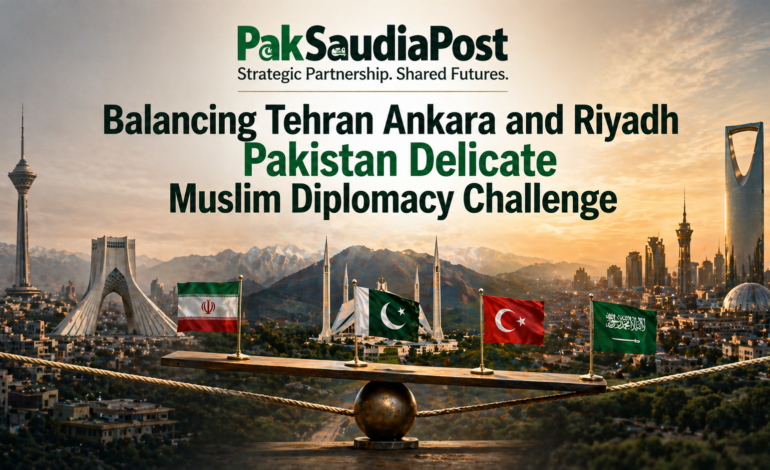
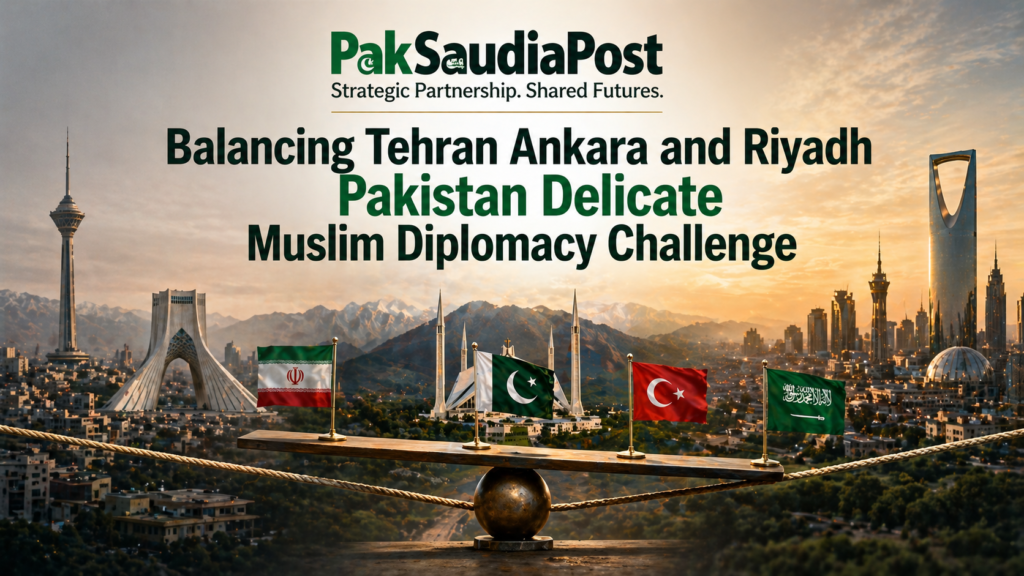
Balancing Tehran Ankara and Riyadh Pakistan Delicate Muslim Diplomacy Challenge

Pakistan’s foreign policy is increasingly shaped by a geopolitical condition that is neither fully stable nor entirely fluid, but suspended in a permanent state of calibrated tension. At the heart of this condition lies a triangular diplomatic reality involving Tehran, Ankara, and Riyadh, each representing not only distinct strategic geographies but also competing ideological memories, economic trajectories, and security anxieties. For Islamabad, the challenge is not merely to maintain relations with all three, but to do so in a manner that avoids the perception of strategic contradiction in a region where symbolism often travels faster than statecraft.
The contemporary Middle Eastern and adjoining South Asian strategic environment is defined by overlapping processes of de-escalation and re-competition. Iran’s cautious reintegration into regional diplomacy following its détente with Saudi Arabia has not erased decades of mistrust, but it has altered the grammar of confrontation. Türkiye, under an assertive yet pragmatic foreign policy doctrine, continues to oscillate between NATO commitments, Middle Eastern engagement, and Eurasian outreach. Saudi Arabia, meanwhile, is undergoing a structural transformation under its Vision framework, recalibrating its external alignments from ideological leadership toward investment-led global integration.
Within this evolving architecture, Pakistan is neither a peripheral observer nor a dominant architect. It is instead a structurally embedded participant whose economic vulnerabilities, energy dependencies, and security entanglements compel it to maintain active engagement with all three poles. The result is a diplomacy that is increasingly multi-vector, but also exposed to the risks of interpretive fragmentation.
In classical international relations theory, such positioning might be described as balancing or hedging. Yet these categories insufficiently capture the informational and media dimensions that now define diplomatic perception. Pakistan’s engagements are not interpreted solely in foreign ministries, but in digital ecosystems, transnational news networks, and diasporic communication channels where simplified narratives often override nuanced policy intent. A meeting in Tehran can be read in Riyadh as strategic deviation, while an economic agreement with Saudi Arabia may be interpreted in Iran as symbolic alignment against regional parity. Türkiye, operating through its own expansive media diplomacy, adds another layer of narrative complexity.
The challenge for Pakistan is therefore not only structural but semiotic. It must manage meaning as much as it manages policy. The concept of “managed ambiguity” becomes relevant here, not as a form of indecision, but as a deliberate strategy of preventing over-identification with any single regional bloc. This requires a diplomatic posture that is issue-specific, temporally adaptive, and institutionally disciplined.
Energy cooperation is one of the most sensitive domains within this triangular relationship. Iran offers potential long-term energy connectivity through gas infrastructure, yet sanctions and financial restrictions continue to limit operational feasibility. Saudi Arabia provides financial stability, investment inflows, and labour market absorption, yet its own diversification agenda requires Pakistan to reposition itself not merely as a labour-exporting state, but as a partner in skills development and service economies. Türkiye, meanwhile, presents a hybrid model of defence cooperation, construction industry linkages, and cultural diplomacy that resonates strongly with Pakistan’s domestic political imagination.
The difficulty lies in synchronizing these engagements without allowing one relationship to structurally constrain the others. In practice, this is less a matter of diplomatic doctrine and more a question of sequencing, signalling, and institutional compartmentalization. Pakistan’s foreign policy establishment must increasingly operate like a portfolio manager rather than a traditional diplomatic hierarchy, balancing risk exposure across multiple regional assets.
Security dynamics further complicate this balancing act. The Iran–Pakistan border remains a zone of intermittent tension, shaped by militancy concerns, cross-border movement, and mutual suspicion of external influence. At the same time, Pakistan’s deep defence cooperation with Türkiye and Saudi Arabia creates expectations of alignment that may not always be compatible with Iran’s security perceptions. The absence of a unified threat framework in the region means that Pakistan is constantly navigating asymmetrical security expectations.
The media environment intensifies these asymmetries. Regional television networks, social media influencers, and digital news platforms often construct geopolitical narratives that reduce complex diplomatic engagements into binary alignments. Pakistan’s attempts at neutrality or issue-based cooperation are frequently reframed as strategic inconsistency. In such an environment, diplomatic communication is no longer confined to official statements but extends into the realm of narrative management, where perception becomes a form of power.
The emergence of China as a silent but influential actor in this regional matrix adds another layer of complexity. Through infrastructure investment, diplomatic facilitation, and economic connectivity initiatives, Beijing has indirectly contributed to lowering tensions between Iran and Saudi Arabia, while simultaneously deepening its strategic partnership with Pakistan. This triangular overlay means that Pakistan’s diplomatic decisions are often interpreted not only in regional terms but also within broader global competition frameworks.
Yet despite these complexities, Pakistan retains certain structural advantages. Its geographical positioning as a corridor between the Gulf, Central Asia, and South Asia provides it with inherent connectivity value. Its historical relationships across the Islamic world grant it a degree of symbolic legitimacy that few other states possess. Moreover, its absence of direct territorial ambitions in the Middle East allows it to operate as a relatively neutral interlocutor, provided it avoids over-identification with any single axis.
The key question, therefore, is whether Pakistan can institutionalize a doctrine of calibrated non-alignment within the Muslim world, one that is not passive but strategically active. This would require a shift from reactive diplomacy to anticipatory diplomacy, where Islamabad engages in scenario planning across multiple regional futures simultaneously. It also requires strengthening internal policy coherence, ensuring that economic diplomacy, security engagement, and cultural outreach are not operating in fragmented silos.
Another critical dimension is domestic narrative coherence. Pakistan’s internal political discourse often reflects external alignments in exaggerated or simplified forms. Public perception of Saudi Arabia, Iran, and Türkiye is frequently shaped by religious sentiment, historical memory, and media framing rather than strategic analysis. This creates pressure on policymakers to respond to symbolic expectations rather than structural realities. Managing this gap between domestic narrative and external necessity is increasingly central to diplomatic sustainability.
At the institutional level, Pakistan’s foreign service faces the challenge of operating in an environment where regional volatility is matched by informational acceleration. Diplomatic reporting, policy analysis, and crisis response must now account for real-time narrative shifts across multiple platforms. This demands a level of analytical agility that traditional bureaucratic systems are often not designed to deliver.
Despite these constraints, there are emerging opportunities. The gradual normalization of Iran–Saudi relations reduces the zero-sum pressure that previously defined Pakistan’s balancing act. Türkiye’s expanding economic footprint in South and Central Asia opens avenues for trilateral cooperation in infrastructure and trade. Saudi Arabia’s diversification strategy creates openings for Pakistan in non-traditional sectors such as technology services, tourism support industries, and vocational training ecosystems.
If managed effectively, these converging shifts could allow Pakistan to transition from a reactive balancer to a structured connector within the Muslim world. However, this outcome is not predetermined. It depends on Islamabad’s ability to resist episodic diplomacy and instead construct a coherent long-term regional strategy that is resilient to political cycles and media volatility.
Ultimately, the balancing of Tehran, Ankara, and Riyadh is not a temporary diplomatic challenge but a structural condition of Pakistan’s geopolitical existence. It reflects the broader transformation of the Muslim world from ideological blocs to fragmented but interconnected power centres. In this environment, success will not be measured by alignment, but by adaptability; not by exclusivity, but by credibility across multiple strategic narratives.
Pakistan’s delicate diplomacy, therefore, is less about choosing between rivals and more about redefining the meaning of engagement itself. In a region where certainty is increasingly rare, the ability to remain consistently relevant without becoming exclusively aligned may prove to be its most valuable strategic asset.
A Public Service Message