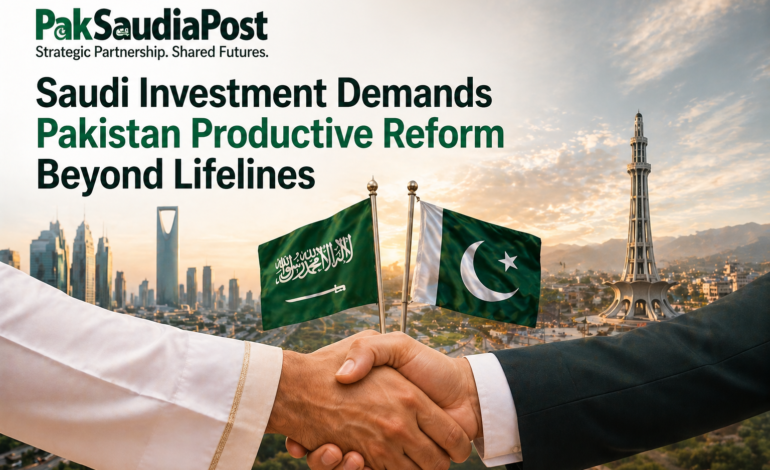
Saudi Investment Demands Pakistan Productive Reform Beyond Lifelines

The Pakistan Saudi economic relationship is approaching a turning point where inherited habits are no longer sufficient to sustain future ambitions. For decades, the partnership functioned through cycles of reassurance and relief. Saudi Arabia provided financial support during balance of payments stress, facilitated energy supplies during external shocks, and absorbed millions of Pakistani workers whose remittances became a backbone of household incomes and national reserves. Pakistan, in return, offered diplomatic alignment, labour supply, and strategic proximity in a volatile region. This arrangement was effective in stabilising short term pressures but structurally limited in transforming economic fundamentals. The present moment is different because both countries are simultaneously undergoing internal reconfiguration. Saudi Arabia is pursuing economic diversification under Vision 2030, while Pakistan is under pressure to reform an economy constrained by low investment, weak exports, and chronic fiscal imbalance. In this convergence lies both opportunity and risk.
The opportunity is clear. Saudi Arabia is no longer merely a provider of financial assistance or energy concessions. It is emerging as a global investor state, deploying sovereign wealth into infrastructure, mining, technology, logistics, and tourism across multiple continents. Its investment decisions are increasingly driven by return, strategic positioning, and long term portfolio diversification. Pakistan, with its large population, geographic connectivity, resource potential, and underdeveloped industrial base, appears on paper as a natural destination for productive capital. However, capital is increasingly selective. It does not respond to historical sentiment alone. It responds to governance quality, institutional reliability, and the predictability of economic rules.
Pakistan’s core challenge is that its investment deficit is not simply a matter of insufficient external inflows. It is rooted in domestic structural weaknesses that discourage both local and foreign capital formation. Low domestic savings, inconsistent taxation, policy volatility, energy inefficiencies, and weak regulatory enforcement create a high risk environment. Foreign investors entering Pakistan often encounter delays in approvals, disputes in contracts, fragmented decision making between federal and provincial authorities, and periodic foreign exchange restrictions during external stress. These conditions do not eliminate investment, but they raise its cost and reduce its scale. Saudi investors, despite strategic goodwill, are not immune to these realities.
The debate in Pakistan often mischaracterises Saudi engagement as a form of financial rescue mechanism. In reality, Saudi Arabia is recalibrating its external economic posture. It is moving away from episodic liquidity support toward structured, return oriented investments. This shift reflects its own internal transformation. Sovereign capital is being deployed not as political subsidy but as strategic asset allocation. This means that future Saudi engagement with Pakistan will likely be more conditional, project driven, and performance linked.
The implications are significant. Pakistan cannot assume that historical ties will automatically translate into large scale productive investment. It must actively construct an investable environment. This requires reforms that go beyond macro stabilisation and enter the domain of institutional credibility. Tax systems must become predictable rather than negotiable. Energy pricing must reflect economic reality rather than recurrent subsidy cycles. Investment approvals must be centralised and digitised to reduce bureaucratic fragmentation. Legal enforcement of contracts must become faster and more reliable. Without these shifts, even politically supported investments will struggle to scale.
Saudi Arabia’s interest in Pakistan spans several sectors, but each sector reveals the same underlying condition. Mining projects require clarity of licensing and revenue sharing. Energy projects require long term tariff stability and payment security. Infrastructure projects require coordination between multiple levels of government. Agricultural investments require land governance transparency and export facilitation. Tourism projects require regulatory coherence and security assurance. In each case, the constraint is not absence of opportunity but inconsistency of execution.
This is particularly visible in large scale resource projects. Pakistan’s mineral potential, especially in copper and gold deposits, is globally significant. Saudi Arabia, seeking to secure critical minerals for industrial diversification and future technologies, has strategic interest in such assets. Yet extractive industries are notoriously sensitive to governance credibility. Delays in arbitration, disputes over contract interpretation, or changes in fiscal terms can freeze capital for years. Investors in mining do not fear geological uncertainty as much as institutional uncertainty.
Energy presents a similar paradox. Pakistan’s demand for refined petroleum products, electricity infrastructure and renewable energy expansion is high. Saudi Arabia possesses capital, technical expertise and global energy market experience. On paper, the alignment is strong. In practice, circular debt, tariff distortions, and payment delays create structural risk. Even well designed energy projects become financially strained if the downstream distribution system remains inefficient. Saudi investors evaluating energy opportunities will therefore assess not only generation capacity but also transmission discipline and fiscal sustainability.
Agriculture and food security, often presented as the most natural area of cooperation, also depend on reform. Pakistan’s agricultural base is large but inefficient. Productivity per hectare is low compared to global benchmarks. Post harvest losses are high. Export compliance systems are uneven. Saudi Arabia’s food import needs are stable and long term, but its procurement decisions increasingly prioritise reliability, quality assurance and supply chain integration. Without modernization of Pakistan’s agricultural logistics and certification systems, even strong demand will not translate into sustained contracts.
Tourism, logistics, and services sectors add another dimension. Pakistan’s geographic position offers connectivity potential between the Gulf, Central Asia and western China. Saudi Arabia’s own logistics ambitions align with this geography. However, connectivity is not only physical. It is regulatory, digital and institutional. Customs efficiency, visa regimes, transport coordination and service standards determine whether geography becomes an asset or remains underutilised. Investors in logistics are particularly sensitive to friction costs. Small delays accumulate into large inefficiencies.
Underlying all these sectors is a central theme. Saudi investment is no longer primarily about financial support. It is about productive deployment of capital in environments that can generate returns. This is a significant departure from earlier phases of the relationship where support was often counter cyclical and politically driven. The new phase requires Pakistan to adjust its expectations. It must move from viewing Saudi Arabia as a stabiliser to viewing it as a strategic investor with commercial discipline.
Media narratives in Pakistan have not fully caught up with this shift. Public discourse still often interprets Saudi engagement through the lens of bilateral solidarity and crisis management. Announcements of deposits or oil facilities are treated as macroeconomic relief events. However, less attention is paid to the conditions that determine whether long term investment follows. In contrast, financial markets and institutional investors interpret Saudi actions more analytically. They assess project feasibility, governance risk, and implementation capacity. This divergence between political narrative and financial reality can lead to misplaced expectations.
Saudi media and policy discourse, meanwhile, has become more analytical and less symbolic in its external economic framing. Pakistan is increasingly assessed in terms of risk adjusted return, reform trajectory, and sectoral opportunity. This shift is consistent with broader global investment behaviour. Capital flows increasingly follow data rather than sentiment. For Pakistan, this means that diplomatic goodwill is necessary but insufficient. It must be complemented by measurable institutional reform.
The role of international financial institutions further complicates the picture. Engagement with the International Monetary Fund imposes fiscal discipline and reform benchmarks. While often politically sensitive domestically, such frameworks provide a level of macroeconomic signalling that can support investor confidence. Saudi capital is more likely to enter in larger volumes when macro stability is partially restored. However, IMF programmes alone are not sufficient. They stabilise conditions but do not create investment ecosystems.
The deeper issue is credibility. Investment is fundamentally a trust-based activity. Trust in policy continuity, trust in currency stability, trust in contract enforcement, and trust in administrative efficiency. Pakistan’s challenge is that credibility has been periodically weakened by reversals, delays, and inconsistencies. Restoring it requires not one policy announcement but sustained institutional behaviour over time.
There is also a geopolitical dimension. Saudi Arabia’s investment decisions are influenced by broader regional dynamics, including competition for influence, diversification of partnerships, and strategic hedging. Pakistan’s relationships with other major partners, including China and Gulf states, form part of this calculus. However, Saudi investment is unlikely to be driven primarily by geopolitical alignment. It will be shaped by economic logic within a strategic framework.
The central policy implication is that Pakistan must shift from an invitation based approach to an architecture based approach. Inviting investment is not enough. Building investable systems is essential. This includes legal reform, administrative centralisation of investment approvals, energy sector restructuring, export facilitation, and regulatory predictability. Without these foundations, even strong diplomatic relations will struggle to generate transformative economic outcomes.
For Saudi Arabia, the challenge is different but related. It must balance strategic interest with commercial discipline. Excessively cautious approaches may underutilise opportunities in Pakistan. Excessively optimistic approaches may expose capital to avoidable risk. The optimal strategy lies in structured engagement through phased investments, performance linked financing, and sector specific partnerships that allow gradual scaling based on outcomes.
The next decade will therefore test both countries in different ways. Pakistan will be tested on its ability to reform sufficiently to attract and retain productive capital. Saudi Arabia will be tested on its ability to deploy capital in complex emerging markets without compromising returns. The success or failure of this interaction will not be measured in summit declarations or memorandums. It will be measured in factories built, mines operationalised, exports expanded, and financial systems strengthened. Ultimately, Saudi capital cannot rescue Pakistan’s structural investment deficit in isolation. It can only participate in its resolution. The decisive factor remains domestic reform. Without it, external capital will remain episodic and cautious. With it, Saudi investment can become catalytic, helping shift Pakistan from a cycle of financial dependence to a trajectory of productive growth. The difference between those two outcomes lies not in Riyadh’s willingness, but in Islamabad’s capacity to reform itself into an investable economy.
A Public Service Message