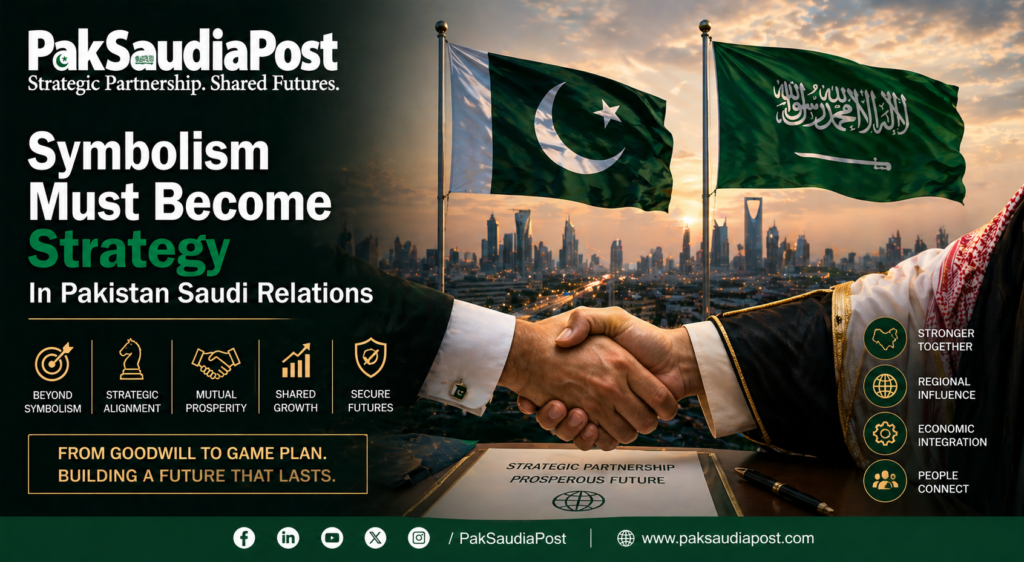
Symbolism Must Become Strategy In Pakistan Saudi Relations

Few bilateral relationships in the Muslim world carry as much emotional vocabulary and as little institutional depth as that between Pakistan and Saudi Arabia. For decades, leaders in both states have described one another as brothers, trusted partners and strategic friends. The language is warm, familiar and politically useful. It evokes religion, shared sentiment, labour ties, military cooperation and moments of financial assistance. Yet beneath the rhetoric lies a persistent structural weakness. The relationship has often been reactive rather than planned, leader driven rather than system driven, ceremonial rather than contractual. The central question in 2026 is whether recurring diplomatic warmth can finally be converted into a permanent strategic compact.
The timing of that question is not accidental. Saudi Arabia is transforming itself at extraordinary speed. Vision 2030 seeks to diversify the kingdom from hydrocarbon dependence into logistics, technology, tourism, manufacturing and sovereign investment leadership. Pakistan, meanwhile, remains trapped between immense potential and chronic instability. It needs foreign direct investment, export growth, institutional reform and strategic patience. Both countries are therefore entering a decade in which old habits are insufficient. Saudi Arabia cannot rely forever on oil rents and imported security. Pakistan cannot rely forever on remittances, emergency bailouts and rhetorical friendships.
Historically, the Pakistan Saudi relationship rested on four pillars. The first was religious affinity, anchored by pilgrimage flows and public reverence for the holy cities. The second was labour migration, through which millions of Pakistanis sought livelihoods in the Gulf and remittances stabilized households back home. The third was defence cooperation, including training links and strategic familiarity. The fourth was episodic financial support, often extended during Pakistan’s moments of external stress. These pillars were real and often valuable. But they belonged to an earlier era.
The contemporary world rewards institutionalized relationships. Investors seek enforceable contracts. Security planners seek interoperable systems. Citizens seek measurable outcomes. Markets seek continuity beyond personalities. When relations depend too heavily on summit optics, they become vulnerable to mood changes, leadership transitions and bureaucratic drift. Pakistan and Saudi Arabia have experienced precisely this pattern. Grand visits produce headlines. Memorandums of understanding generate optimism. Months later, implementation slows, priorities shift and expectations reset downward.
This cycle is costly. It wastes political capital, creates public cynicism and prevents compounding trust. A permanent strategic compact would therefore require moving from symbolism to systems. Such a compact need not resemble a formal alliance treaty. In fact, flexible architecture may be wiser. But it must be institutional enough to survive changes in government, fiscal pressures and regional crises.
What would that architecture look like. First, both states need structured annual strategic dialogues involving foreign affairs, defence, finance, energy and investment officials. Too many bilateral relationships operate through ad hoc leader level engagement. High politics matters, but without regular ministerial and technical mechanisms it cannot sustain delivery. A yearly two plus two format bringing foreign and defence ministers together, supplemented by economic working groups, would create rhythm and accountability.
Second, investment relations must be professionalized. Pakistan often approaches Gulf partners with lists of opportunities but insufficient project readiness. Saudi Arabia increasingly evaluates external commitments through commercial discipline, not sentimental generosity. This means Pakistan must present bankable projects with clear land titles, regulatory certainty, revenue models and dispute resolution frameworks. In turn, Saudi capital should prioritize productive sectors such as mining, logistics, renewable energy, agriculture technology, petrochemicals and industrial zones rather than purely extractive or symbolic ventures.
Third, labour ties require modernization. The old model of low skilled migration is under strain as Gulf economies automate, nationalize workforces and demand higher productivity. Pakistan should negotiate a next generation labour compact focused on technical training, digital skills, health services, engineering and management pipelines. If it fails to upgrade human capital, it risks losing market share to better prepared competitors. If it succeeds, labour mobility can remain a pillar of bilateral interdependence.
Fourth, security cooperation must adapt to new threats. Past cooperation often centred on conventional military familiarity. The present threat landscape includes drones, cyber attacks, maritime disruption, supply chain sabotage and grey zone coercion. Pakistan’s military institutions still possess significant training capacity and operational experience. Saudi Arabia possesses resources and modernization momentum. Joint work in air defense training, cyber resilience, maritime domain awareness and counter drone doctrine would be more relevant than nostalgic references to past deployments.
Fifth, financial mechanisms should evolve. Trade and investment relations remain vulnerable when entirely dependent on dollar liquidity cycles or emergency state to state arrangements. Currency settlement experimentation, joint investment funds, export credit facilities and blended finance vehicles could create more durable channels. Such tools would also signal maturity: partnerships built on finance architecture rather than occasional rescue narratives.
Sixth, crisis management mechanisms are essential. Regional shocks are no longer rare events. Energy price volatility, Red Sea disruptions, Iran related tensions, global recessions and domestic emergencies can emerge rapidly. A bilateral hotline connecting key ministries, along with standing crisis consultation protocols, would allow faster coordination. Permanent compacts are tested not during ceremonies but during turbulence.
Yet architecture alone cannot solve political realities. Pakistan’s biggest obstacle remains internal inconsistency. Governments change, priorities swing, bureaucracies stall and elite competition often override national strategy. Foreign partners notice when promises outlast administrations by only months. Saudi Arabia’s leadership, increasingly managerial in style, places premium value on execution. If Pakistan cannot guarantee continuity, even friendly states will hedge.
Saudi Arabia also carries contradictions. It seeks long term partnerships yet often prefers tactical flexibility. It welcomes investment opportunities abroad yet has immense domestic capital demands. It values historical friends yet is expanding ties with India, China, Europe and others simultaneously. None of this is irrational. It reflects a rising middle power maximizing option. But it means Pakistan should not assume preferential treatment absent competitive value.
India’s growing profile in the Gulf is particularly relevant. New Delhi offers market size, technology sectors, infrastructure capability and diplomatic steadiness. Saudi Arabia will continue deepening relations with India. Pakistan must avoid reading this as betrayal. It should instead understand the new rule of geopolitics: states diversify. Emotional exclusivity has little place in contemporary strategy. Pakistan’s task is to offer differentiated advantages, not demand inherited privilege.
Those advantages exist. Pakistan offers a large workforce, military experience, agricultural potential, proximity to western China, Arabian Sea geography and influence across segments of the Muslim world. It is also a country whose upside remains significant if governance improves. Saudi Arabia can gain from participating in that upside early, particularly in sectors aligned with Vision 2030. But upside is not enough. Execution converts possibility into returns.
Media narratives in both countries often obstruct realism. Pakistani commentary frequently celebrates every visit as transformational, then forgets implementation. Saudi media sometimes frames ties in broad diplomatic terms without engaging Pakistan’s structural reform needs. Social media intensifies the spectacle. Viral videos of motorcades and palace receptions create illusions of progress detached from policy substance. Public discourse must mature. Citizens should ask not how warmly leaders embraced, but how many projects reached financial close, how many workers were upskilled, how much trade diversified and what institutional mechanisms were created.
There is also a generational shift underway. Younger Saudis are shaped less by old ideological solidarities and more by opportunity, efficiency and global competitiveness. Younger Pakistanis, despite frustration, increasingly seek meritocratic openings and digital integration. A future compact must speak to these generations. It must create jobs, innovation exchanges, startup capital, university partnerships and technology cooperation. Sentiment alone does not mobilize ambitious youth.
Climate and food security add further urgency. Saudi Arabia is deeply interested in resilient food supply chains. Pakistan possesses agricultural capacity but suffers from water stress, low productivity and post-harvest losses. Strategic cooperation in irrigation technology, seed science, cold storage and agri logistics could benefit both. Likewise renewable energy collaboration could help Pakistan reduce import burdens while offering Saudi firms’ new markets.
One must also consider the symbolic dimension honestly. Symbolism is not worthless. Shared narratives can create trust reservoirs unavailable in colder relationships. Public goodwill can smooth difficult negotiations. Religious affinity can sustain patience during setbacks. The problem arises only when symbolism substitutes for delivery. Healthy relationships use sentiment as lubricant, not foundation.
What then should a permanent compact prioritize over the next five years. A credible shortlist would include one flagship industrial investment zone, one labour skills modernization pact, one maritime security framework, one agricultural resilience initiative, one annual strategic dialogue and one functioning crisis hotline. Success in a few areas would matter more than dozens of unsigned or unimplemented announcements.
For Pakistan, reform at home is the ultimate foreign policy tool. Stable taxation, predictable regulation, faster courts, reliable power supply and administrative professionalism would attract Saudi capital more effectively than repeated diplomatic appeals. For Saudi Arabia, patience with reforming partners can yield long term strategic dividends that exceed short term transactional gains.
The wider Muslim world would also benefit from a more mature Pakistan Saudi partnership. Too often major Muslim states oscillate between rhetorical solidarity and fragmented interests. A functional compact based on investment, technology, security and skills could model a more practical form of cooperation.
Still, realism requires acknowledging risk. Pakistan may continue cyclical instability. Saudi priorities may remain domestically concentrated. Bureaucracies on both sides may dilute ambition. Regional crises may intrude. Yet uncertainty is precisely why institutions matter. They preserve momentum when politics becomes noisy.
The relationship between Pakistan and Saudi Arabia stands at an inflection point. It can remain a theatre of recurring warmth, where every summit promises renewal and every year ends in partial delivery. Or it can evolve into a rules-based partnership calibrated to the demands of a harsher world.
Permanent compacts are not declared into existence. They are built through calendars, contracts, committees, capital and continuity. They require fewer poetic adjectives and more competent administrators. They demand that both sides accept uncomfortable truths: friendship does not replace feasibility, and history does not guarantee future relevance.
Pakistan and Saudi Arabia possess enough shared interest to justify seriousness. One needs capital and confidence. The other needs partners, markets and strategic depth. Both need resilience in an era of disruption. If they can align ambition with discipline, symbolism may yet become strategy. If not, future generations will inherit a relationship rich in memory and poor in structure.
A Public Service Message