Pakistan Saudi Strategic Council

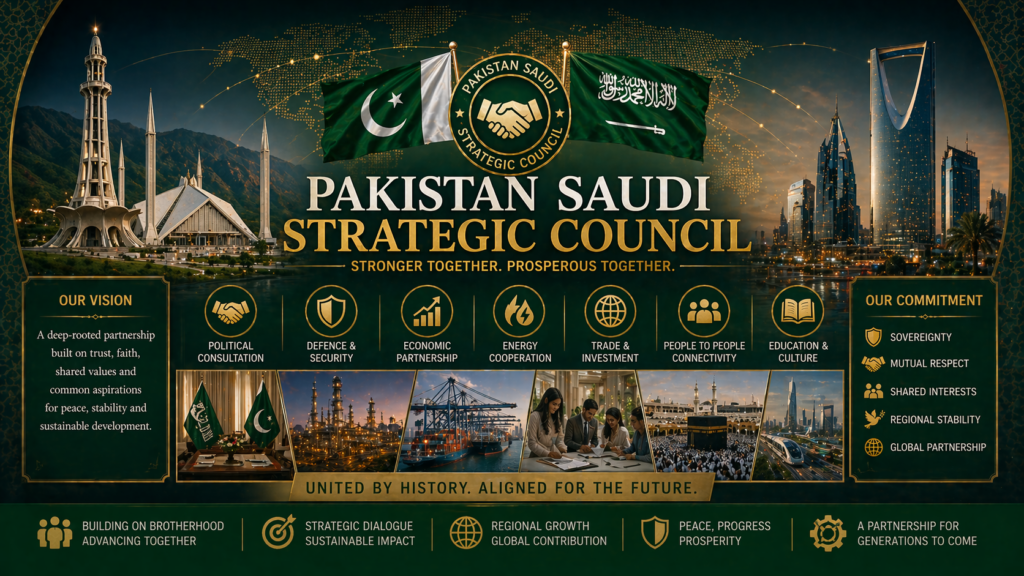
The evolving relationship between Pakistan and Saudi Arabia is entering a phase that can no longer be adequately interpreted through the conventional grammar of bilateral diplomacy. What has historically been framed as a mix of religious affinity, labor remittances, episodic financial assistance, and security cooperation is now undergoing a structural reconfiguration shaped by shifting regional security architectures, Saudi Arabia’s Vision 2030 transformation agenda, and Pakistan’s persistent macroeconomic fragility. The emerging proposal for a Pakistan Saudi Strategic Council represents not merely an institutional refinement but an attempt to codify a transition from ad hoc transactionalism to managed interdependence. Yet such a transformation must be read through deeper theoretical lenses that expose both its promise and its contradictions.
From a dependency theory perspective, the relationship has long exhibited classical asymmetries characteristic of core periphery dynamics. Saudi Arabia, as a capital surplus state embedded within global hydrocarbon markets, has functioned as a financial stabiliser for Pakistan, a labor exporting economy repeatedly reliant on external inflows to offset structural trade deficits. Pakistan’s dependence on remittances, concessional oil arrangements, and periodic fiscal bailouts reflects a pattern in which external liquidity substitutes for domestic productive restructuring. The proposed Strategic Council, if not carefully institutionalised, risks reinforcing this dependency architecture by formalising asymmetry under the guise of coordination. However, dependency theory also evolves in its neo dependency formulations, suggesting that institutional depth can either entrench or mitigate unequal exchange depending on governance design. The critical question is whether this council becomes an instrument of mutual transformation or a mechanism of managed dependence.
Saudi Arabia’s own motivations for deeper institutionalisation are grounded in its ongoing post oil economic transition. Vision 2030 is not merely a domestic reform blueprint but a geopolitical repositioning strategy aimed at diversifying partnerships beyond traditional Western security umbrellas and oil centered financial cycles. In this context, Pakistan emerges as a strategically useful partner due to its demographic scale, military capabilities, geographic proximity to key maritime corridors, and role as a labor reservoir. Yet Saudi strategic recalibration also introduces internal tensions. Increased external commitments require institutional mechanisms that reduce diplomatic volatility and ensure predictability in bilateral engagements. A Strategic Council, therefore, becomes an instrument of risk management as much as partnership building.
Complex interdependence theory provides a more nuanced framework to understand this transition. Unlike realist paradigms that prioritise military power as the primary currency of state relations, complex interdependence suggests that multiple channels of interaction across security, economic, and societal domains create overlapping networks of mutual sensitivity and vulnerability. The Pakistan Saudi relationship increasingly reflects this condition. Defence cooperation is no longer isolated from labor migration regimes, which in turn are linked to fiscal stability in Pakistan and domestic labor market reforms in Saudi Arabia. Energy agreements intersect with global oil price volatility, while infrastructure investments are tied to Chinese Belt and Road dynamics in Pakistan and Gulf diversification strategies in Saudi Arabia. In such a multidimensional environment, policy coordination without institutional architecture becomes unstable and reactive.
The proposed Strategic Council can thus be interpreted as an attempt to formalise complex interdependence into a structured governance mechanism. Its potential strength lies in integrating four domains that have historically operated in silos. Defence coordination remains central, particularly given evolving regional security uncertainties in the Gulf and South Asia. Pakistan’s conventional military capacity and Saudi Arabia’s financial and logistical resources create complementarities that have historically been activated during crises but rarely institutionalised into continuous planning frameworks. A permanent chamber for strategic deterrence coordination would theoretically reduce the lag between crisis emergence and bilateral response, embedding predictability into an otherwise episodic security relationship.
Trade and investment coordination represents another critical dimension. Despite rhetorical commitments to economic deepening, bilateral trade remains underdeveloped relative to political symbolism. Saudi capital flows into Pakistan have often been project based and politically timed rather than structurally integrated into long term industrial planning. A Strategic Council could theoretically address this fragmentation by aligning Saudi investment priorities with Pakistan’s industrial restructuring needs, particularly in energy infrastructure, mining, logistics, and digital economy sectors. However, neo structural economic theory cautions that without domestic productive transformation, external investment may reinforce enclave economies rather than catalyse broad based development.
Labor governance constitutes perhaps the most politically sensitive domain. Pakistan’s labor exports to Saudi Arabia have historically functioned as a safety valve for domestic unemployment and foreign exchange shortages. Yet Saudi Arabia’s increasing emphasis on Saudisation introduces structural constraints on low skill labor absorption. This creates a transitional tension in which Pakistan must either upgrade its labor export profile or risk gradual marginalisation of its traditional labor markets in the Gulf. A Strategic Council that incorporates labor governance as a core pillar could potentially manage this transition by facilitating skill certification frameworks, mobility agreements, and sectoral reallocation of Pakistani workers into higher value segments of the Saudi economy.
Crisis diplomacy is the fourth and perhaps most strategically significant pillar. Regional volatility in the Middle East, particularly involving maritime security in the Red Sea and broader Gulf tensions, necessitates rapid diplomatic coordination mechanisms. Pakistan’s historical role as a stabilising military partner to Saudi Arabia positions it as a potential crisis responder, yet the absence of institutionalised protocols limits effectiveness. A standing crisis coordination chamber within the Strategic Council would therefore function as a real time diplomatic and security interface, reducing reliance on ad hoc elite level communication during emergencies.
Despite these theoretical advantages, the institutionalisation of asymmetry remains a central concern. Neo structuralist theory emphasises that development outcomes are shaped not merely by external linkages but by internal institutional capacity and state coherence. Pakistan’s governance fragmentation, fiscal volatility, and policy discontinuity present significant constraints on its ability to engage in equal institutional bargaining. Without domestic reforms in tax capacity, regulatory stability, and bureaucratic coordination, Pakistan risks entering the Strategic Council as a structurally weaker actor unable to shape agenda setting processes. In such a scenario, institutionalisation may paradoxically deepen dependence by formalising unequal bargaining power.
Conversely, Saudi Arabia’s capacity to act as agenda setter introduces its own strategic dilemma. Over institutionalisation of asymmetric relationships can generate long term political liabilities, particularly if perceived as extractive or hierarchically structured. Saudi foreign policy has increasingly sought to project itself as a diversified global partner rather than a regional patron. Therefore, the legitimacy of a Strategic Council depends on its ability to project formal equality even in conditions of material asymmetry. This requires carefully designed decision-making protocols, rotating leadership structures, and transparent agenda setting mechanisms.
The geopolitical environment further complicates this institutional design. Pakistan’s deepening engagement with China through the China Pakistan Economic Corridor introduces an additional layer of triangulated interdependence. Saudi Arabia’s own evolving relationship with China as an energy partner adds further complexity. The Strategic Council must therefore operate within a broader matrix of multipolar alignments where bilateral decisions are increasingly influenced by third party relationships. Complex interdependence theory suggests that such overlapping networks reduce the utility of unilateral coercion but increase the importance of institutional coordination.
Moreover, domestic political economies in both states shape the feasibility of sustained institutional engagement. In Pakistan, frequent political transitions and economic crises limit long term policy consistency. In Saudi Arabia, rapid socio-economic transformation generates internal pressures that require external stability. The Strategic Council thus emerges as both a stabilising mechanism and a potential site of policy contestation.
Ultimately, the Pakistan Saudi Strategic Council should be understood not as an administrative innovation but as an experiment in governing asymmetry under conditions of accelerating regional transformation. Its success will depend less on formal design and more on the ability of both states to reconcile structural inequalities with institutional predictability. Dependency theory warns of entrenched hierarchies, complex interdependence highlights networked vulnerabilities, and neo structuralism emphasises domestic institutional capacity. Between these theoretical poles lies the practical reality of international politics, where strategic councils do not eliminate asymmetry but reorganise it into more manageable forms.
The question is therefore not whether such a council will deepen cooperation, but whether it can transform cooperation into a stable architecture that survives beyond crisis cycles, leadership changes, and shifting geopolitical winds. If successful, it may represent a new model of South South institutional diplomacy. If unsuccessful, it will become another layer in a long history of symbolic structures that mask persistent structural imbalance.
A Public Service Message