Deterrence Beyond Oil Through Pakistan Saudi Alliance

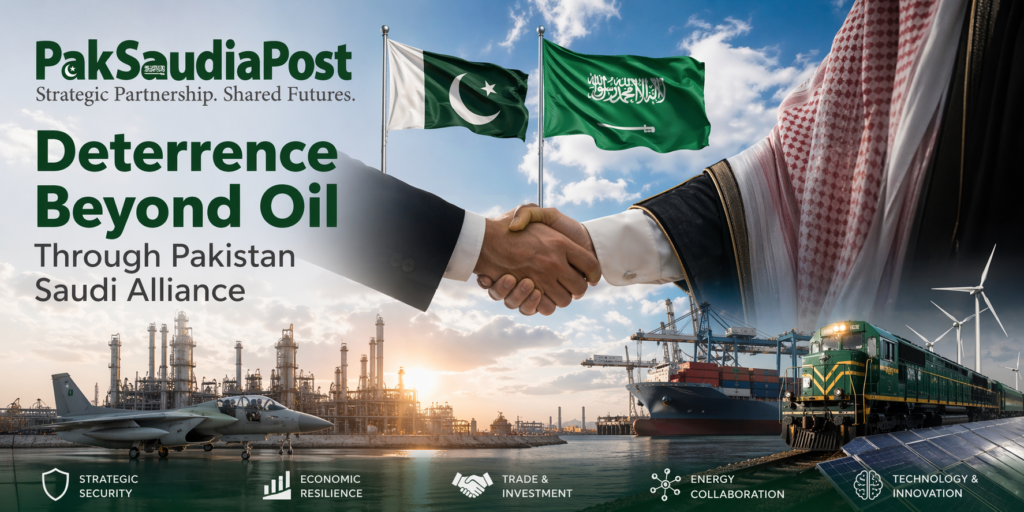
The attacks on Gulf energy infrastructure have done more than scorch storage tanks, interrupt exports, and unsettle markets. They have altered the strategic grammar of the wider Middle East and adjoining seas. For decades, the security architecture linking Pakistan and Saudi Arabia rested on a relatively familiar bargain. Riyadh possessed capital, energy centrality, and political influence in the Arab world. Islamabad possessed military manpower, strategic geography, and a professional defence establishment able to supply training, doctrine, and, when required, discreet reassurance. That arrangement was often described in simplistic terms as friendship, religious affinity, or transactional necessity. In reality, it was always a calculation of interests conducted beneath ceremonial language. What has changed now is the object being defended. No longer is the central question merely regime security or territorial defence. It is the protection of infrastructure, maritime continuity, and economic circulation in an era where a drone swarm can produce consequences once associated only with armies.
The contemporary battlespace has become profoundly asymmetric. An adversary need not seize a city, occupy a province, or defeat an air force to impose pain. It can strike pumping stations, ports, desalination plants, communications hubs, and undersea cables. It can raise insurance costs, trigger shipping delays, and generate psychological uncertainty among investors. Such methods are attractive precisely because they are cheaper than conventional war and often deniable. The strategic lesson for Saudi Arabia has been severe. Vast spending on advanced aircraft and armour does not automatically secure exposed industrial networks spread across deserts and coastlines. The strategic lesson for Pakistan has been equally important. Traditional military partnerships must now be redesigned around resilience rather than ceremony.
This explains the recent recalibration in bilateral defence ties. Reports of Pakistani aircraft deployments and expanded military coordination with Saudi Arabia should be read not as isolated gestures but as indicators of doctrinal change. Airpower in this setting is not simply about offensive capability. It is about layered surveillance, interception, rapid response, and reassurance. The visible presence of allied assets complicates enemy planning. It signals that attacks on infrastructure may trigger wider consequences. In deterrence theory, uncertainty can be as valuable as firepower. If an adversary cannot know how many radars are networked, how many interceptors are ready, or how many states might respond, the cost of aggression rises.
Yet deterrence today extends beyond missiles and aircraft. It includes redundancy. Saudi Arabia’s westward export routes to the Red Sea have become strategically precious because they reduce dependence on the Strait of Hormuz. Pipelines once evaluated mainly through commercial efficiency are now judged as instruments of national survival. Ports on the Red Sea acquire greater military significance. Tank farms, storage depots, and maintenance facilities become strategic nodes. This has direct implications for Pakistan. If Saudi Arabia seeks diversified routes and resilient partnerships, Pakistan offers a complementary geography on the Arabian Sea. Karachi, Port Qasim, and Gwadar are not interchangeable assets, but together they represent maritime depth near crucial sea lanes linking the Gulf, South Asia, and East Africa.
The Arabian Sea itself is no longer a passive expanse crossed by merchant vessels. It is a theatre where naval presence, surveillance systems, submarine awareness, and escort capacity matter increasingly. Pakistan’s navy, though modest compared with larger powers, occupies a geography others cannot replicate. Its coastline sits near the junction of Gulf exports, Indian Ocean commerce, and routes feeding Asia’s industrial economies. Saudi Arabia, for its part, has growing incentives to think beyond the Gulf littoral and toward broader maritime partnerships. A future in which tankers require convoy support, intelligence sharing, and real time monitoring would naturally pull the two states into deeper naval coordination.
Such cooperation need not take the dramatic form of a formal alliance directed against named enemies. Modern states often prefer flexible arrangements. Joint exercises, shared command protocols, cyber cooperation, logistics agreements, maintenance contracts, and officer exchanges can create real capability without provocative headlines. This suits both sides. Saudi Arabia wants security without perpetual escalation. Pakistan wants strategic relevance without being trapped in another state’s quarrels. Quiet interoperability may therefore prove more durable than grand declarations.
Still, no strategic partnership exists in a vacuum. Pakistan must manage relations with Iran, a neighbour with whom it shares a border, sectarian sensitivities, and overlapping economic possibilities. Islamabad cannot appear as a spear pointed westward on behalf of Riyadh. Saudi Arabia, meanwhile, has pursued periods of de escalation with Tehran even while preparing for contingencies. The result is an intricate balancing act. Pakistan can strengthen Saudi deterrence against attacks on infrastructure while simultaneously advocating regional dialogue. Critics may call this contradictory. In truth it reflects how middle powers survive. They often separate deterrence from diplomacy rather than choosing one exclusively.
The economic dimension is equally important. Defence ties once revolved around subsidies, remittances, and episodic assistance. Today they may revolve around investment in security relevant infrastructure. Joint ventures in ship repair, drone technology, coastal surveillance, fuel storage, and secure communications could create a more institutional relationship. Saudi capital seeking productive strategic outlets may find opportunities in Pakistan’s ports and industrial zones. Pakistan, chronically constrained by foreign exchange pressures, would benefit from projects that enhance both commerce and resilience.
There is also a labour and demographic layer frequently ignored in military analyses. Millions of Pakistanis have worked in the Gulf over decades. Human networks create familiarity, remittance flows, and political constituencies for stable relations. In moments of crisis, such interdependence matters. States are often more willing to protect relationships that are socially embedded rather than merely diplomatic abstractions. The Pakistan Saudi connection therefore possesses societal depth many security arrangements lack.
Technology is reshaping the equation further. Cheap drones, autonomous systems, commercial satellite imagery, and cyber sabotage have lowered the threshold for strategic disruption. The old model in which only advanced states could threaten critical infrastructure has eroded. This means Saudi Arabia requires not merely expensive imports but adaptive ecosystems able to detect, repair, and recover quickly. Pakistan’s value may lie partly in human capital. Its engineers, technicians, pilots, and military professionals can contribute to building systems that are manpower intensive as well as hardware dependent.
Deterrence matrices stretching from the Red Sea to the Arabian Sea also intersect with broader great power competition. The United States remains a central security actor in the Gulf, but Washington has signalled varying appetites for deep entanglement. China is now a major energy customer with expanding maritime interests. Europe worries about supply disruptions more than regional prestige. Russia benefits opportunistically from higher prices and distracted rivals. In such an environment, regional states seek supplementary partnerships. Pakistan and Saudi Arabia can each hedge uncertainty through closer ties with one another while preserving wider external relations.
For Pakistan, the benefits are substantial but not automatic. Strategic relevance can become overextension if not carefully managed. Islamabad’s economy cannot sustain open ended commitments abroad. Domestic politics may resist visible involvement in foreign conflicts. Military planners understand that symbolic deployments must not become entrapment mechanisms. Hence Pakistan is likely to prefer bounded contributions such as training, air defence assistance, maritime patrol cooperation, and intelligence liaison rather than expeditionary adventures.
For Saudi Arabia, partnership with Pakistan cannot substitute entirely for indigenous reform. Outsourced security has limits. Sustainable deterrence requires domestic capacity, efficient bureaucracy, integrated command structures, and credible repair and recovery mechanisms. Yet external partners can accelerate this process, especially when they bring operational experience rather than only equipment catalogues.
The philosophical shift underway is from guarding territory to guarding circulation. Classical geopolitics focused on borders, forts, and armies. Contemporary geoeconomics focuses on flows of oil, data, finance, water, and shipping. Power belongs increasingly to those who can preserve flows under pressure. A missile battery protecting a refinery may generate more strategic value than a tank brigade far from any economic artery. A naval drone watching a chokepoint may matter more than ceremonial troop numbers.
Pakistan and Saudi Arabia are therefore adapting to a world in which vulnerability is networked. If one node fails, consequences spread globally through prices, freight rates, inflation, and political sentiment. The attacks on Gulf infrastructure exposed that interdependence dramatically. The bilateral response suggests both states understand the lesson. Security can no longer be measured only by how much territory a state controls. It must also be measured by how quickly it can restore exports, reopen ports, reassure markets, and prevent panic.
There remains, of course, the possibility that diplomacy reduces regional tensions and renders some of these calculations less urgent. That would be welcome. Yet prudent states do not build strategy on optimism alone. They prepare for recurrence. Energy infrastructure has been targeted before and likely will be again somewhere in the world. Maritime chokepoints will remain susceptible to coercion. Non state actors and rival states alike have learned the leverage of disruption.
The emerging Pakistan Saudi defence architecture should thus be seen as part insurance policy, part political signal, part practical adaptation. It is not a dramatic new bloc overturning the region overnight. It is subtler than that. It is two states adjusting inherited ties to meet new threats. The glamour of grand alliances may attract headlines, but the real future of deterrence lies in sensors, maintenance crews, reserve routes, cyber hygiene, trained pilots, interoperable procedures, and calm decision-making during crisis.
If this partnership matures intelligently, it could contribute to wider regional stability. If it becomes ideological or reckless, it could sharpen rivalries. Much depends on discipline. Strategic maturity requires recognising that strength and restraint are not opposites. They are companions.
The age of oil wealth alone is passing. The age of protecting oil systems, maritime arteries, and economic continuity has arrived. Pakistan and Saudi Arabia appear determined not to be late to that lesson.
A Public Service Message