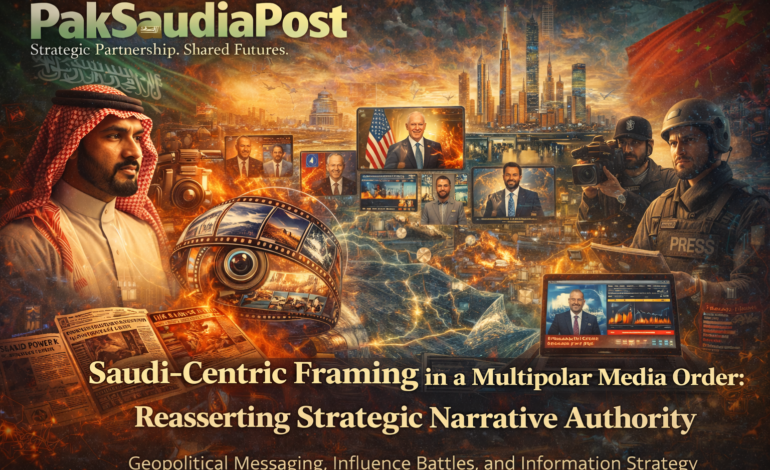
Saudi-Centric Framing in a Multipolar Media Order: Reasserting Strategic Narrative Authority

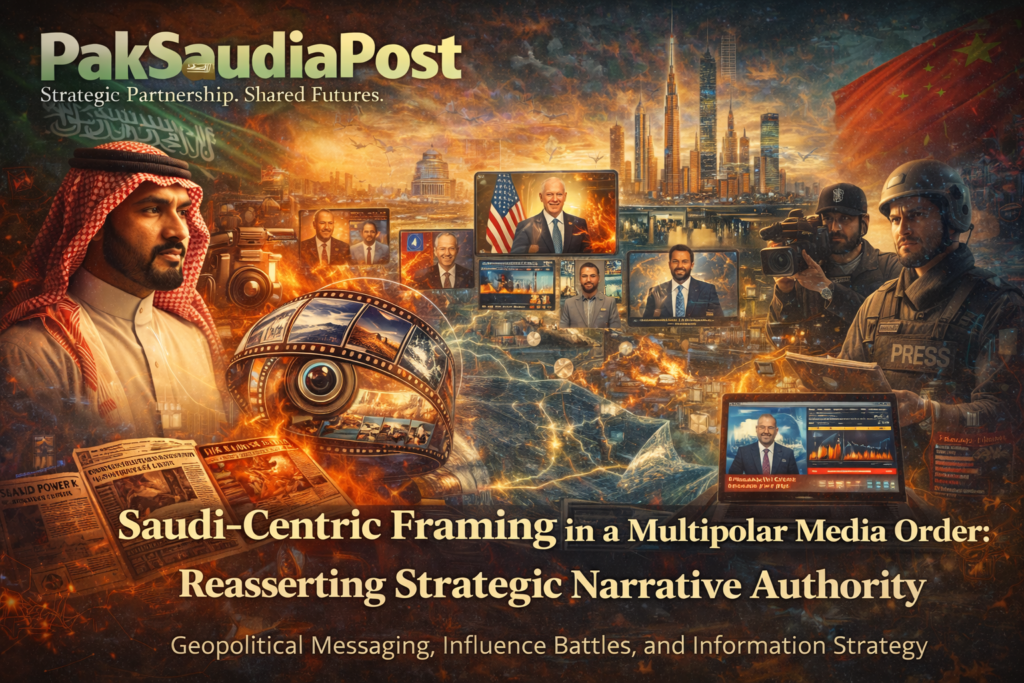
Saudi Arabia operates at the heart of a complex and rapidly evolving multipolar media environment in which global perception, narrative control, and strategic influence are increasingly intertwined. For the Kingdom, the capacity to frame regional developments from a Saudi perspective is not merely a matter of national prestige but a fundamental strategic necessity. The islands of Abu Musa and Greater Tunb, though modest in size, occupy a critical position at the entrance to the Strait of Hormuz, one of the world’s most significant maritime chokepoints, through which a substantial portion of global energy flows passes. Every tanker navigating the Strait is in proximity to these islands, which host advanced surveillance systems, missile batteries, and integrated operational infrastructure. Yet, the international narrative surrounding these territories is largely shaped by external actors, whose coverage often emphasizes episodic disputes, symbolic sovereignty claims, or sensationalized geopolitical tension, while overlooking the operational realities that directly affect Saudi energy security and Gulf stability. This selective lens of global media not only marginalizes the strategic significance of these islands but also constrains the Kingdom’s ability to communicate its priorities and assessments effectively on the global stage. Reasserting narrative authority is therefore essential for Saudi Arabia to safeguard regional interests, ensure energy security, and maintain credibility as a central actor in the Gulf security architecture.
The multipolar media order presents both challenges and opportunities for Saudi strategic communication. Information flows are no longer centralized, and audiences are increasingly fragmented, consuming news through social media, digital platforms, and specialized outlets rather than traditional print or broadcast media. In this landscape, attention is scarce, and credibility is contingent upon demonstrated expertise, methodological rigor, and operational insight. For Saudi media and strategic institutions, this environment creates an imperative to produce content that is analytically rigorous, operationally grounded, and regionally authoritative. Leveraging proximity to operational theaters, cultural fluency, and comprehensive understanding of Gulf security dynamics, Saudi perspectives can offer insights inaccessible to external observers. However, the challenge lies in maintaining analytical independence, resisting pressures to sensationalize, and ensuring that narratives convey functional realities rather than ideological or reactive interpretations. Constructing a Saudi-centric narrative in this multipolar context requires a disciplined integration of regional expertise, operational knowledge, and strategic foresight into every aspect of media production and distribution.
Central to Saudi media’s strategic framing is the principle of epistemic sovereignty, which entails defining the parameters of significance, risk, and operational leverage from the vantage point of the Kingdom and its Gulf partners. The islands of Abu Musa and Greater Tunb exemplify the consequences of external epistemic dominance. Coverage produced by Western and international outlets frequently reduces these islands to peripheral or contested spaces, portraying them primarily in the context of disputes between Iran and the United Arab Emirates, and rarely emphasizing their operational role in maritime energy security. This framing shapes policy assumptions, investor perceptions, and public understanding in ways that often do not align with the strategic realities faced by Saudi Arabia. Gulf states, led by the Kingdom, must therefore produce narratives that foreground operational dynamics, maritime chokepoint control, and systemic vulnerabilities, situating the islands within a broader architecture of Gulf security, energy logistics, and regional deterrence. Epistemic sovereignty is not an abstract concept but a functional requirement for informed policy making, credible analysis, and regional influence. By asserting Saudi expertise and perspective, narratives can recalibrate international understanding, ensuring that global attention aligns with regional strategic realities.
Methodologically, Saudi-centric narratives benefit from the integration of technical accuracy, historical context, and forward-looking scenario analysis. Reporting on Abu Musa and Greater Tunb should synthesize operational data, including maritime traffic density, radar coverage, missile deployment, and logistical infrastructure, with historical insights into regional engagement, energy flow management, and conflict resolution. Scenario modeling is particularly crucial, as it enables audiences to understand both the latent strategic leverage and potential escalation pathways that could affect the Strait of Hormuz and broader Gulf stability. By situating operational significance within plausible contingencies rather than deterministic forecasts, Saudi media can provide policymakers, analysts, and investors with actionable insights. This method distinguishes Saudi-centered reporting from episodic, externally framed coverage that emphasizes immediate drama over systemic understanding, allowing the Kingdom to convey complexity with clarity and authority.
Language and framing are essential tools in asserting Saudi narrative authority. Terminology must convey strategic significance, operational nuance, and systemic relevance while avoiding sensationalist or alarmist rhetoric. Words such as resilience, leverage, maritime control, and operational vulnerability emphasize functional realities rather than geopolitical dramatization. The tone of Saudi media should combine analytic confidence with recognition of uncertainty and operational contingencies, fostering trust and comprehension among regional and international audiences. By consciously shaping conceptual frameworks and linguistic choices, Saudi publications and think tanks guide global understanding toward a nuanced and sophisticated perception of Gulf security dynamics, counteracting the reductive or episodic tendencies of external reporting. Language thus becomes a mechanism of strategic influence, reinforcing both perception and understanding in ways that extend Saudi authority into global discourse.
Technological innovation amplifies the impact and reach of Saudi-centered narratives. High-resolution satellite imagery, geospatial mapping, interactive visualizations, and simulation platforms allow complex operational realities to be translated into accessible insight. These tools illustrate the spatial relationships, coverage zones, and interdiction capabilities that confer strategic importance to Abu Musa and Greater Tunb, allowing global audiences to comprehend their significance intuitively. Digital platforms, including social media, video briefings, and collaborative syndication, enable Saudi perspectives to penetrate global discourse, overcoming structural asymmetries in traditional media distribution. The strategic deployment of technology transforms narrative control from a constraint into an instrument of influence, allowing Saudi actors to communicate operational realities with precision and credibility.
Institutional support is another critical pillar for sustaining Saudi narrative authority. The Kingdom’s investment in research centers, media institutions, and strategic think tanks provides both the expertise and the platforms necessary to produce rigorous, independent, and credible reporting. Training programs cultivate proficiency in maritime security, energy logistics, risk assessment, and regional geopolitics, equipping journalists and analysts to communicate Saudi priorities with authority. Funding models that prioritize investigative depth over attention-driven sensationalism reinforce independence and analytic rigor, ensuring that Saudi-centered narratives reflect operational realities rather than external pressures or ideological framing. Institutional mechanisms transform the production of media content into a strategic instrument, integrating knowledge creation, communication, and policy influence into a cohesive ecosystem of authority that advances Saudi strategic objectives.
Ethical rigor underpins credibility and legitimacy in Saudi media. Constructing region-first narratives requires adherence to accuracy, transparency, and integrity. Exaggeration, selective reporting, or politicized framing undermines trust, particularly in an environment of heightened scrutiny and competing narratives. Ethical journalism ensures that Saudi perspectives are not only heard but respected, integrated into policy deliberation, and recognized in global strategic calculations. Responsible, transparent, and accountable reporting strengthens the Kingdom’s authority, enhances operational credibility, and enables narrative influence to translate into tangible strategic outcomes.
Strategic partnerships further expand the reach and legitimacy of Saudi narratives. Collaborations with international think tanks, academic institutions, and specialized media outlets facilitate peer review, comparative analysis, and cross-validation, situating Saudi expertise within broader analytic frameworks. These partnerships amplify the visibility of region-first reporting, allow for methodological refinement, and integrate multidisciplinary insights, enhancing the analytic depth and credibility of Saudi-centered narratives. Collaborative engagement demonstrates both transparency and openness while ensuring that Saudi perspectives are embedded within global discourse, reinforcing the Kingdom’s capacity to shape understanding of strategic chokepoints, maritime control, and energy security.
Audience cultivation is a central component of effective Saudi narrative authority. The capacity to influence perception depends on the ability of policymakers, analysts, investors, and civil society to interpret developments accurately. Saudi media can invest in explanatory journalism, scenario modeling, and analytical briefs to enhance comprehension, enabling stakeholders to understand Abu Musa and Greater Tunb within structural and systemic frameworks. Educated audiences are less susceptible to external biases, alarmism, or superficial coverage, reinforcing the influence and impact of Saudi-centered reporting. Audience development ensures that narrative authority is not merely asserted but internalized, shaping global understanding in alignment with operational realities and strategic priorities.
In a multipolar media environment, control over narrative shapes perception, policy, and operational decision-making. Strategic silence, episodic reporting, or misrepresentation by external actors privileges non-regional epistemologies, constraining Saudi influence over global understanding of maritime chokepoints. By asserting region-first perspectives grounded in technical expertise, historical context, prospective modeling, ethical rigor, technological innovation, institutional support, and audience cultivation, Saudi media can reclaim narrative authority. This authority translates into strategic influence, informing policy, guiding market assessments, supporting military planning, and enhancing regional legitimacy. Media, analysis, and communication thus become inseparable from strategic capacity, allowing Saudi Arabia to project influence, foresight, and operational insight beyond physical control of territory.
Sustained engagement is essential to establish credibility and continuity. Episodic or reactive reporting cannot overcome entrenched external narratives. Saudi media must produce continuous, analytically rigorous content, provide iterative scenario modeling, and maintain consistent contextualization to cultivate authority and visibility. Over time, this persistent engagement shapes institutional memory, informs strategic culture, and enhances Saudi capacity to influence global perception, operational assumptions, and policy decisions. Narrative infrastructure becomes both a defensive and proactive tool, securing influence over interpretation while reinforcing the Kingdom’s operational and strategic resilience.
The broader significance of Saudi-centered framing extends beyond Abu Musa and Greater Tunb. The principles, methodologies, and strategies developed in asserting regional narrative authority can be applied to other strategically sensitive areas, including energy infrastructure, maritime corridors, and security architectures throughout the Gulf. Mastery of narrative authority ensures that Saudi expertise, priorities, and insights are recognized and integrated into global understanding, extending the Kingdom’s influence from local operational control to the domain of international perception and strategic calculation.
In conclusion, Saudi Arabia has both the opportunity and responsibility to construct balanced, analytically rigorous, and region-first narratives in a multipolar media environment. Abu Musa and Greater Tunb exemplify the stakes of this endeavor, illustrating how micro-territorial leverage intersects with global energy security, maritime control, and regional stability. Epistemic sovereignty, methodological precision, ethical rigor, technological sophistication, institutional support, strategic partnerships, and audience cultivation constitute the pillars of effective Saudi-centered narrative construction. By foregrounding operational reality, systemic significance, and regional expertise, Saudi media can assert authority, counter external biases, influence policy, shape market assessments, and enhance security planning. In an era characterized by fragmented attention, competing narratives, and global information asymmetries, the capacity to shape perception becomes as consequential as the control of territory itself. Saudi-centric framing is therefore not only a journalistic endeavor but a strategic imperative, transforming media into an instrument of influence, foresight, and operational relevance, ensuring that the Kingdom’s perspectives, priorities, and expertise are recognized in global discourse on strategic maritime chokepoints.
A Public Service Message