The Fortress of Sovereignty: Pakistan Saudi Economic Shield in a Volatile Global Order

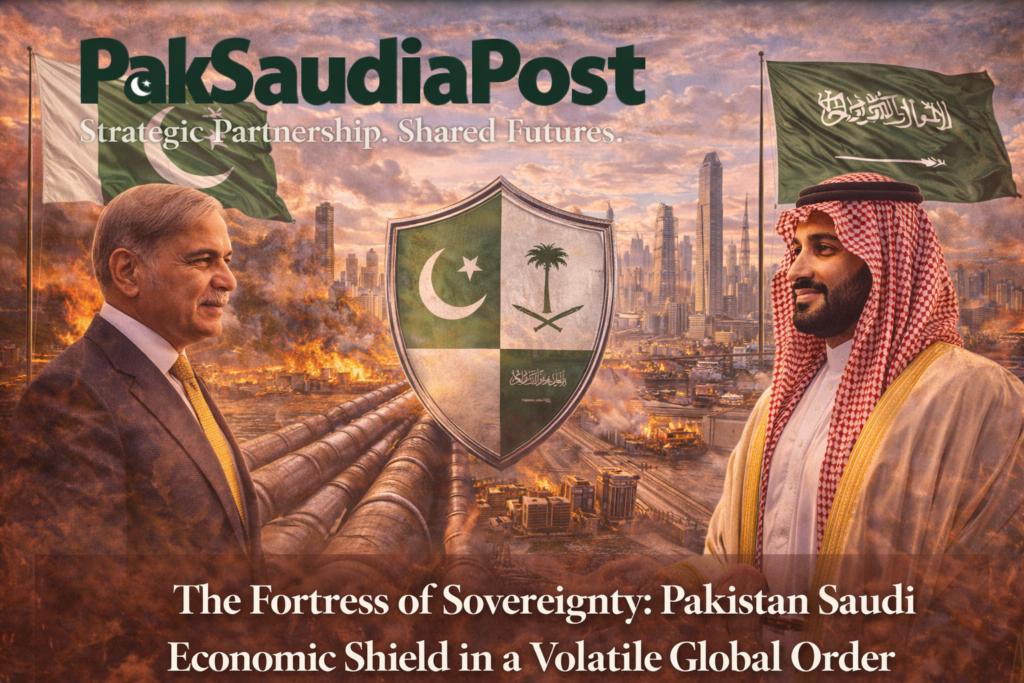
The contemporary global order is increasingly characterized by the weaponization of economics. Sanctions, financial isolation, trade restrictions, and supply chain manipulation have emerged as instruments of coercion in international relations. States that lack resilience in the face of such pressures are compelled to compromise autonomy, defer strategic objectives, or submit to external influence. For Pakistan and Saudi Arabia, the stakes are profound. Pakistan’s economy is exposed to external fiscal shocks, energy vulnerabilities, and market volatility. Saudi Arabia faces potential disruption in export markets and the need to diversify its geopolitical dependencies. Together they face the imperative of constructing a bilateral economic shield capable of preserving sovereignty, sustaining operational continuity, and projecting resilience in the face of coercive economic instruments.
The foundation of an economic shield is financial architecture. Pakistan and Saudi Arabia must establish mechanisms that enable autonomous and secure cross-border financial transactions. Bilateral currency swap arrangements, sovereign reserve pooling, and contingency liquidity lines provide a buffer against external pressure. Payment systems independent of global financial intermediaries create operational autonomy, allowing both states to conduct essential trade and investment without vulnerability to third-party sanctions. These measures must be institutionally codified, with clear rules of engagement, accountability mechanisms, and contingency protocols to ensure reliability under stress. Financial sovereignty forms the backbone of strategic resilience, enabling both nations to act in alignment with national interest rather than external compulsion.
Complementing financial instruments are strategic stockpiles and resource security arrangements. Energy, food, medical supplies, and critical industrial components must be pre-positioned in strategic reserves. Saudi Arabia can secure supply lines for crude and refined products, while Pakistan can maintain reserves of food, energy, and industrial inputs. These stockpiles reduce immediate vulnerability to disruption and provide operational flexibility in the event of sanctions, conflict, or supply chain interruption. Coordinated management, periodic audits, and technologically integrated monitoring systems ensure the effectiveness of stockpiling efforts, providing a credible deterrent to coercive actions and signaling operational competence to regional and global actors.
Industrial cooperation enhances the shield by creating domestic capability in critical sectors. Dual-use industries, including pharmaceuticals, semiconductors, aerospace components, and energy infrastructure, should be developed through joint ventures, technology transfer agreements, and capacity building initiatives. Saudi investment in strategic industrial zones within Pakistan strengthens local production, ensures operational continuity, and reduces reliance on external supply chains. For Pakistan, industrial integration converts foreign partnership into endogenous capability, reinforcing sovereignty while creating economic growth and employment. Saudi Arabia benefits from reliable production nodes and expanded regional influence, reinforcing the bilateral partnership and demonstrating the depth of strategic alignment.
Governance structures are essential to the operationalization of the economic shield. A Pakistan Saudi Economic Security Council should be established, comprising senior representatives from finance, trade, energy, defense, and foreign affairs. Its mandate would include oversight of financial instruments, stockpile management, industrial cooperation, crisis simulation, and sanctions response coordination. The council must integrate real-time intelligence, market analysis, and geopolitical assessment to anticipate emerging threats and adapt policy dynamically. Institutionalizing decision-making ensures continuity, coherence, and resilience even during political transitions or external pressure scenarios.
Risk forecasting and contingency planning are integral to strategic autonomy. Scenario modeling for economic coercion, trade embargoes, or global market shocks enables preemptive measures rather than reactive crisis management. Pakistan and Saudi Arabia must develop early warning systems, integrating financial, trade, energy, and intelligence data to predict vulnerability and initiate response protocols. Contingency drills, simulated embargoes, and crisis exercises strengthen institutional readiness and operational confidence, ensuring that both nations can maintain functionality under extreme conditions. Strategic foresight transforms vulnerability into capability and operational agility.
Trade diversification is a complementary pillar. Pakistan must expand export markets, identify alternative suppliers, and reduce reliance on single-source inputs. Saudi Arabia can facilitate preferential trade arrangements, investment guarantees, and infrastructure integration to enhance Pakistan’s economic resilience. By coupling diversified trade with secure financial mechanisms, both nations reduce exposure to external coercion while enhancing mutual interdependence. Trade resilience is a form of strategic leverage, enabling negotiation from strength and preserving autonomy in multilateral forums.
Technology and innovation play a decisive role in the shield. Financial technologies, secure communication channels, industrial automation, and supply chain monitoring enhance operational independence. Joint research and development initiatives foster indigenous capabilities, reduce reliance on external expertise, and ensure that strategic sectors remain operational under pressure. Human capital investment is equally essential. Training programs, professional exchanges, and capacity building create skilled personnel capable of executing complex economic security operations with precision and adaptability. The fusion of technology, expertise, and institutional capacity creates a credible barrier to coercion.
Legal frameworks undergird the shield. Bilateral agreements must codify financial, trade, and industrial cooperation. Compliance procedures, enforcement mechanisms, and dispute resolution protocols must be clearly defined. Legal certainty ensures investor confidence, operational reliability, and the enforceability of crisis response measures. Additionally, harmonization with international law strengthens legitimacy and reduces the risk of inadvertent violations that could compromise strategic objectives. Legal robustness reinforces operational stability and credibility in a competitive global environment.
Political alignment and diplomatic coherence are indispensable. Domestic consensus in Pakistan enhances negotiating leverage and ensures continuity of policy irrespective of internal political changes. Saudi political support strengthens the credibility and durability of cooperative arrangements. Diplomatic messaging must be consistent, emphasizing sovereignty, partnership, and mutual resilience. Regional and global stakeholders must recognize that the Pakistan Saudi economic shield is a defensive and stabilizing instrument rather than an aggressive economic maneuver. Clear diplomatic articulation reduces misperception, prevents escalation, and secures broader support for corridor stability and economic cooperation.
Security integration complements economic and diplomatic measures. The protection of strategic stockpiles, industrial installations, energy transit points, and financial networks requires coordination between military, police, and private security assets. Intelligence sharing, operational protocols, and rapid response capabilities are essential to deter sabotage, theft, or coercive interference. Security measures must be proportionate, effective, and transparent to preserve operational continuity without exacerbating regional tensions. Pakistan and Saudi Arabia can synchronize security doctrine to ensure the shield’s integrity while reinforcing bilateral trust.
Operational signaling reinforces deterrence. Public statements, coordinated exercises, and transparent reporting convey resilience, competence, and preparedness to external actors. Such signaling reassures markets, deters potential coercion, and communicates the strategic depth of Pakistan Saudi partnership. Strategic visibility without escalation enhances credibility and demonstrates that both nations possess the capacity and resolve to maintain economic sovereignty under pressure.
Environmental sustainability is integral to resilience. Industrial and energy stockpiling infrastructure must adhere to environmental standards, mitigate ecological risks, and incorporate renewable energy where possible. Sustainability ensures long-term operational viability and enhances international legitimacy. Community engagement in the development and maintenance of infrastructure strengthens societal support, creating a domestic constituency invested in the shield’s success.
The economic shield also provides leverage for broader geopolitical engagement. Pakistan’s capacity to maintain energy flows, financial stability, and industrial continuity under pressure positions it as a reliable partner in regional and global forums. Saudi Arabia’s support reinforces trust, political influence, and the projection of stability across the Gulf and South Asia. Together, the shield creates a platform from which both nations can negotiate, collaborate, and influence regional order while maintaining operational autonomy and national sovereignty.
In conclusion the Pakistan Saudi economic shield represents a strategic innovation in the management of modern coercive instruments. By integrating financial sovereignty, industrial capability, strategic stockpiles, security coordination, technology development, and diplomatic coherence, both nations create a fortress of resilience capable of withstanding sanctions, economic pressure, and supply chain disruption. The initiative strengthens brotherly relations, deepens strategic interdependence, and enables Pakistan to pivot from vulnerability to agency in a complex global order. Operationalizing this shield transforms external engagement into strategic advantage, ensuring that sovereignty, economic stability, and regional influence are preserved and enhanced in a volatile and contested international system. The fortress of sovereignty thus symbolizes a proactive, adaptive, and credible bilateral strategy in the twenty first century, securing Pakistan Saudi partnership as a cornerstone of regional stability and enduring influence.
A Public Service Message