

Corridors of Consequence: Pakistan’s Strategic Resurrection as the Pivot of Transregional Connectivity

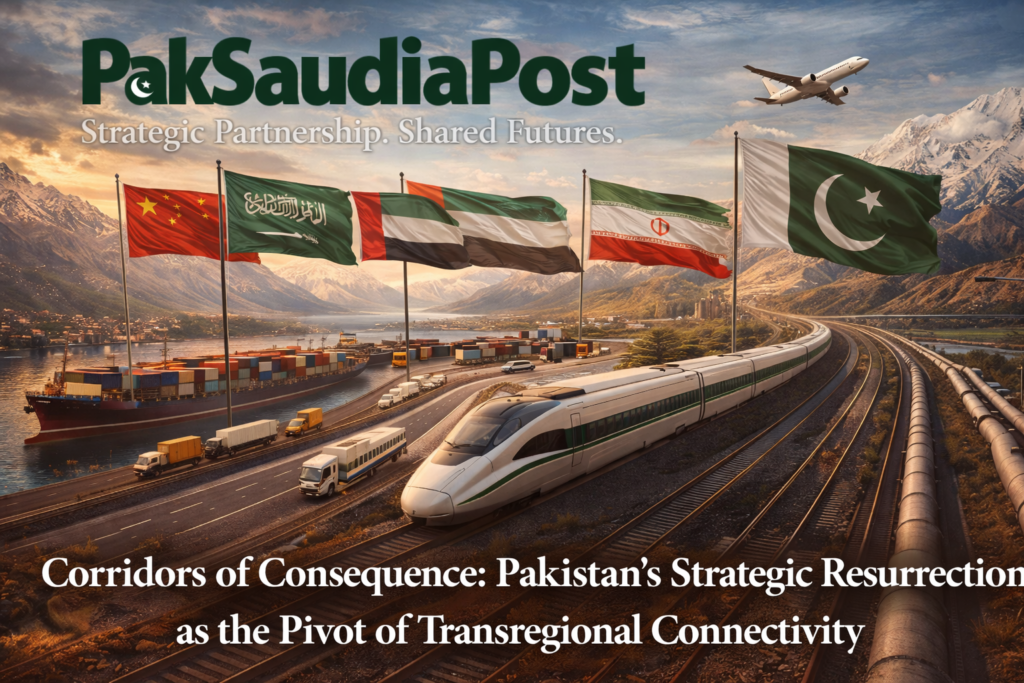
The twenty first century is being quietly but decisively shaped not by ideological blocs or conventional alliances, but by corridors. These corridors are not merely physical infrastructures of roads, ports, and pipelines. They are instruments of power, arteries of influence, and architectures through which economic sovereignty and geopolitical relevance are constructed and contested. In this unfolding cartography of connectivity, Pakistan occupies a location of extraordinary consequence, yet one that remains precariously underleveraged. Its geography places it at the intersection of South Asia, Central Asia, the Middle East, and the maritime expanse of the Arabian Sea. However, geography alone does not confer centrality. It must be activated through strategy, institutional coherence, and a deliberate reimagining of national purpose.
The emergence of competing connectivity frameworks has intensified the urgency of this transformation. China’s Belt and Road Initiative has already embedded Pakistan within a transcontinental vision of infrastructure and economic integration. Through the China Pakistan Economic Corridor, Pakistan has acquired a foundational role in linking western China to warm water maritime routes. Simultaneously, the proposed India Middle East Europe Economic Corridor seeks to reconfigure trade flows in a manner that strategically circumvents Pakistan, thereby redefining regional connectivity in exclusionary terms. This dual dynamic creates a paradox. Pakistan is both central and bypassed, included and excluded, indispensable yet vulnerable to marginalization.
To navigate this paradox, Pakistan must transcend passive participation and instead assert itself as a pivot state. A pivot state is not merely a transit territory. It is a strategic fulcrum that shapes the direction, flow, and governance of connectivity. Achieving this status requires a fundamental recalibration of how Pakistan conceptualizes its geography. Geography must be treated not as a static inheritance but as a dynamic asset capable of being augmented, optimized, and strategically deployed.
At the heart of this transformation lies the development of Gwadar. The port is often invoked as a symbol of Pakistan’s connectivity potential, yet symbolism is insufficient. Gwadar must evolve into a functional, integrated, and globally competitive maritime hub. This requires the convergence of infrastructure, governance, and economic ecosystems. Port facilities must be complemented by efficient customs regimes, digital logistics platforms, financial services, and regulatory frameworks that facilitate seamless trade. Without such integration, Gwadar risks remaining an underutilized asset rather than a transformative node.
Connectivity is not limited to physical infrastructure. It encompasses the movement of energy, data, and capital. Pakistan must therefore adopt a multidimensional approach that integrates transport corridors with energy pipelines, fiber optic networks, and financial linkages. This holistic perspective ensures that connectivity generates value across multiple sectors, reinforcing its strategic significance.
Central Asia represents a critical axis in this vision. The landlocked republics of Central Asia possess vast reserves of energy and natural resources, yet their access to global markets remains constrained. Pakistan offers the most direct and economically viable route to the Arabian Sea. By positioning itself as the primary gateway for Central Asian exports, Pakistan can create a mutually reinforcing relationship of interdependence. This requires the acceleration of transit agreements, the development of cross border infrastructure, and the establishment of stable security conditions that facilitate trade.
The integration of Central Asia into Pakistan’s connectivity framework also carries geopolitical implications. It shifts the orientation of Central Asian economies southward, reducing their reliance on traditional northern routes and diversifying their strategic options. For Pakistan, this enhances its regional influence and creates opportunities for economic collaboration in sectors such as energy, agriculture, and manufacturing.
Maritime security constitutes another pillar of Pakistan’s pivot strategy. As trade corridors converge upon the Arabian Sea, the security of sea lines of communication becomes paramount. Pakistan’s naval capabilities must therefore be aligned with the requirements of corridor protection. This involves not only conventional naval strength but also the integration of advanced surveillance systems, maritime domain awareness, and cooperative security arrangements with regional partners. A secure maritime environment enhances confidence among investors and trading partners, reinforcing Pakistan’s attractiveness as a connectivity hub.
The concept of inclusive connectivity is central to avoiding marginalization. Pakistan must resist the temptation to align exclusively with any single corridor initiative. Instead, it should adopt a strategy that accommodates multiple frameworks, positioning itself as a platform rather than a participant. This approach allows Pakistan to benefit from diverse sources of investment and engagement, while reducing vulnerability to geopolitical shifts. By maintaining openness, Pakistan can attract stakeholders from competing blocs, transforming competition into convergence.
Economic diplomacy plays a decisive role in operationalizing this strategy. Pakistan must articulate a coherent narrative that emphasizes its strategic indispensability, reliability, and potential for growth. This narrative must be supported by tangible reforms that enhance the ease of doing business, improve regulatory transparency, and strengthen institutional capacity. Without such reforms, Pakistan’s geostrategic advantages will remain theoretical rather than actionable.
The interplay between connectivity and security cannot be overstated. Corridors that facilitate economic activity also create vulnerabilities. They can become targets for disruption, whether by non state actors, criminal networks, or geopolitical adversaries. Pakistan must therefore develop a comprehensive security architecture that integrates military, intelligence, and civilian components. This architecture must be proactive, anticipating threats and neutralizing them before they materialize. Security must be embedded within the design of connectivity projects rather than treated as an afterthought.
Technological integration offers a pathway to enhancing efficiency and competitiveness. Digital platforms can streamline customs procedures, reduce transaction costs, and improve transparency. The adoption of advanced technologies such as artificial intelligence, blockchain, and data analytics can transform Pakistan’s connectivity infrastructure into a modern, responsive, and resilient system. This technological dimension is essential for competing in an environment where efficiency and reliability are as important as physical capacity.
Institutional coherence is a prerequisite for success. Connectivity initiatives often span multiple sectors and jurisdictions, requiring coordination among various government agencies and stakeholders. Pakistan must develop mechanisms that ensure alignment between federal and provincial authorities, as well as between public and private sectors. This requires not only administrative reform but also a cultural shift toward collaboration and strategic planning.
The role of external partners remains significant. China’s investment and expertise have been instrumental in developing Pakistan’s infrastructure. However, Pakistan must diversify its partnerships to include Gulf states, Central Asian republics, and Western economies. This diversification reduces dependency and enhances resilience. It also creates opportunities for knowledge transfer, technological collaboration, and financial investment.
The economic benefits of becoming a pivot state are substantial. Increased trade flows generate revenue, create employment, and stimulate industrial development. Connectivity also facilitates the integration of domestic markets, reducing regional disparities and promoting inclusive growth. These economic gains reinforce political stability and enhance Pakistan’s capacity to pursue its strategic objectives.
However, the pursuit of this transformation is not without challenges. Political instability, bureaucratic inefficiencies, and security concerns can undermine progress. Pakistan must address these internal constraints with urgency and determination. Reforms must be implemented consistently and sustained over time. Short term measures are insufficient for achieving long term transformation.
The broader geopolitical context adds complexity to Pakistan’s strategy. Competing powers may seek to influence or constrain Pakistan’s role in connectivity networks. Navigating these pressures requires diplomatic agility and a clear articulation of national interest. Pakistan must engage with all relevant actors while preserving its autonomy and strategic flexibility.
Environmental considerations are increasingly relevant in the design and implementation of connectivity projects. Sustainable practices must be integrated into infrastructure development to ensure long term viability. This includes considerations related to energy efficiency, environmental protection, and climate resilience. By adopting sustainable approaches, Pakistan can enhance the credibility and attractiveness of its connectivity framework.
The concept of strategic geography must be internalized at all levels of policymaking. It requires a shift from viewing geography as a constraint to recognizing it as an asset. This shift must be reflected in education, policy discourse, and institutional priorities. A nation that understands its geography can leverage it effectively. One that does not risks being shaped by external forces.
The transformation of Pakistan into a pivot state also carries symbolic significance. It represents a redefinition of national identity from a peripheral actor to a central node in global networks. This transformation requires confidence, vision, and a willingness to embrace change. It also requires the cultivation of a narrative that inspires domestic support and international confidence.
In practical terms, Pakistan must prioritize the completion and operationalization of key infrastructure projects. Delays and inefficiencies undermine credibility and discourage investment. Timely execution demonstrates reliability and reinforces Pakistan’s commitment to its strategic objectives. This requires strong governance, accountability mechanisms, and effective project management.
Financial sustainability is another critical consideration. Connectivity projects often require substantial investment, and their returns may be realized over extended periods. Pakistan must develop financing models that balance public and private participation, manage debt effectively, and ensure long term viability. Innovative financial instruments and partnerships can play a role in achieving these objectives.
The integration of regional economies through connectivity has the potential to reduce conflict and promote stability. Economic interdependence creates incentives for cooperation and reduces the likelihood of confrontation. By positioning itself as a facilitator of such integration, Pakistan can contribute to regional peace while advancing its own interests.
The role of human capital should not be overlooked. Connectivity projects require skilled labor, technical expertise, and managerial capacity. Pakistan must invest in education and training to develop a workforce capable of supporting its ambitions. This investment not only enhances the effectiveness of connectivity initiatives but also contributes to broader economic development.
The evolution of global trade patterns underscores the importance of adaptability. As technologies and markets change, connectivity frameworks must evolve accordingly. Pakistan must remain responsive to these changes, continuously updating its strategies and infrastructure to remain competitive. This requires a culture of innovation and a willingness to experiment with new approaches.
Ultimately, the corridors of consequence are not predetermined pathways. They are shaped by decisions, strategies, and the ability to anticipate and respond to change. Pakistan’s location provides a foundation, but it is strategy that will determine whether this foundation is transformed into a structure of enduring relevance.
The stakes are considerable. Failure to act decisively risks marginalization in an increasingly interconnected world. Success, however, offers the prospect of economic transformation, enhanced geopolitical influence, and a redefined national identity. By embracing its role as a pivot state, Pakistan can move from the periphery to the center of transregional connectivity, shaping the flows of commerce, energy, and information that define the modern world.
In this emerging order, corridors are not merely routes. They are expressions of power, instruments of strategy, and determinants of destiny. Pakistan stands at the intersection of these forces. The question is not whether it possesses the potential to lead, but whether it will summon the vision and resolve required to realize that potential.
A Public Service Message


