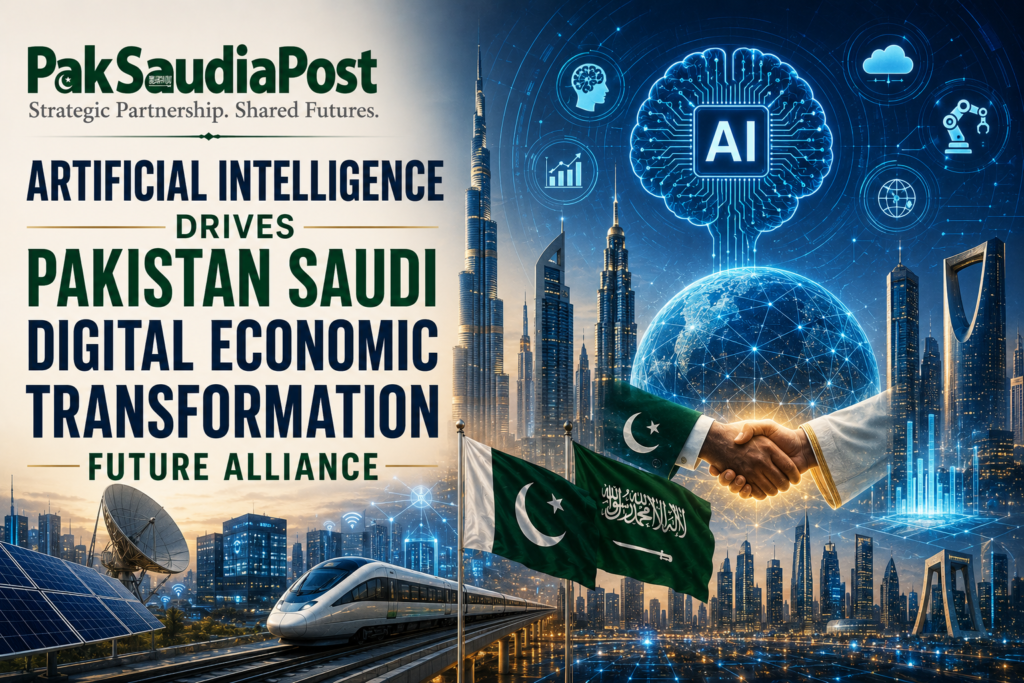
Artificial Intelligence Drives Pakistan Saudi Digital Economic Transformation Future Alliance

Artificial intelligence is no longer a distant technological abstraction reserved for advanced economies; it has become an operational grammar of state power, economic restructuring, and geopolitical reorientation. Across the Gulf region, and particularly within Saudi Arabia’s accelerating Vision 2030 framework, AI is being embedded into the very logic of governance, investment planning, and industrial diversification. What is unfolding is not merely digital modernization but a deeper epistemic transition in which data, algorithms, and predictive systems are becoming central instruments of statecraft. In this emerging landscape, Pakistan appears not as a peripheral observer but as a potentially significant, albeit structurally constrained, partner whose demographic dynamism, software talent pool, and expanding digital services sector could align with Saudi Arabia’s capital intensive technological ambitions.
The relationship between Pakistan and Saudi Arabia has historically been anchored in labor mobility, energy flows, religious affinity, and strategic security cooperation. Yet the current technological moment is reshaping the foundations of bilateral engagement. The shift from hydrocarbon dependency toward knowledge based economies in the Gulf is creating new demands for digital infrastructure, AI governance systems, cybersecurity frameworks, and smart city ecosystems. Saudi Arabia’s giga projects, including NEOM and associated urban innovation zones, are not merely infrastructural endeavors; they are experimental laboratories for algorithmic governance and AI mediated societal design. Within this paradigm, Pakistan’s tech ecosystem, though fragmented, offers a reservoir of engineering capacity, software outsourcing expertise, and a growing cadre of AI researchers and data scientists that could be integrated into Gulf driven digital value chains.
However, the asymmetry between the two economies remains pronounced. Saudi Arabia operates within a capital abundant, centrally coordinated transformation model, where sovereign wealth funds and state directed investment vehicles dictate technological priorities. Pakistan, by contrast, navigates fiscal constraints, intermittent policy continuity, and an innovation ecosystem that is often driven by private initiative rather than state orchestration. This structural divergence complicates direct technological convergence, yet it also creates space for complementary integration if properly architected through institutional mechanisms rather than ad hoc cooperation.
The global AI race has intensified this urgency. The United States and China continue to dominate foundational AI model development, semiconductor supply chains, and cloud infrastructure. Middle powers such as Saudi Arabia are increasingly aware that technological sovereignty in the twenty first century will depend on their ability to localize AI ecosystems, develop sovereign data centers, and cultivate domestic algorithmic capacity. Pakistan, while not a major AI power, possesses an expanding digital workforce and a cost competitive software industry that could be leveraged for downstream AI applications, localization of models, Arabic Urdu linguistic processing systems, and public sector digitalization initiatives.
Within Saudi Arabia’s Vision 2030 architecture, AI is already being deployed in predictive governance models for urban planning, energy optimization, and public service delivery. Machine learning algorithms are increasingly integrated into transportation systems, healthcare diagnostics, and financial compliance monitoring. The ambition is not simply efficiency but systemic reconfiguration of state functionality. Governance is gradually being reframed as a data driven enterprise, where decision making is informed by real time analytics rather than traditional bureaucratic processes. In this context, external partnerships are evaluated not only on economic grounds but on their compatibility with long term technological sovereignty objectives.
Pakistan’s digital economy, while still in an emergent phase, has demonstrated pockets of resilience. Freelance software exports, fintech experimentation, mobile banking penetration, and startup ecosystems in urban centers indicate a gradual but uneven digital transformation. Yet the absence of large scale AI infrastructure, limited investment in research and development, and weak integration between academia and industry continue to constrain its upward mobility in the global digital hierarchy. The challenge for Pakistan is not simply participation in the AI economy but avoidance of structural relegation to low value service provision within global digital supply chains.
A strategic convergence with Saudi Arabia could potentially alter this trajectory. Joint development of AI driven governance tools, smart city management systems, Islamic finance algorithmic compliance frameworks, and digital identity infrastructures could create a shared technological ecosystem that transcends traditional donor recipient paradigms. In such a configuration, Pakistan would contribute human capital, software engineering capabilities, and linguistic localization expertise, while Saudi Arabia would provide capital investment, infrastructure deployment capacity, and sovereign scale data environments.
Yet this optimistic scenario is not guaranteed. The political economy of technology transfer is inherently uneven. Without institutional safeguards, Pakistan risks becoming a subcontracted labor pool for Gulf digital megaprojects, with limited intellectual property ownership or long term technological upgrading. Conversely, Saudi Arabia risks overdependence on external technical labor without cultivating indigenous innovation capacity. The challenge, therefore, lies in designing a framework of co development rather than hierarchical outsourcing.
One of the most promising domains for collaboration lies in natural language processing and culturally contextualized AI systems. The global dominance of English centric AI models has created significant gaps in linguistic inclusivity, particularly for languages such as Urdu and Arabic in their diverse dialectical forms. Joint research initiatives could focus on developing bilingual AI systems capable of processing legal, financial, and administrative data across both linguistic environments. Such systems would not only enhance public service delivery but also embed cultural and ethical considerations into algorithmic decision making processes.
Another critical area is Islamic fintech and digital finance governance. Saudi Arabia’s advanced financial infrastructure and Pakistan’s rapidly expanding mobile banking ecosystem provide a fertile ground for experimentation in Sharia compliant AI driven financial systems. Algorithmic credit scoring, fraud detection, and compliance monitoring could be jointly developed to enhance financial inclusion while maintaining regulatory and religious coherence. This would position both countries at the forefront of ethical AI financial innovation in Muslim majority economies.
Cyber governance also emerges as a crucial intersection point. As both states deepen their digital integration, vulnerabilities to cyber intrusion, data manipulation, and algorithmic disruption increase proportionally. Collaborative development of AI enabled cybersecurity frameworks, real time threat intelligence sharing, and joint cyber defense protocols could serve as a stabilizing pillar for broader technological cooperation. In an era where cyber operations increasingly blur the lines between state and non state actors, resilience depends on anticipatory rather than reactive security architectures.
The broader geopolitical dimension cannot be ignored. The Gulf’s digital transformation is unfolding within a global environment marked by technological bifurcation, supply chain fragmentation, and strategic competition between major powers. Saudi Arabia’s efforts to maintain strategic autonomy require diversification of technological partnerships beyond traditional Western and East Asian providers. Pakistan, while not a technological superpower, offers geopolitical alignment, strategic trust, and demographic complementarity that can be leveraged within this diversification strategy.
For Pakistan, alignment with Saudi Arabia’s AI driven modernization agenda offers more than economic opportunity; it represents a potential pathway toward structural technological upgrading. However, this requires internal reform. Without investment in digital education, research ecosystems, data governance frameworks, and regulatory modernization, Pakistan will struggle to move beyond peripheral participation. Human capital alone is insufficient without institutional depth and policy coherence.
Policy makers in both countries must therefore rethink the architecture of bilateral cooperation. Traditional models of labor export, remittance dependence, and episodic investment flows are inadequate for the demands of the AI era. Instead, what is required is the construction of a structured Pakistan Saudi digital innovation corridor. This would include joint AI research institutes, sovereign cloud interoperability agreements, cross border startup incubation platforms, and coordinated regulatory frameworks for emerging technologies.
Furthermore, both states must confront the ethical and societal implications of AI deployment. Algorithmic governance raises fundamental questions about accountability, transparency, and human agency. Without robust ethical frameworks, AI systems risk reinforcing existing inequalities, embedding bias, and concentrating decision making power in opaque technological systems. Collaborative development of AI ethics guidelines grounded in both international standards and Islamic ethical philosophy could provide a distinctive normative framework for responsible innovation.
Education will play a decisive role in shaping this future. Universities in both countries must move beyond traditional curricula toward interdisciplinary programs integrating computer science, data analytics, public policy, and ethical philosophy. Exchange programs, joint research initiatives, and digital skill certification frameworks could help cultivate a transnational AI workforce capable of operating across both ecosystems.
Ultimately, the convergence of Pakistan and Saudi Arabia in the field of artificial intelligence is not predetermined. It is contingent upon strategic vision, institutional design, and political will. The global AI economy is rapidly consolidating around a small number of technological hubs, and late entrants face structural disadvantages. However, latecomers are not without agency. Through targeted cooperation, intelligent policy design, and sustained investment in human capital, Pakistan and Saudi Arabia can position themselves not as passive consumers of global technology but as active co architects of an emerging digital order.
The stakes are significant. Artificial intelligence will define not only economic competitiveness but also governance capacity, social stability, and geopolitical influence in the coming decades. For Pakistan and Saudi Arabia, the challenge is to ensure that their partnership evolves from historical affinity into technological co evolution. If successful, this alliance could represent a model of South West Asian digital integration, demonstrating that technological transformation need not be monopolized by traditional power centers but can emerge from strategically aligned regional cooperation grounded in shared aspirations for modernization, sovereignty, and sustainable development.
A Public Service Message