Smart Deserts Cities Saudi Model Pakistan Urban Lessons

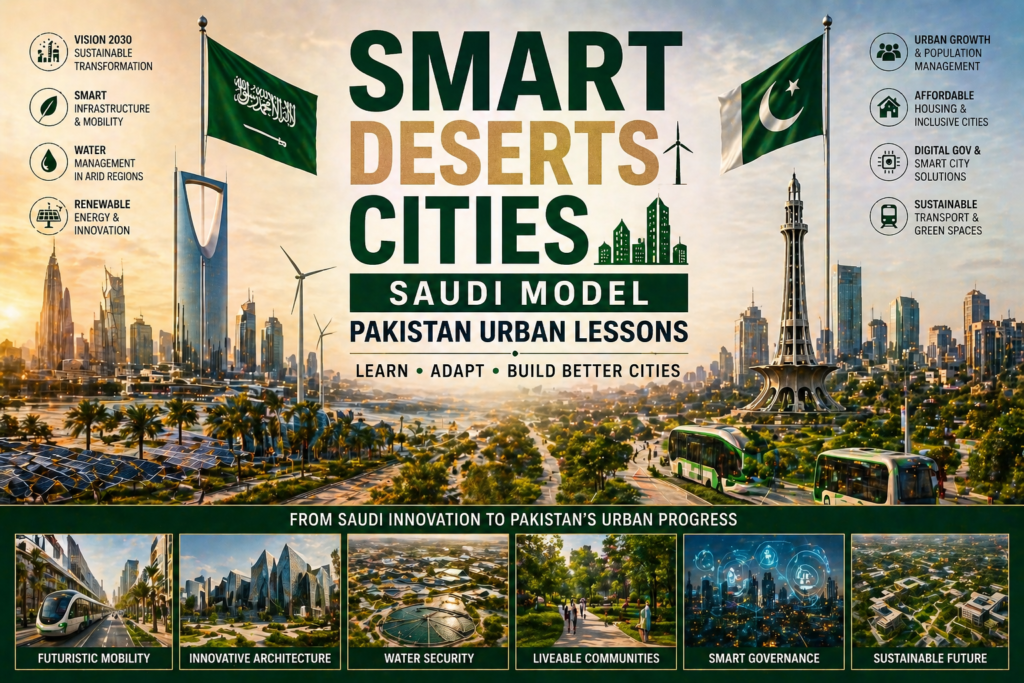
Urban transformation in the twenty first century is no longer a question of physical expansion alone but of informational density, algorithmic governance, and infrastructural intelligence. Cities are being reimagined as computational systems where mobility, energy, security, housing, and public services are increasingly mediated through data flows rather than administrative discretion. In this global shift, Saudi Arabia’s smart city agenda, particularly its flagship NEOM project and broader urban modernization initiatives, has become one of the most ambitious attempts to redesign urbanity as a digitally governed construct. For Pakistan, where urbanization is accelerating under conditions of infrastructural stress, governance fragmentation, and climate vulnerability, the Saudi experiment presents both an inspiration and a warning.
Saudi Arabia’s urban transformation is embedded in a broader state strategy of post oil reinvention. The city is no longer conceptualized as a static settlement but as a dynamic platform. In this vision, urban space is continuously optimized through artificial intelligence, predictive analytics, Internet of Things architectures, and centralized digital governance systems. The ambition is not merely to improve efficiency but to fundamentally restructure the relationship between citizen and state through data mediated governance.
NEOM, often described in global media as a futuristic mega city, represents this conceptual shift in its most radical form. It is not simply an urban development project but a redefinition of urban ontology. The city is designed as a fully integrated digital environment where energy systems, transportation networks, administrative services, and security mechanisms are synchronized through algorithmic coordination. While critics often focus on scale and feasibility, the deeper significance lies in its attempt to create a post traditional urban system governed by predictive intelligence rather than reactive administration.
Saudi Arabia’s smart city agenda extends beyond NEOM into broader national urban restructuring. Cities such as Riyadh and Jeddah are undergoing digital transformation in governance systems, traffic management, public service delivery, and infrastructure monitoring. Smart mobility systems, digital identity frameworks, and integrated municipal platforms are being introduced to streamline urban governance. The underlying principle is centralization of data and decentralization of execution, where decision making is informed by real time analytics but implemented through automated or semi automated systems.
In global media discourse, this transformation is often framed through contrasting narratives. One narrative emphasizes efficiency, modernization, and technological leapfrogging. Another raises concerns about surveillance, social control, and the erosion of civic autonomy. Both narratives are partially accurate but incomplete. The Saudi model is not simply about control or efficiency; it is about constructing a new form of state capacity where governance is embedded within digital infrastructure itself.
Pakistan’s urban trajectory stands in sharp contrast. Rapid urbanization in cities such as Karachi, Lahore, Faisalabad, and Islamabad is occurring without corresponding upgrades in governance systems. Municipal fragmentation, informal settlements, transport inefficiencies, water scarcity, and energy instability define the urban experience for large segments of the population. While there are emerging smart city initiatives in Pakistan, they remain largely project based rather than system based, often lacking integration across sectors.
The key analytical distinction lies in governance architecture. Saudi Arabia is moving toward integrated urban operating systems, whereas Pakistan continues to rely on fragmented administrative layers. This difference is not merely technological but institutional. Smart cities are not built by technology alone; they are built by governance coherence, regulatory clarity, and long term infrastructural planning.
The question of what Pakistan can learn from Saudi urban transformation must therefore be reframed. It is not about replicating NEOM or importing smart city templates. It is about understanding the underlying logic of computational governance and assessing its adaptability within Pakistan’s socio political and fiscal constraints.
One transferable lesson lies in centralized digital governance platforms. Saudi Arabia’s integration of municipal services into unified digital dashboards allows for real time monitoring of infrastructure, traffic, utilities, and public services. For Pakistan, where administrative fragmentation often leads to inefficiency and duplication, a unified digital governance layer could significantly improve urban management. However, implementation would require overcoming institutional resistance and inter agency coordination failures.
Another lesson is predictive urban management. Saudi smart city systems increasingly rely on predictive analytics to manage traffic flows, energy demand, and emergency response systems. Instead of reacting to crises, cities anticipate them. In Pakistan, urban management remains largely reactive, responding to crises such as flooding, traffic congestion, or power shortages after they occur. Introducing predictive systems would require investment in data infrastructure, sensor networks, and AI driven analytics capabilities.
A third lesson concerns infrastructure digitization. Saudi Arabia is embedding digital technologies directly into physical infrastructure, creating what can be described as cyber physical urban systems. Roads, buildings, energy grids, and transport systems are increasingly connected through IoT frameworks. Pakistan’s infrastructure, by contrast, remains largely analog, limiting the scope for real time optimization.
However, the transferability of these lessons is constrained by political economy realities. Saudi Arabia’s smart city agenda is financed through sovereign wealth, centralized governance, and long term strategic planning. Pakistan operates under fiscal constraints, decentralized governance structures, and short policy cycles. This creates a structural gap between aspiration and implementation capacity.
Media narratives surrounding smart cities in the region often oscillate between utopian and dystopian framings. On one hand, smart cities are presented as symbols of modernity, efficiency, and technological advancement. On the other hand, they are critiqued as instruments of surveillance, social control, and technocratic governance. In the Gulf context, these narratives are further complicated by geopolitical positioning, where smart city development is also a tool of global image construction and investment attraction.
In Pakistan, media discourse on urban transformation is shaped by different anxieties. These include concerns over affordability, displacement, informal economies, and governance inequality. The idea of a fully digitized urban environment often appears distant from the lived realities of large urban populations. This creates a perception gap between elite driven smart city narratives and everyday urban experience.
Climate change adds another layer of urgency. Both Saudi Arabia and Pakistan face increasing climate stress, including heatwaves, water scarcity, and environmental degradation. Smart city technologies offer potential tools for climate adaptation through energy optimization, water management, and environmental monitoring. However, technological solutions alone cannot address structural environmental vulnerabilities without broader ecological and policy reforms.
The emerging Pak Saudi urban dialogue, although still limited, reflects a broader shift toward knowledge exchange in governance technologies. Saudi expertise in large scale urban planning and digital infrastructure could potentially inform Pakistan’s urban reform agenda. Conversely, Pakistan’s experience with informal urban systems and adaptive resilience offers lessons in managing complexity under constraint.
The deeper question is whether smart cities represent a universal model or a context specific adaptation. The Saudi model is built on centralized authority, high capital availability, and top down planning. Pakistan’s urban reality is decentralized, resource constrained, and socially heterogeneous. Any attempt at transfer must therefore involve translation rather than transplantation.
In strategic terms, smart cities are becoming instruments of state transformation. They redefine how states perceive control, efficiency, and governance legitimacy. In Saudi Arabia, smart cities are part of a broader effort to reconfigure the state as a digital service provider. In Pakistan, the state remains largely infrastructural and administrative rather than computational.
The convergence between the two countries in urban technology discourse reflects a broader regional trend where digital governance is becoming a key dimension of state capacity. However, convergence does not imply uniformity. It implies selective adaptation shaped by local constraints and political priorities.
Ultimately, the lesson from Saudi urban transformation for Pakistan is not architectural but epistemological. It lies in understanding cities as data systems rather than static spaces, governance as continuous computation rather than episodic administration, and infrastructure as intelligent networks rather than passive structures.
Whether Pakistan can integrate these principles depends not only on technological adoption but on institutional reform, fiscal restructuring, and long term policy continuity. Without these foundations, smart city projects risk remaining symbolic rather than systemic.
In the evolving narrative of Pakistan Saudi cooperation, urban transformation may become a key site of experimentation. But its success will depend on moving beyond visibility driven mega projects toward invisible infrastructures of governance that reshape how cities function at their core.
A Public Service Message