Red Sea and Arabian Sea Maritime Security Convergence System

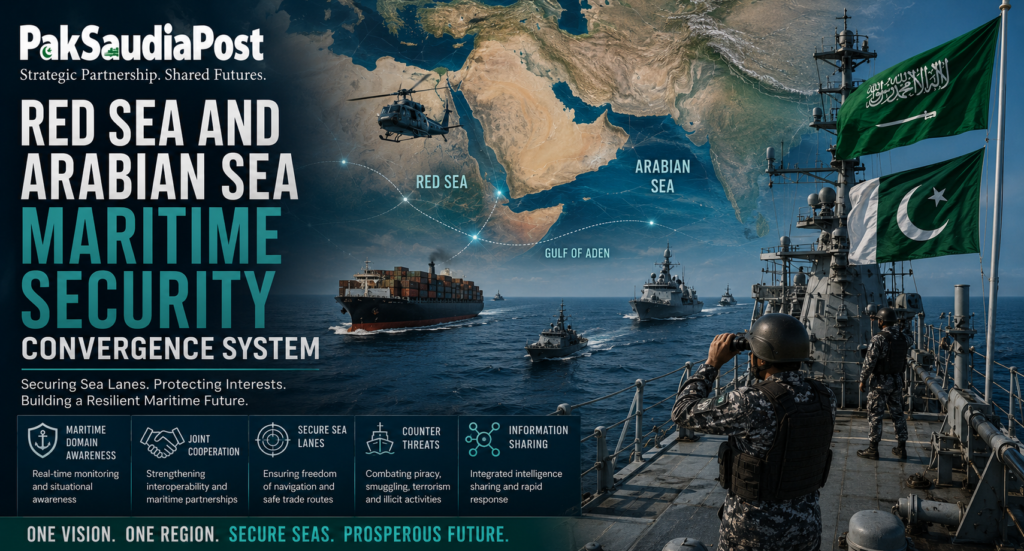
The maritime space linking the Red Sea and the Arabian Sea has entered a phase of operational complexity that is no longer adequately described through conventional naval terminology or legacy security doctrines. What was once treated as a set of discrete shipping lanes governed by coastal state jurisdiction and periodic naval patrols has now evolved into an integrated system of energy transport arteries, undersea digital infrastructure, insurance sensitive logistics routes, and high frequency commercial flows whose stability is increasingly shaped by nontraditional security variables. Within this environment, Pakistan and Saudi Arabia are positioned not merely as adjacent maritime stakeholders but as functional participants in a shared maritime ecosystem whose resilience is becoming central to both economic continuity and strategic confidence across multiple regions.
The emergence of this interconnected maritime theatre has been driven by a convergence of structural developments. Global energy distribution continues to rely heavily on Gulf exports routed through maritime chokepoints. At the same time, the expansion of containerised trade between Asia, Africa, and Europe has increased traffic density across waters that are simultaneously experiencing elevated security volatility. Incidents involving unmanned maritime systems, precision targeting of commercial vessels, and episodic disruptions linked to non-state actors have exposed vulnerabilities that extend beyond traditional naval deterrence models. In parallel, the proliferation of undersea fibre optic networks has introduced a new layer of strategic dependency, where digital continuity is tied directly to the physical integrity of maritime corridors.
For Pakistan, the western maritime frontier is no longer simply an extension of coastal defence responsibilities. It is directly linked to national economic stability through port operations, transit trade potential, and integration into broader logistical networks. The operational viability of ports such as Gwadar is influenced not only by local conditions but by the overall predictability of maritime flows extending into the Arabian Sea. For Saudi Arabia, maritime stability is inseparable from the uninterrupted export of hydrocarbons, the diversification of logistics under long term economic transformation frameworks, and the protection of offshore infrastructure. These parallel interests create a natural basis for convergence, but convergence in this context must be understood as systemic coordination rather than symbolic alignment.
The concept of a maritime security convergence system between Pakistan and Saudi Arabia therefore emerges as a response to a structural gap in current regional security arrangements. Existing mechanisms tend to operate either at the level of unilateral naval deployment or through ad hoc multinational initiatives that lack continuity of data integration and operational synchronisation. What is absent is a persistent architecture that allows for real time maritime awareness sharing, coordinated response planning, and integrated risk assessment across the Red Sea and Arabian Sea continuum. The establishment of such a system would not require the creation of a formal alliance structure but would instead depend on the development of interoperable platforms that connect surveillance, analysis, and response capabilities across both states.
At the operational level, maritime domain awareness represents the foundational layer of this convergence. The ability to maintain a coherent and continuously updated picture of vessel movement, anomaly detection, and environmental conditions is essential for anticipatory security management. Pakistan’s coastal monitoring infrastructure and Saudi Arabia’s investments in maritime surveillance technologies could be integrated into a shared analytical grid capable of processing satellite imagery, radar feeds, automatic identification system data, and port entry logs. This would allow both countries to identify deviations from normal shipping behaviour patterns with greater precision and reduced latency.
However, maritime domain awareness alone is insufficient without corresponding analytical depth. The increasing sophistication of maritime incidents requires interpretive frameworks capable of distinguishing between commercial irregularities, technical malfunctions, and deliberate hostile actions. A joint maritime analysis centre could be envisaged to process incoming data streams and generate calibrated risk assessments. Such a centre would require multidisciplinary expertise, combining naval intelligence officers, data scientists, maritime economists, and cyber security analysts. Its function would not be to replace national decision-making structures but to enhance the quality and speed of situational understanding.
The protection of undersea infrastructure introduces a particularly sensitive dimension to this emerging system. Fibre optic cables traversing the Red Sea and Arabian Sea carry a significant proportion of global digital communications, financial transactions, and governmental data exchange. These systems are inherently vulnerable due to their physical exposure on the seabed and the difficulty of continuous monitoring. A coordinated Pakistan Saudi framework for underwater infrastructure protection could involve joint mapping of cable routes, deployment of acoustic monitoring systems, and collaboration on detection technologies capable of identifying interference or physical disruption. This would also necessitate engagement with private sector operators who control significant portions of global subsea infrastructure.
Energy shipping security remains another central pillar of maritime convergence. The uninterrupted movement of crude oil, refined products, and liquefied natural gas through maritime routes is critical not only for producer states but also for global market stability. Even minor disruptions can generate disproportionate impacts on pricing mechanisms and insurance premiums. Within this context, Pakistan and Saudi Arabia share a vested interest in ensuring that energy transport routes remain predictable and resilient. Coordinated escort protocols, shared threat intelligence, and joint contingency planning for shipping disruptions could form part of a broader energy maritime security framework.
The evolving nature of maritime threats also requires reconsideration of response mechanisms. Traditional naval deterrence models are designed for identifiable state-based adversaries operating through conventional platforms. However, current maritime incidents increasingly involve non state actors using asymmetric tools such as unmanned surface vessels, remote targeting systems, and commercially disguised logistical platforms. These actors operate below thresholds that typically trigger formal military responses, creating a grey zone in which ambiguity becomes a strategic advantage. A convergence system between Pakistan and Saudi Arabia would need to incorporate rapid attribution capabilities and flexible response protocols designed for this ambiguous operational space.
Maritime logistics resilience is another dimension that warrants systematic attention. The efficiency of global supply chains is increasingly sensitive to disruptions in key maritime nodes. Port congestion, insurance fluctuations, and rerouting decisions can cascade across global markets within short timeframes. A coordinated Pakistan Saudi logistics resilience framework could focus on synchronising port operations, sharing predictive analytics on shipping flows, and developing contingency routing strategies for high-risk scenarios. This would enhance the ability of both countries to function as stabilising nodes within broader maritime trade systems.
Institutional design for such a convergence system would require careful calibration to ensure operational effectiveness without bureaucratic redundancy. A high-level maritime coordination council could be established to set strategic priorities and approve joint initiatives. Beneath this, specialised working groups could focus on surveillance integration, infrastructure protection, energy transport security, and logistics continuity. These structures would need to be supported by secure communication channels and data sharing protocols that maintain confidentiality while enabling operational transparency.
Technological investment will be a decisive factor in determining the viability of this system. Advanced satellite imaging, autonomous maritime surveillance platforms, machine learning based anomaly detection systems, and secure data fusion centres represent essential components of modern maritime security infrastructure. While both Pakistan and Saudi Arabia have made progress in certain areas, the integration of these technologies into a unified operational framework will require sustained investment and selective partnerships with external technology providers. The challenge will be to ensure that such partnerships enhance rather than compromise strategic autonomy.
Human capital development is equally critical. Maritime security in its contemporary form requires expertise that spans traditional naval operations, data analytics, cyber security, and logistics management. Joint training programmes between Pakistani and Saudi naval institutions could be expanded to include simulation-based exercises focused on multi domain maritime incidents. Academic collaboration with maritime research centres could further strengthen analytical capabilities and contribute to the development of indigenous expertise in maritime risk assessment.
Financial architecture for sustaining such a convergence system would need to be structured around long-term investment logic rather than short term operational budgeting. A joint maritime security fund could be established to support infrastructure development, technology acquisition, and training programmes. This fund would require transparent governance mechanisms to ensure accountability and efficient allocation of resources across priority areas.
From a strategic perspective, the significance of a Pakistan Saudi maritime convergence system extends beyond bilateral cooperation. It represents a potential model for managing complex maritime environments where traditional security frameworks are no longer sufficient to address multi layered risks. By developing interoperable systems that enhance situational awareness, improve response coordination, and strengthen infrastructure protection, both countries would contribute to broader regional maritime stability without formalising rigid alliance structures.
At the same time, the design of such a system must remain sensitive to external perceptions and geopolitical considerations. Maritime cooperation should be framed in functional terms rather than as part of broader alignment strategies. This ensures that operational effectiveness is not undermined by political misinterpretation. The emphasis should remain on practical problem solving, risk mitigation, and infrastructure resilience rather than symbolic positioning.
Implementation challenges will inevitably arise from institutional inertia, resource constraints, and differing operational cultures. Overcoming these challenges will require sustained political commitment at the highest levels, coupled with incremental implementation strategies that allow for gradual integration of systems and procedures. Early success in specific areas such as maritime surveillance integration or joint training exercises could build momentum for more complex forms of cooperation.
Ultimately, the Red Sea and Arabian Sea maritime environment is entering a phase where stability can no longer be assumed as a default condition. It must be actively constructed through coordinated systems that integrate technology, intelligence, and operational capability. A Pakistan Saudi Arabia maritime convergence system offers one pathway toward such construction. Its effectiveness will depend not on the scale of its ambition but on the precision of its design and the consistency of its implementation across time.
A Public Service Message