Muslim World Leadership Contestation Pakistan Saudi Strategic Recalibration Today

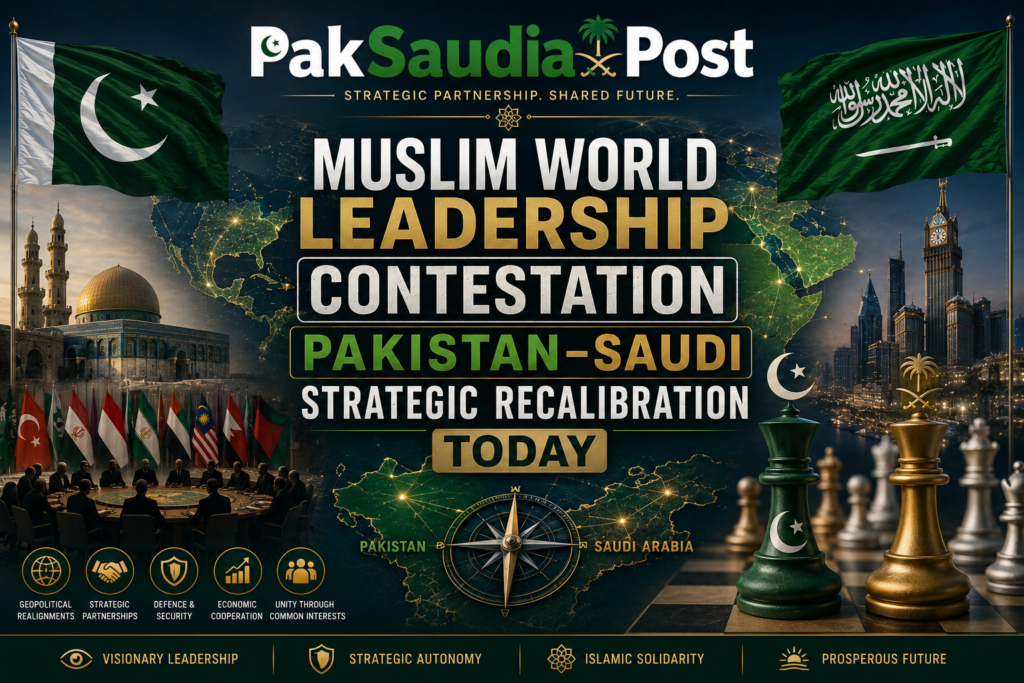
The question of leadership within the Muslim world has long been less a matter of formal designation and more an evolving contest of symbolic capital, strategic utility, and narrative authority. In the contemporary geopolitical moment, this contest has become more fragmented, more competitive, and more structurally diffuse than at any point since the post-colonial ordering of Muslim majority states. Pakistan and Saudi Arabia, once comfortably positioned within a relatively intelligible architecture of Islamic solidarity politics, now find themselves navigating an increasingly pluralized arena where authority is no longer conferred through singular custodianship, but through competing performances of relevance, resilience, and reinvention.
Saudi Arabia’s historical claim to symbolic leadership has been rooted in its custodianship of Islam’s two holiest sites, a position that conferred an almost metaphysical legitimacy in the collective imagination of the Muslim world. Yet the contemporary recalibration of the Kingdom under its ongoing transformation agenda has complicated this inherited authority. Economic diversification, social liberalisation, and strategic reorientation have repositioned Riyadh as a state seeking global centrality rather than solely Islamic representational primacy. This transition has not diminished its religious capital, but it has reframed the terms under which that capital is deployed. The custodial role is now embedded within a broader ambition of becoming a global investment hub, a technological adopter, and a diplomatic balancer across rival blocs.
Pakistan, by contrast, occupies a distinct register of symbolic authority. Its claim to leadership has never rested on geography or sacred custodianship, but rather on ideological resonance, demographic weight, and a historically cultivated narrative of Islamic solidarity. The Pakistani state emerged with a self perception of being a laboratory of Muslim modernity, a post colonial experiment in reconciling religious identity with modern statehood. Over time, this identity has been refracted through military capability, nuclear deterrence, and its role as a mediator in intra Muslim political dynamics. Yet Pakistan’s symbolic capital has been constrained by persistent economic fragility, political discontinuity, and dependence on external financial stabilization mechanisms, which limit its ability to translate narrative authority into structural leadership.
The Muslim world today, however, no longer conforms to a binary axis of leadership anchored in Riyadh and Islamabad. Turkey has asserted a form of civilisational revivalism rooted in Ottoman memory, projecting influence through assertive diplomacy, media ecosystems, and selective military interventions. Iran has constructed an alternative axis of resistance based on revolutionary ideology and asymmetric regional engagement. Gulf states beyond Saudi Arabia, particularly the United Arab Emirates and Qatar, have developed distinct micro diplomacies, leveraging finance, mediation, and media influence to carve independent diplomatic identities. This proliferation of actors has dissolved the coherence of a unified pan Islamic leadership structure, replacing it with a fragmented constellation of competing centres of gravity.
In this environment, the idea of Muslim world leadership becomes less a fixed hierarchy and more a fluid negotiation of legitimacy across overlapping domains. Religious legitimacy, economic power, military capability, and narrative influence no longer converge in a single actor. Instead, they are distributed unevenly across multiple states, each claiming partial authority in different registers. Saudi Arabia retains religious centrality, Turkey amplifies cultural assertiveness, Iran wields ideological resistance, and Pakistan embodies demographic and strategic symbolism. Yet none can singularly aggregate these dimensions into comprehensive leadership.
The interaction between Pakistan and Saudi Arabia must therefore be understood as a strategic partnership operating within this fragmented ecology rather than a hierarchical patron client relationship. Historically, Saudi financial support and Pakistani manpower and military cooperation created a complementary model of interaction. This arrangement was underpinned by shared Islamic identity narratives and converging security concerns during the Cold War and its aftermath. However, the contemporary landscape has introduced new variables that complicate this symmetry.
Saudi Arabia’s increasing engagement with global capital markets, its recalibration of security partnerships beyond traditional alliances, and its cautious diplomatic balancing with regional rivals have reduced the exclusivity of its reliance on ideologically framed partnerships. Pakistan, meanwhile, has diversified its diplomatic engagements, deepened its strategic relationship with China, and sought to balance relations across competing Middle Eastern blocs. This mutual diversification has produced a more transactional and less ideologically saturated relationship, even as rhetorical references to Islamic brotherhood continue to function as stabilising narrative instruments.
The fragmentation of pan Islamic political consensus is perhaps the most defining feature of the current era. In earlier decades, events in one part of the Muslim world could generate relatively coherent responses across state and non state actors, often mediated through organisations such as the Organisation of Islamic Cooperation. Today, responses are more heterogeneous, filtered through national interest calculations, domestic political pressures, and external alliance structures. The result is a decoupling of sentiment from policy, where rhetorical solidarity does not necessarily translate into coordinated action.
Within this context, Pakistan and Saudi Arabia are engaged in a delicate recalibration of their symbolic roles. Saudi Arabia seeks to modernise its leadership image by projecting itself as a global rather than exclusively Islamic actor, thereby expanding its diplomatic flexibility. Pakistan seeks to preserve its relevance within the Muslim world by leveraging its historical identity while simultaneously adapting to new economic and geopolitical constraints. Both states are thus engaged in what can be described as adaptive symbolic repositioning.
The Turkish and Iranian dimensions further complicate this recalibration. Turkey’s assertive foreign policy underpinned by cultural production, media influence, and selective military engagement challenges the notion that religious custodianship alone confers leadership legitimacy. Iran’s sustained projection of resistance ideology offers an alternative model of leadership grounded in opposition to Western influence and regional status quo arrangements. These competing narratives erode the possibility of a singular Muslim world leader and instead institutionalise a competitive pluralism.
In this environment, leadership becomes performative rather than positional. It is measured not by formal recognition but by the ability to shape agendas, influence discourse, and mobilise selective coalitions. Saudi Arabia’s ability to convene investment forums, mediate regional de-escalations, and reframe global energy diplomacy contributes to its leadership performance. Pakistan’s participation in strategic dialogues, its nuclear deterrence capability, and its demographic significance contribute to its own form of performative relevance. Yet neither translates into comprehensive authority over the Muslim world’s collective direction.
A further dimension of this evolving landscape is the increasing role of external powers in shaping intra Muslim world dynamics. The United States, China, and Russia each interact with Muslim majority states in ways that indirectly structure the possibilities of leadership contestation. China’s growing economic footprint, particularly through infrastructure financing and energy partnerships, introduces a new axis of influence that is not ideologically driven but materially embedded. This further dilutes the possibility of a unified Muslim leadership framework, as external dependencies diversify and multiply.
The implications for Pakistan Saudi relations are profound. Their bilateral relationship is no longer solely a function of shared identity but is increasingly mediated through broader geopolitical architectures. Energy security, labour markets, investment flows, and regional stability considerations now define the contours of engagement. Islamic solidarity remains an important rhetorical and psychological anchor, but it is no longer the primary determinant of policy alignment.
Policy makers in both states must therefore operate within a conceptual shift from hierarchical leadership aspirations to networked influence management. For Pakistan, this requires a strategic transition from identity-based diplomacy to capability-based diplomacy, where economic reform, technological upgrading, and institutional stability enhance its credibility within the Muslim world. For Saudi Arabia, it necessitates balancing global integration with regional responsibility, ensuring that its leadership ambitions are not perceived as detached from broader Muslim world concerns.
The future of Muslim world leadership is likely to remain contested, distributed, and episodically reconfigured. Periodic crises will continue to generate temporary alignments, but these will not crystallise into permanent hierarchies. Instead, leadership will resemble a shifting mosaic of issue specific coalitions, where different states assume prominence in different domains. Energy governance may be led by Gulf states, ideological narratives shaped by Iran and Turkey, and strategic deterrence anchored in South Asian capabilities.
In such a system, Pakistan and Saudi Arabia must redefine their relationship not as a pursuit of joint leadership of the Muslim world, but as a partnership in managing fragmentation. Their cooperation can contribute to stabilising certain regional dynamics, particularly in economic and security domains, but it cannot restore a unified leadership structure that no longer exists.
The intellectual challenge for policy makers is to abandon inherited assumptions of singular Islamic leadership and instead embrace a more complex understanding of distributed authority. This requires a shift in diplomatic imagination, away from symbolic hierarchies and toward functional interdependence. It also demands a recognition that legitimacy in the contemporary Muslim world is no longer monopolised, but continuously negotiated across multiple overlapping arenas.
Ultimately, the contest for Muslim world leadership is not a competition with a final victor, but an ongoing process of adaptation within a fragmented system. Pakistan and Saudi Arabia remain central actors within this system, but their roles are now defined less by claims of leadership and more by their capacity to navigate complexity, manage expectations, and sustain relevance in an increasingly polycentric geopolitical order.
A Public Service Message