Climate Stress Drives Pakistan Saudi Food Security Alignment Today

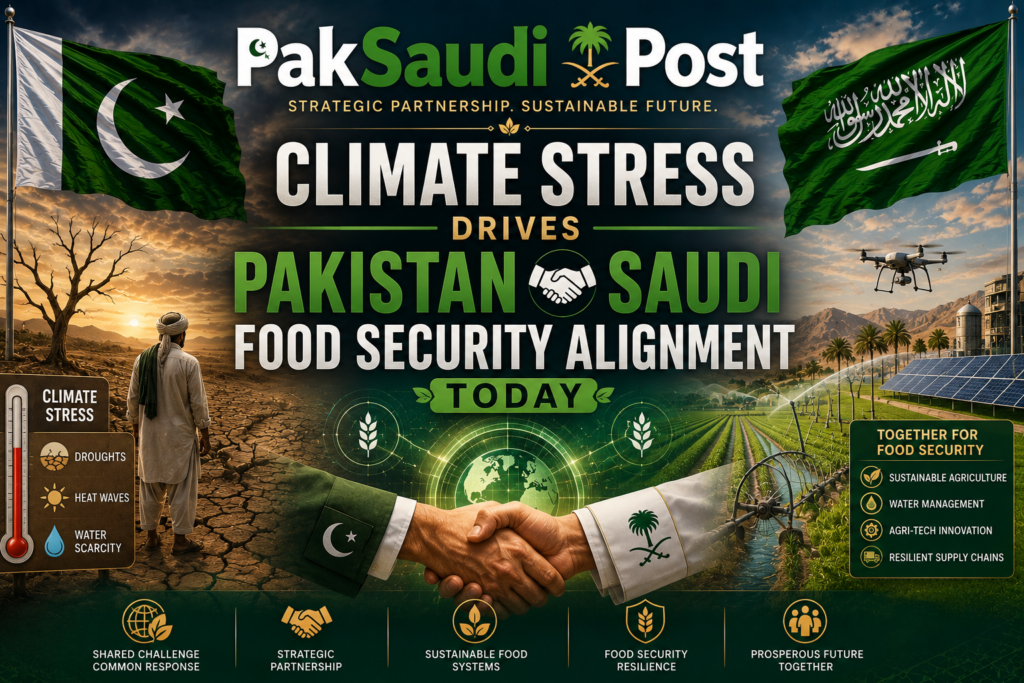
The accelerating convergence of climate instability, water scarcity, agricultural fragility, and global food market volatility is quietly but decisively reshaping the strategic calculus of Pakistan–Saudi relations. What was once a peripheral area of cooperation limited to episodic trade in agricultural commodities is now emerging as a central pillar of geo economic engagement. Food security, once treated as a domestic policy concern, is increasingly being reframed as a matter of national survival and geopolitical strategy. In this context, Pakistan and Saudi Arabia are gradually moving toward a new form of agro economic alignment shaped by climate pressures rather than conventional trade logic.
Saudi Arabia’s growing urgency around food security is rooted in structural ecological constraints that cannot be resolved through domestic production alone. The Kingdom’s arid geography, limited freshwater resources, and dependence on desalination technologies create a permanent structural vulnerability in its food supply system. As global supply chains become increasingly unstable due to geopolitical fragmentation, climate shocks, and logistical disruptions, Riyadh is compelled to diversify its food sourcing strategies and invest in external agricultural ecosystems. This shift is not temporary; it reflects a long term recalibration of how the Saudi state conceptualizes food as a strategic asset.
Pakistan occupies a paradoxical position within this emerging framework. On one hand, it is itself one of the most climate vulnerable countries in the world, facing increasingly severe floods, heatwaves, water stress, and agricultural productivity fluctuations. On the other hand, it remains a significant agricultural producer with large arable land resources, diverse climatic zones, and a substantial rural labor force. This duality makes Pakistan both a risk exposed system and a potential food production partner for climate stressed import dependent economies such as Saudi Arabia.
The emerging narrative within strategic policy circles increasingly frames food security not merely as an economic issue but as a dimension of geopolitical resilience. In this framing, agricultural systems are no longer viewed as isolated domestic sectors but as interconnected nodes within global security architectures. For Saudi Arabia, securing stable food supply chains is directly linked to internal social stability, economic diversification, and long term strategic autonomy. For Pakistan, strengthening agricultural output and export capacity is tied to macroeconomic stability, foreign exchange generation, and climate adaptation resilience.
This convergence is driving a gradual reorientation of Pakistan–Saudi economic engagement toward agro strategic cooperation. The idea is no longer limited to commodity trade but extends into agricultural investment, land use partnerships, food processing infrastructure, logistics corridors, and climate adaptive farming technologies. Saudi capital, increasingly deployed through sovereign wealth mechanisms, is exploring opportunities in overseas agriculture as part of its broader food security diversification strategy. Pakistan, facing chronic fiscal constraints and climate induced agricultural volatility, presents both opportunity and vulnerability within this equation.
However, the relationship cannot be reduced to simplistic notions of land acquisition or resource extraction. Contemporary agro economic cooperation is increasingly structured around integrated value chains rather than raw commodity flows. This includes investment in cold storage systems, irrigation modernization, seed technology, agro logistics networks, and export oriented food processing industries. If properly structured, such cooperation could enhance productivity, reduce post harvest losses, and improve supply chain efficiency across both domestic and export markets.
Water scarcity is emerging as the most critical binding constraint within this evolving relationship. Both Pakistan and Saudi Arabia face severe water stress, albeit through different environmental mechanisms. In Pakistan, water insecurity is driven by glacial melt variability, monsoon unpredictability, inefficient irrigation systems, and inter provincial distribution challenges. In Saudi Arabia, water scarcity is structural and largely dependent on energy intensive desalination processes. This shared vulnerability creates a strategic incentive for joint research and technological collaboration in water efficient agriculture, drought resistant crop development, and advanced irrigation systems.
Climate change is also altering traditional agricultural calendars and productivity cycles in Pakistan. Rising temperatures, erratic rainfall patterns, and increased frequency of extreme weather events are disrupting staple crop yields and threatening long term food stability. These pressures are forcing a shift toward climate adaptive agriculture, precision farming techniques, and digital agricultural monitoring systems. Saudi Arabia’s investment capacity and technological ambition could potentially support this transition if aligned with Pakistan’s domestic agricultural reform agenda.
At the same time, global food markets are becoming increasingly volatile due to geopolitical tensions, export restrictions, and supply chain fragmentation. Events such as pandemics, regional conflicts, and energy crises have demonstrated how quickly food systems can become politically weaponized. In this environment, states are prioritizing food sovereignty and supply chain diversification over purely cost driven import strategies. Saudi Arabia’s overseas agricultural investments must therefore be understood as part of a broader strategy to secure stable and politically resilient food supply chains.
Pakistan’s strategic value in this context extends beyond production capacity to include geographic proximity and logistical connectivity. The Arabian Sea provides a direct maritime corridor linking Pakistani agricultural output to Gulf consumption markets. Ports, shipping infrastructure, and cold chain logistics thus become critical components of agro strategic cooperation. The development of integrated food corridors between Pakistan and Saudi Arabia could significantly reduce transport costs and enhance supply chain reliability.
Yet significant structural challenges remain. Pakistan’s agricultural sector suffers from low productivity, outdated farming practices, inefficient water usage, fragmented landholding patterns, and weak value chain integration. Without substantial structural reform, the potential benefits of Saudi investment risk being constrained by domestic inefficiencies. Similarly, concerns over governance, regulatory stability, and institutional coordination remain key considerations for external investors.
Saudi Arabia also faces reputational and operational sensitivities in overseas agricultural investments. Global debates surrounding land use, food sovereignty, and environmental sustainability have placed greater scrutiny on foreign agricultural acquisitions. As a result, Riyadh is increasingly favoring partnership models that emphasize joint ventures, technology transfer, and shared production systems rather than direct land control. This shift aligns more closely with Pakistan’s preference for sovereignty sensitive investment frameworks.
The role of technology is becoming central to this emerging agro economic architecture. Precision agriculture, satellite based crop monitoring, artificial intelligence driven irrigation systems, and climate predictive analytics are transforming how agricultural systems are managed. Saudi Arabia’s investment in agricultural technology and Pakistan’s large scale farming base create conditions for potential technological diffusion and capacity building. However, realizing this potential requires institutional coordination and sustained investment in human capital development.
Another emerging dimension is the rise of halal food supply chains as a global economic category. Saudi Arabia, as a central authority in Islamic economic frameworks, is increasingly engaged in standard setting for halal certification and food quality assurance. Pakistan, with its large agricultural base, could become a significant supplier within global halal food markets if it aligns its production systems with international certification standards. This would not only enhance export revenues but also integrate Pakistan more deeply into global food value chains.
Media narratives surrounding food security cooperation are also evolving. Increasingly, climate change is being framed not as an environmental issue alone but as a geopolitical catalyst reshaping regional alliances and economic dependencies. Within this narrative, Pakistan–Saudi agricultural cooperation is being positioned as part of a broader adaptation strategy to global ecological instability. This framing enhances the strategic legitimacy of agro economic partnerships and elevates them within policy discourse.
Despite these opportunities, risks remain significant. Large scale agricultural investments without adequate safeguards can generate social tensions, environmental degradation, and inequitable resource distribution. Pakistan must therefore ensure that any external investment in agriculture is aligned with domestic food security priorities, local farmer interests, and sustainable environmental practices. Similarly, Saudi Arabia must ensure that its external food security strategies are not exposed to excessive geopolitical or climate related vulnerabilities.
Policy makers in both countries must therefore adopt a more integrated approach to food security cooperation. This includes the establishment of joint climate agricultural research institutions, shared water management frameworks, coordinated food reserve strategies, and integrated agro logistics planning. Agricultural cooperation must be elevated from a trade issue to a strategic pillar of bilateral relations.
Ultimately, the rise of food security as a central axis of Pakistan–Saudi cooperation reflects a broader transformation in global geopolitics. Climate change is no longer a distant environmental concern but a present structural force reshaping economic systems, political priorities, and international alliances. In this emerging context, agriculture is becoming a domain of strategic importance comparable to energy and finance.
Pakistan and Saudi Arabia now face a critical opportunity to redefine their relationship through the lens of climate resilience and food security. If managed effectively, agro economic cooperation could evolve into a long term strategic partnership that enhances stability, strengthens economic resilience, and contributes to regional food system sustainability. If neglected, however, it risks becoming another missed opportunity in a rapidly transforming global order where climate and food systems are becoming central determinants of geopolitical power.
A Public Service Message