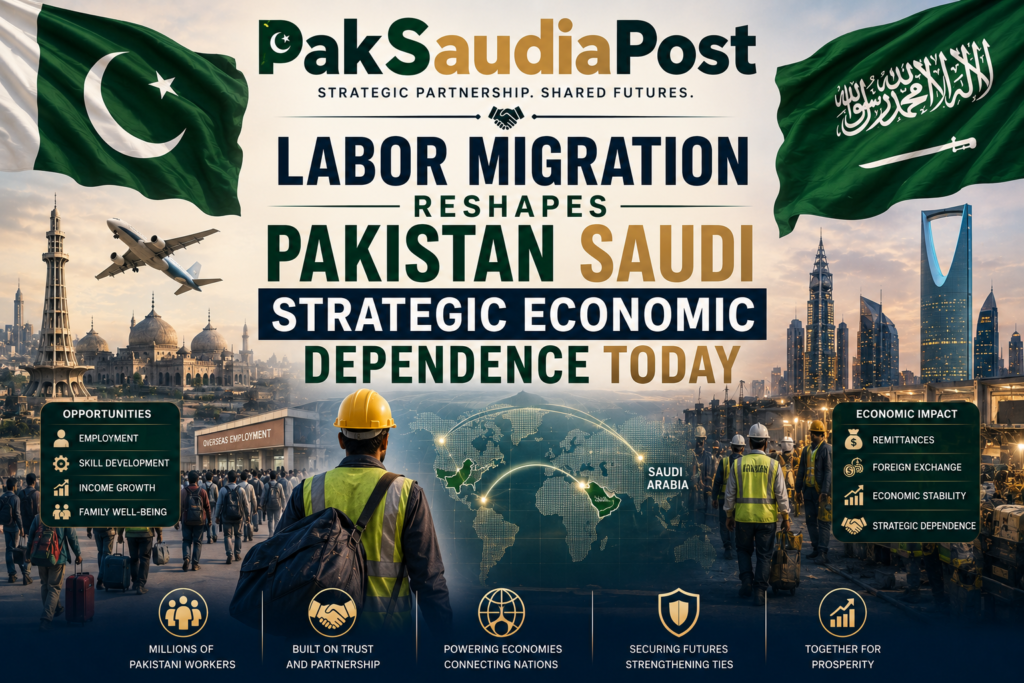
Labor Migration Reshapes Pakistan Saudi Strategic Economic Dependence Today

The movement of Pakistani labor into Saudi Arabia has long been treated as a peripheral element of bilateral relations, a social spillover of economic necessity rather than a core instrument of statecraft. Yet this interpretation increasingly appears outdated. What is unfolding instead is the gradual transformation of labor migration into a structured geopolitical mechanism through which remittance flows, demographic interdependence, labor market engineering, and diplomatic leverage converge into a single integrated system of influence. In this evolving architecture, the Pakistani workforce in the Kingdom is no longer simply an expatriate population; it is becoming a living infrastructure of economic interdependence that binds two states in ways that conventional diplomacy cannot easily disentangle.
At the heart of this transformation lies the scale and stability of remittance flows. Pakistan’s macroeconomic resilience has, for decades, depended disproportionately on inflows from Gulf labor markets, with Saudi Arabia occupying a central position within this external lifeline. These remittances function not merely as household income transfers but as systemic stabilizers of Pakistan’s foreign exchange reserves, current account balance, and consumption cycles. In moments of economic stress, political uncertainty, or external financing gaps, remittance inflows from Saudi Arabia act as an informal but decisive shock absorption mechanism. This structural dependence elevates labor migration from a socioeconomic variable into a macro strategic asset embedded within national economic security.
However, the geopolitical significance of this system extends beyond Pakistan’s dependency. Saudi Arabia’s labor market architecture is itself undergoing profound transformation under the broader modernization agenda associated with Vision 2030. The Kingdom is attempting to recalibrate its workforce composition through nationalization policies, skill upgrading initiatives, and automation driven industrial restructuring. Yet despite these efforts, the reality of large scale infrastructure development, urban expansion, tourism sector growth, and logistics modernization ensures continued reliance on foreign labor, particularly in semi skilled and service oriented sectors. Pakistani workers, due to linguistic adaptability, cultural proximity, and established migration networks, remain deeply embedded within this transitional labor ecosystem.
This mutual dependency creates a subtle but powerful form of demographic interlocking. Unlike traditional geopolitical alliances anchored in military treaties or trade agreements, labor migration generates a dispersed and socially embedded form of interdependence that is more resilient to political shocks yet more sensitive to regulatory shifts. Visa policies, labor quotas, and employment regulations become instruments of indirect diplomatic influence, capable of affecting domestic economic conditions thousands of kilometers away. In this sense, labor migration functions as a quiet but persistent channel of geopolitical signaling between Islamabad and Riyadh.
The remittance economy itself has evolved into a parallel financial system with strategic implications. It operates across formal banking channels, informal transfer networks, and increasingly digital platforms that connect migrant workers to domestic financial ecosystems in real time. This financial circulation not only supports household consumption but also stabilizes Pakistan’s external account vulnerabilities in ways that reduce immediate pressure on sovereign borrowing. Consequently, labor migration becomes embedded within macroeconomic governance, influencing fiscal planning, currency stability, and external debt management.
Yet this dependence also introduces structural asymmetry. Saudi Arabia retains the capacity to modulate labor inflows through administrative adjustments, regulatory tightening, or workforce localization policies. Even subtle changes in visa issuance or employment conditions can generate significant ripple effects within Pakistan’s domestic economy. This creates an implicit hierarchy of influence that is not formally acknowledged in diplomatic discourse but is nevertheless operational in practice. Pakistan’s economic exposure to Gulf labor markets therefore translates into a form of soft structural leverage for Saudi policy makers.
At the same time, the Pakistani state is not a passive actor in this relationship. It actively manages labor export flows through bilateral agreements, recruitment frameworks, and diaspora engagement policies. Labor migration is increasingly recognized within Islamabad’s policy circles not only as a source of foreign exchange but also as a strategic export sector requiring institutional coordination. However, the governance architecture supporting this sector remains fragmented, often characterized by weak regulation, intermediated recruitment systems, and insufficient skill development alignment with Gulf labor market demands.
A critical structural shift underway is the gradual transition from low skilled labor export toward demand for more technically trained and semi professional workers. Saudi Arabia’s economic diversification strategy is increasingly oriented toward sectors such as construction technology, renewable energy infrastructure, logistics management, healthcare services, and digital systems. This shift implies that future labor demand will prioritize skills rather than sheer numerical labor supply. For Pakistan, this represents both a challenge and an opportunity. Without significant investment in vocational training, technical education, and certification systems aligned with Gulf standards, Pakistan risks gradual erosion of its competitive advantage in labor export markets.
Conversely, if managed effectively, this transition could reposition Pakistani labor not as expendable manpower but as skilled human capital embedded within high value sectors of the Saudi economy. Such a shift would fundamentally alter the nature of remittance flows, potentially increasing per capita earnings, improving worker protections, and strengthening long term bilateral economic integration. However, achieving this outcome requires deep structural reforms in Pakistan’s education and training systems, alongside bilateral coordination on labor certification standards.
Beyond economics, labor migration also carries important sociopolitical dimensions. The Pakistani diaspora in Saudi Arabia functions as a transnational social bridge reinforcing cultural, religious, and interpersonal linkages between the two societies. This sociocultural connectivity plays an understated but significant role in stabilizing bilateral relations during periods of political tension or regional uncertainty. The presence of millions of Pakistani workers embedded within Saudi society creates a dense network of informal interactions that sustain mutual familiarity and reduce the likelihood of abrupt diplomatic rupture.
However, this social embeddedness is not without tensions. Labor rights issues, wage disparities, working conditions, and regulatory constraints periodically generate friction within the migrant labor system. These issues, while often managed quietly through diplomatic channels, reflect the inherent asymmetry of labor mobility regimes in the Gulf region. As global scrutiny of migrant labor practices intensifies, Saudi Arabia faces increasing pressure to align its labor governance frameworks with evolving international standards. Pakistan, as a major labor exporting country, has a strategic interest in advocating improved protections while maintaining access to employment opportunities.
The emergence of digital financial technologies is also transforming the structure of remittance economies. Mobile banking, fintech platforms, and cross border payment systems are reducing transaction costs and increasing financial transparency within migrant remittance flows. This digitization has geopolitical implications, as it enhances state visibility over financial movements while simultaneously integrating diaspora populations more closely into formal economic systems. Saudi Pakistani cooperation in digital finance could significantly enhance efficiency while also deepening institutional interdependence between the two states.
Another emerging dimension involves the politicization of labor mobility within broader geopolitical negotiations. Labor agreements are increasingly being linked, implicitly or explicitly, to wider strategic considerations including energy cooperation, investment flows, and infrastructure partnerships. This bundling of labor with other economic domains reflects the growing complexity of Pakistan Saudi relations, where multiple domains of interaction are no longer compartmentalized but interconnected within a broader geo economic framework.
From a policy standpoint, Pakistan faces an urgent need to elevate labor migration from a reactive administrative function to a proactive strategic sector. This requires institutional reforms including the establishment of dedicated migration diplomacy units, enhanced skill certification frameworks, stronger diaspora engagement policies, and integration of labor export strategy within national economic planning. Labor migration cannot remain a peripheral issue managed through fragmented bureaucratic channels; it must become a central pillar of economic diplomacy.
Saudi Arabia, on its part, must reconcile its modernization agenda with the realities of continued labor dependence. While localization policies and automation will gradually reshape labor demand, the transition will be gradual rather than abrupt. Managing this transition requires calibrated policies that balance national employment objectives with the practical requirements of large scale economic transformation projects.
Ultimately, labor migration between Pakistan and Saudi Arabia represents far more than a flow of workers across borders. It constitutes a deeply embedded geopolitical system linking two states through economic necessity, demographic exchange, financial interdependence, and sociocultural connectivity. In an era where traditional instruments of diplomacy are increasingly supplemented by economic interdependence mechanisms, labor migration stands out as one of the most resilient and strategically significant forms of bilateral linkage.
The future of Pakistan Saudi relations will therefore depend not only on energy investments or industrial cooperation but also on how effectively both states manage, regulate, and transform their shared labor ecosystem. If restructured through skill development, institutional reform, and digital integration, labor migration could evolve from a dependency driven arrangement into a sophisticated partnership in human capital exchange. If neglected, however, it risks reinforcing structural asymmetries and economic vulnerabilities. In either case, labor migration will remain central to the evolving geopolitical economy of Pakistan and Saudi Arabia, shaping not only their bilateral relationship but also their respective positions within the wider architecture of the global labor order.
A Public Service Message