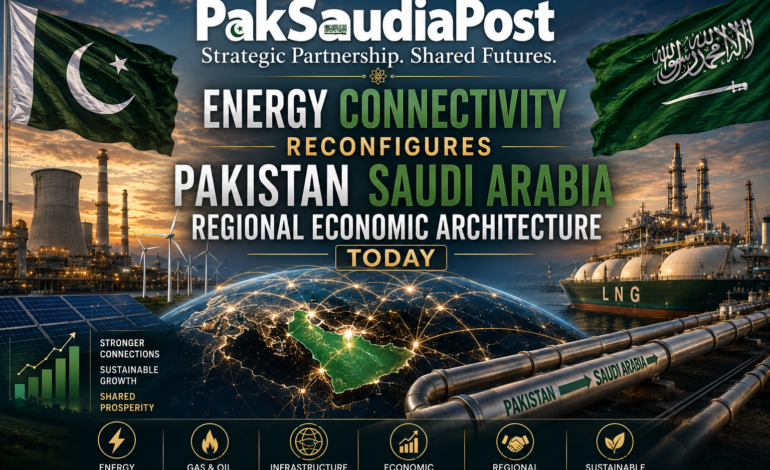
Energy Connectivity Reconfigures Pakistan Saudi Arabia Regional Economic Architecture Today

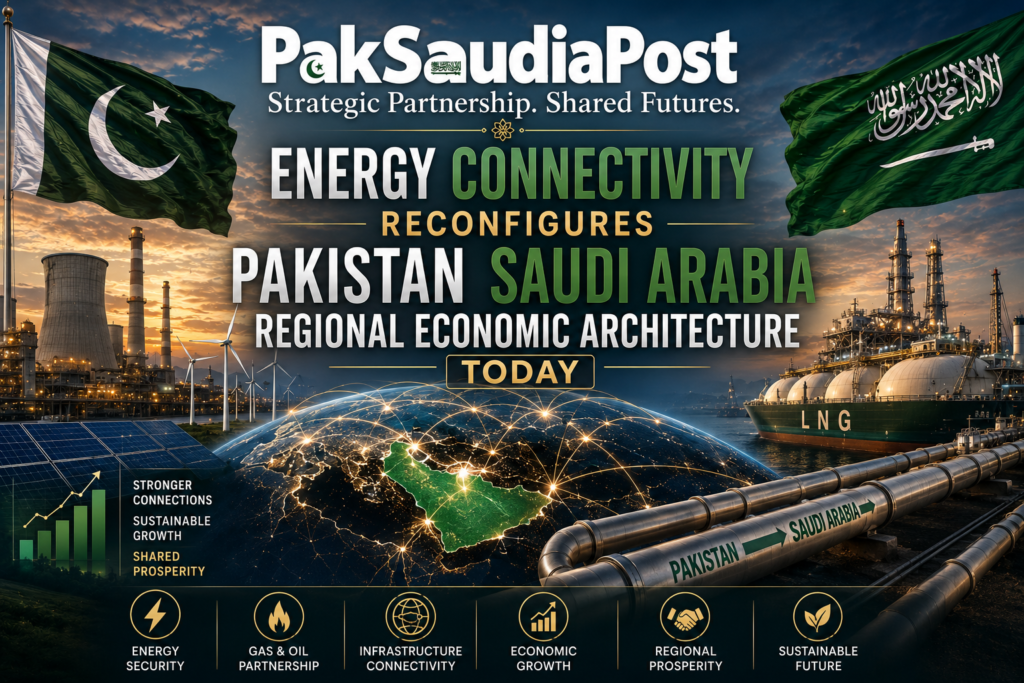
relationship between Pakistan and Saudi Arabia is increasingly being redefined through a prism that extends far beyond traditional diplomacy, religious affinity, or episodic financial assistance. It is now being reconstituted within a deeper structural logic of energy connectivity, investment interdependence, and regional corridor politics that links South Asia to the Gulf in ways that were previously fragmented, transactional, and strategically underdeveloped. What is emerging is not merely a bilateral relationship but a tentative geo economic architecture in which energy flows, refinery investments, renewable transitions, logistics corridors, and sovereign capital alignments converge to reshape the broader political economy of the Arabian Sea basin.
At the core of this transformation lies a recognition in both Islamabad and Riyadh that the classical hydrocarbon centered model of engagement is reaching its structural limits. Saudi Arabia’s internal economic reconfiguration under its long term diversification agenda associated with Vision 2030 has compelled it to rethink the geography of its external investments. The Kingdom is no longer content to remain solely a supplier of crude oil and refined petroleum products to distant markets; instead, it is increasingly positioning itself as a global investor in downstream energy infrastructure, renewable technologies, logistics networks, and industrial ecosystems. Pakistan, in turn, is undergoing its own forced recalibration under conditions of chronic external debt dependence, energy insecurity, and recurring balance of payments crises that render long term structural partnerships more attractive than short term financial stabilization.
Within this mutual reorientation, energy connectivity emerges as the most tangible and strategically consequential axis of convergence. The long discussed possibility of Saudi investment in Pakistan’s refining sector, particularly in coastal industrial zones, represents more than a commercial transaction. It signals an attempt to embed Saudi capital within the physical infrastructure of South Asian energy systems. Such integration would allow the Kingdom not only to secure downstream processing capacity closer to Asian demand centers but also to diversify geopolitical risk by reducing overconcentration in traditional refining hubs. For Pakistan, the infusion of Gulf capital into energy infrastructure offers the possibility of stabilizing chronic fuel import vulnerabilities, improving domestic refining capacity, and gradually shifting from an import heavy energy structure toward a more balanced configuration.
Yet energy connectivity in this emerging framework cannot be understood solely in fossil fuel terms. The global transition toward renewable energy systems is fundamentally altering the grammar of energy geopolitics. Saudi Arabia’s growing investment in green hydrogen, solar mega projects, and carbon transition technologies reflects an awareness that long term energy influence will depend upon participation in decarbonized supply chains rather than reliance on crude exports alone. Pakistan, despite its economic constraints, possesses significant renewable potential in solar and wind energy that remains largely underutilized due to structural governance deficits and capital shortages. This asymmetry creates a natural complementariness in which Saudi financial capacity and technological ambition can intersect with Pakistan’s geographic and climatic potential.
The idea of convergence between Vision 2030 and the China Pakistan Economic Corridor introduces an additional layer of strategic complexity. While CPEC has historically been framed within the China Pakistan bilateral axis, its evolving infrastructure footprint increasingly intersects with broader regional investment ecosystems. Saudi Arabia’s potential participation in selected CPEC related energy and industrial projects reflects a gradual expansion of the corridor’s geopolitical identity from a bilateral initiative into a multi actor geo economic platform. This evolution, if sustained, could transform Pakistan into a critical node linking Chinese manufacturing capacity, Gulf capital accumulation, and Central Asian resource corridors within a broader Indian Ocean connectivity matrix.
However, such convergence is neither automatic nor guaranteed. It is constrained by structural frictions that include regulatory uncertainty in Pakistan, institutional fragmentation in project execution, and the persistent volatility of global energy markets. Saudi investors, increasingly guided by efficiency driven sovereign wealth logic, are unlikely to commit large scale capital without assurances of governance predictability, contractual stability, and long term policy continuity. Pakistan’s challenge, therefore, is not merely to attract investment but to restructure its internal economic governance in a manner that aligns with the expectations of global capital seeking predictable returns in politically complex environments.
At the same time, Saudi Arabia faces its own strategic balancing act. The Kingdom must navigate between maintaining its dominant position within global hydrocarbon markets while simultaneously accelerating its transition toward a post oil economic identity. This duality creates inherent tensions between short term revenue dependence and long term diversification ambitions. In this context, Pakistan offers a strategically useful partner not because of its economic scale but because of its geographic position and developmental openness. It provides Riyadh with a platform to experiment with diversified investment strategies outside the saturated and politically complex Western and East Asian markets.
Energy connectivity between the two states is also increasingly embedded within broader maritime geopolitics. The Arabian Sea is becoming a contested space shaped by overlapping corridors of trade, energy transport routes, and strategic naval considerations. Ports such as Gwadar are no longer simply logistical facilities but potential nodes within a larger competitive architecture involving China, India, Gulf states, and external maritime powers. Saudi engagement in such infrastructure, whether directly or indirectly, carries implications that extend beyond commercial considerations into the realm of strategic presence and influence projection.
In parallel, the evolution of energy diplomacy is being accompanied by a subtle but important transformation in narrative construction. The discourse surrounding Pakistan Saudi relations is gradually shifting away from purely ideological or religious framing toward a language of economic pragmatism, strategic interdependence, and connectivity driven development. This narrative shift is not cosmetic; it reflects deeper structural changes in how both states conceptualize their external partnerships. Saudi Arabia increasingly presents itself as a global investment power rather than a regional patron state, while Pakistan seeks to reposition itself as a connectivity economy rather than a fragmented crisis economy.
Within this evolving narrative, refinery investments occupy a symbolic as well as material role. They represent not only physical infrastructure but also trust architecture between states. The establishment of downstream energy facilities in Pakistan with Saudi participation would signal a long term commitment that transcends cyclical diplomatic fluctuations. It would also anchor Saudi capital within the physical geography of South Asia in a manner that creates durable interdependence. Yet such projects are also highly sensitive to political stability, security conditions, and macroeconomic coherence, all of which remain persistent challenges within Pakistan’s governance landscape.
The renewable transition dimension adds another transformative vector to this relationship. As global capital increasingly shifts toward decarbonization, Pakistan’s vulnerability to climate induced energy shocks makes it a natural candidate for green investment flows. Saudi Arabia’s own strategic interest in positioning itself as a leader in hydrogen and renewable exports creates potential alignment in technology transfer, joint ventures, and cross border energy innovation ecosystems. However, realizing this potential requires institutional depth that both states are still in the process of developing.
Beyond energy, the broader geo economic implications of Pakistan Saudi convergence extend into industrial relocation and supply chain restructuring. As global manufacturing networks fragment under the pressure of geopolitical competition and logistical reconfiguration, Gulf capital is increasingly seeking proximity to Asian production hubs. Pakistan’s demographic scale and labor availability offer a potential industrial absorption base, while Saudi financial resources provide the capital necessary for large scale industrial parks, logistics hubs, and export oriented manufacturing zones. The interaction between these factors could gradually reshape the industrial geography of the wider region.
Nevertheless, structural asymmetries remain significant. Pakistan’s persistent fiscal fragility and institutional inconsistency limit its ability to fully capitalize on emerging opportunities. Without sustained reforms in taxation, regulatory frameworks, and investment facilitation mechanisms, even high potential geo economic partnerships risk remaining underdeveloped or episodic. Saudi Arabia, operating through increasingly sophisticated sovereign wealth instruments, is likely to prioritize jurisdictions that offer higher predictability and lower transaction risk.
The strategic question, therefore, is not whether Pakistan and Saudi Arabia will deepen energy connectivity, but under what institutional conditions such connectivity will be durable, scalable, and mutually beneficial. The answer to this question lies in the evolution of governance systems, not merely in diplomatic declarations or investment announcements. Energy interdependence without institutional alignment risks producing asymmetrical dependency rather than balanced partnership.
From a policy perspective, both states face distinct but interconnected imperatives. Pakistan must move toward building integrated energy governance frameworks capable of coordinating between federal institutions, provincial authorities, and foreign investors in a coherent manner. Fragmented decision making continues to undermine investor confidence and delays project execution. Saudi Arabia, for its part, must continue refining its global investment strategy to balance risk exposure with long term strategic positioning, particularly in emerging economies where political volatility is structurally embedded.
The convergence between Vision 2030 and Pakistan’s connectivity aspirations under CPEC thus represents a potential inflection point in regional economic history. If successfully aligned, it could produce a layered geo economic system in which energy flows, industrial networks, and financial capital circulate through interconnected corridors spanning the Gulf and South Asia. Such a system would not eliminate geopolitical competition but would embed it within a more complex architecture of interdependence that reduces the likelihood of zero sum outcomes.
Ultimately, the future of Pakistan Saudi energy connectivity will be determined less by grand strategic narratives and more by the incremental construction of institutional trust, regulatory coherence, and infrastructural execution. The emerging architecture is still in formation, fragile and uneven, yet its trajectory suggests a gradual movement toward deeper integration. In an era defined by energy transition, geopolitical fragmentation, and economic realignment, the Pakistan Saudi relationship is evolving into a test case of whether mid tier and regional powers can construct sustainable geo economic partnerships that transcend traditional dependency models and contribute to a more interconnected regional order.
A Public Service Message