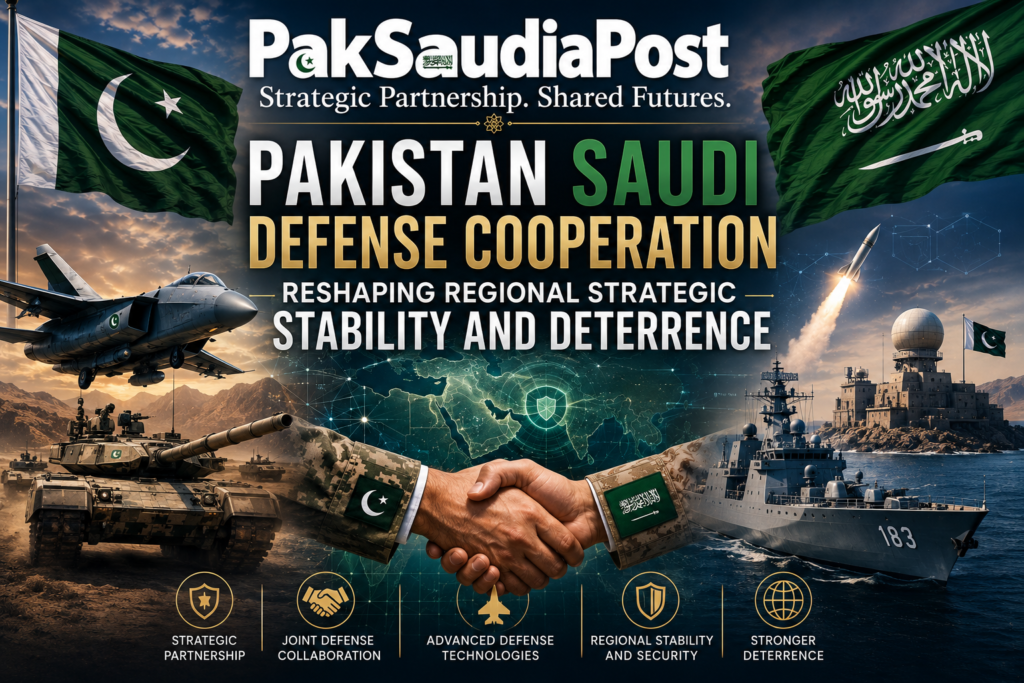
Pakistan Saudi Defense Cooperation Reshaping Regional Strategic Stability And Deterrence

The architecture of modern warfare is undergoing a profound transformation that is steadily dissolving the traditional boundaries between peace and conflict, state and non state actors, conventional deterrence and invisible coercion. The contemporary Middle East no longer functions within the predictable strategic equations that once governed military competition during the late twentieth century. Instead, the region is evolving into a fragmented battlespace where cyber sabotage, unmanned systems, proxy militias, missile proliferation, digital propaganda, and economic disruption coexist within an increasingly hybridized security environment. Within this transforming landscape, Pakistan and Saudi Arabia are recalibrating their strategic calculations in ways that could significantly reshape the future trajectory of regional deterrence, military modernization, and Islamic security cooperation.
For decades Saudi Arabia’s security doctrine rested primarily upon three interconnected assumptions. First, overwhelming financial resources could compensate for limited indigenous military industrial capacity. Second, advanced Western defense systems would provide sufficient protection against regional threats. Third, the strategic umbrella of external powers would deter large scale aggression and preserve Gulf stability. The erosion of these assumptions over recent years has fundamentally altered Riyadh’s understanding of security.
Drone attacks upon critical energy infrastructure exposed the vulnerabilities of even the most sophisticated conventional defense systems. Low cost asymmetric technologies demonstrated their ability to bypass expensive missile shields and threaten strategic economic assets central to global energy markets. Simultaneously, prolonged regional conflicts revealed that modern warfare is increasingly defined not by decisive battlefield victories but by attritional hybrid confrontation involving proxy networks, informational manipulation, cyber disruption, and psychological pressure. Saudi Arabia therefore entered a phase of strategic introspection regarding the future direction of its defense architecture.
Pakistan occupies a uniquely important position within this evolving environment because it combines several characteristics rarely found simultaneously within the Islamic world. It is a nuclear armed state possessing advanced ballistic missile capabilities, one of the region’s largest standing military structures, extensive operational experience confronting asymmetric warfare, and a deeply institutionalized strategic culture shaped by decades of sustained geopolitical pressure. For Riyadh, Pakistan increasingly represents not merely a traditional military ally but a source of strategic expertise relevant to the emerging character of warfare itself.
The significance of Pakistan’s deterrence experience should not be underestimated. Islamabad has spent decades navigating one of the world’s most volatile nuclear environments under conditions of persistent regional rivalry, cross border tensions, and conventional military imbalance. Through this experience Pakistan developed complex command and control systems, layered deterrence doctrines, and adaptive military strategies designed to manage escalation risks while preserving strategic equilibrium. Saudi strategic planners increasingly study these dynamics with growing interest as Gulf security environments become progressively unpredictable.
An important transformation currently underway within regional strategic discourse concerns the concept of deterrence itself. Traditional deterrence models focused primarily upon large scale military retaliation and conventional force projection. Contemporary conflict environments however increasingly involve grey zone warfare operating beneath the threshold of formal war. Cyber intrusions, drone incursions, proxy mobilization, disinformation campaigns, and economic coercion now function as instruments of strategic pressure capable of inflicting significant disruption without triggering conventional military responses.
This evolution has generated a new discourse surrounding deterrence beyond nuclearity. Within this framework strategic stability depends not solely upon nuclear arsenals or conventional military superiority but upon multidimensional resilience across cyber infrastructure, digital communications, energy systems, intelligence coordination, and technological adaptation. Pakistan and Saudi Arabia are gradually recognizing that future security cooperation must extend far beyond traditional military exercises or arms transactions toward integrated strategic ecosystems capable of responding to hybrid threats.
The proliferation of drone warfare has become central to this transformation. Across the Middle East unmanned systems have altered the economics of conflict by enabling relatively inexpensive actors to challenge technologically advanced states. Drone swarms, precision guided munitions, and autonomous surveillance systems increasingly possess the capacity to threaten energy infrastructure, military bases, ports, and communication networks. The strategic implications are enormous because they erode the traditional advantages enjoyed by states relying heavily upon expensive centralized defense architectures.
Saudi Arabia’s response has involved accelerated investment in indigenous military modernization and technological diversification. Riyadh increasingly seeks to reduce excessive dependence upon external defense suppliers by cultivating domestic defense manufacturing capabilities and expanding partnerships with multiple strategic actors. Pakistan naturally emerges as a relevant partner within this context because of its growing expertise in missile development, drone production, and military technological adaptation under resource constrained conditions.
The future trajectory of Pakistan Saudi defense cooperation may therefore evolve toward significantly deeper integration than previously anticipated. Intelligence sharing frameworks, coordinated cyber defense mechanisms, counter drone cooperation, electronic warfare collaboration, and artificial intelligence enabled surveillance systems are increasingly plausible dimensions of future strategic engagement. Such cooperation would reflect the broader reality that modern military power depends increasingly upon informational superiority and technological resilience rather than purely conventional force accumulation.
Cyber warfare constitutes another critical dimension shaping contemporary deterrence structures. Modern states rely extensively upon interconnected digital systems controlling financial networks, energy grids, communication infrastructures, transportation logistics, and military command architectures. These systems simultaneously generate immense efficiency and profound vulnerability. A sophisticated cyber intrusion targeting critical infrastructure could inflict strategic disruption without a single missile being launched.
Saudi Arabia’s rapidly digitizing economy and Pakistan’s expanding technological sectors both face growing exposure to cyber threats emanating from state actors, proxy networks, and transnational criminal ecosystems. Consequently, cyber defense cooperation represents not merely a supplementary component of bilateral relations but a strategic necessity within the evolving security environment. Joint cyber response units, digital intelligence exchanges, and coordinated cyber resilience frameworks could eventually become central pillars of bilateral defense architecture.
The Middle East’s experience with proxy conflict further intensifies these concerns. Conflicts across Yemen, Syria, Iraq, and other theatres have demonstrated how non state actors equipped with modern technologies can shape regional balances of power. Proxy networks increasingly function as instruments of strategic ambiguity enabling states to project influence indirectly while avoiding direct confrontation. Such environments complicate traditional deterrence because attribution itself becomes contested and escalation thresholds become difficult to define.
Pakistan’s long experience confronting irregular warfare and complex militant ecosystems provides valuable operational insights relevant to Saudi strategic calculations. Riyadh increasingly recognizes that future security challenges may emerge less from conventional invasions and more from diffuse hybrid networks capable of exploiting social fragmentation, technological vulnerabilities, and informational chaos. This realization strengthens the rationale for deeper strategic consultation with Islamabad.
Missile proliferation across the Middle East and South Asia also contributes significantly to regional instability. Ballistic missile systems, cruise missiles, hypersonic technologies, and precision strike capabilities are spreading rapidly among both state and non state actors. These developments compress decision making timelines and intensify risks of miscalculation during crises. The emergence of precision warfare technologies means that critical infrastructure can be threatened with unprecedented accuracy from significant distances.
Within this context Pakistan’s missile development experience acquires strategic significance beyond South Asia. Islamabad’s emphasis upon credible deterrence under conditions of conventional asymmetry offers lessons relevant to smaller Gulf states confronting uncertain regional environments. Although Saudi Arabia has not formally pursued nuclear capabilities, persistent speculation regarding future strategic options continues influencing regional security discourse. Pakistan therefore occupies a sensitive symbolic position within broader conversations surrounding Islamic deterrence and strategic balance.
Yet the emerging Pakistan Saudi defense convergence should not be interpreted simplistically through the lens of military alliance formation alone. Both states remain cautious regarding excessive regional polarization and recognize the dangers of uncontrolled escalation. Islamabad particularly seeks to preserve balanced relations across the broader Muslim world while avoiding entanglement within sectarian confrontations. Saudi Arabia similarly appears increasingly aware that sustainable regional stability cannot emerge solely through coercive competition.
Consequently, an alternative narrative is gradually being constructed emphasizing strategic stabilization rather than militarized confrontation. Within this discourse Pakistan and Saudi Arabia present themselves as advocates of moderated deterrence, technological modernization, and coordinated security resilience aimed at preserving regional equilibrium amidst systemic instability. Media narratives increasingly portray bilateral defense cooperation not as preparation for offensive expansion but as an adaptive response to evolving hybrid threats.
The informational dimension of modern warfare reinforces the importance of this narrative management. Contemporary conflicts are fought simultaneously across physical and cognitive domains. Digital propaganda, psychological operations, algorithmic manipulation, and perception warfare increasingly shape public opinion, diplomatic legitimacy, and strategic signaling. States capable of controlling narratives often acquire disproportionate influence over regional political environments.
Pakistan and Saudi Arabia are therefore investing more heavily in strategic communication infrastructures designed to project images of resilience, modernization, and stability. This informational strategy serves several objectives simultaneously. It reassures investors concerned about regional insecurity. It enhances deterrence by projecting technological competence and institutional cohesion. It counters extremist narratives seeking to exploit instability. Most importantly, it attempts to frame both states as responsible middle powers contributing toward regional order rather than exacerbating fragmentation.
The emergence of artificial intelligence introduces another transformative variable into future deterrence structures. AI driven surveillance systems, predictive intelligence analytics, autonomous weapons platforms, and algorithmic warfare capabilities are gradually redefining military competition. States lacking technological adaptation risk strategic obsolescence regardless of traditional military size or expenditure. Pakistan and Saudi Arabia therefore face urgent pressure to expand investment in technological research, military innovation ecosystems, and digital education infrastructure.
However, significant constraints remain. Pakistan’s economic limitations restrict the scale of military modernization it can sustain independently. Saudi Arabia despite vast financial resources continues confronting dependency upon imported defense technologies and foreign technical expertise. Furthermore, external powers retain substantial influence over regional military architectures and may resist the emergence of fully autonomous Islamic security frameworks.
The strategic relationship with the United States remains particularly complex. Washington continues functioning as a central defense partner for Saudi Arabia despite periodic tensions and policy disagreements. Pakistan similarly maintains important though fluctuating relations with Western military institutions. Neither Islamabad nor Riyadh seeks complete rupture with existing security structures. Instead, both pursue diversification strategies designed to reduce vulnerability while preserving flexibility.
China’s growing technological and defense influence further complicates these dynamics. Beijing’s expanding role within Middle Eastern infrastructure, surveillance technology, and digital systems introduces alternative strategic possibilities outside exclusive Western frameworks. Pakistan’s close strategic partnership with China intersects naturally with Saudi Arabia’s diversification agenda, potentially creating new avenues for trilateral technological cooperation. Yet such developments simultaneously intensify geopolitical competition within the broader international system.
The future sustainability of Pakistan Saudi defense cooperation will therefore depend upon careful strategic calibration. Excessive militarization risks escalating regional tensions and provoking counter balancing coalitions. Insufficient coordination meanwhile could leave both states vulnerable within an increasingly unstable security environment. The challenge lies in constructing a framework capable of enhancing deterrence while avoiding destabilizing escalation dynamics.
For policymakers in Islamabad and Riyadh several urgent priorities emerge. First, both states should institutionalize permanent strategic dialogue mechanisms focused specifically upon hybrid warfare, cyber security, and emerging technologies rather than limiting cooperation to conventional military domains. Second, joint investments in indigenous defense innovation ecosystems are essential to reducing long term technological dependency.
Third, coordinated counter drone architectures and integrated cyber defense systems should become central pillars of future security cooperation. Fourth, both countries must strengthen crisis communication channels and strategic transparency mechanisms capable of reducing escalation risks during periods of regional tension. Fifth, academic and research collaboration involving military universities, strategic think tanks, and technological institutes should be expanded to cultivate indigenous expertise in next generation warfare.
Most importantly, Pakistan and Saudi Arabia must recognize that sustainable security within the contemporary Middle East cannot be achieved exclusively through military accumulation. Strategic stability increasingly depends upon economic resilience, technological adaptation, informational credibility, and diplomatic flexibility. The future balance of power will belong not merely to states possessing weapons but to those capable of integrating military modernization with broader societal transformation.
The evolving Pakistan Saudi defense relationship therefore represents more than bilateral military cooperation. It reflects a deeper transformation within the strategic consciousness of the Islamic world as regional powers adapt to the realities of hybrid warfare, technological disruption, and multipolar fragmentation. Whether this convergence contributes toward durable regional equilibrium or intensifies existing insecurities will depend largely upon the wisdom, restraint, and strategic imagination with which both states navigate the uncertainties of the emerging international order.
A Public Service Message