

Food Security Diplomacy and Land-Lease Geopolitics: Pakistan’s Emerging Role in Regional Agrarian Strategy

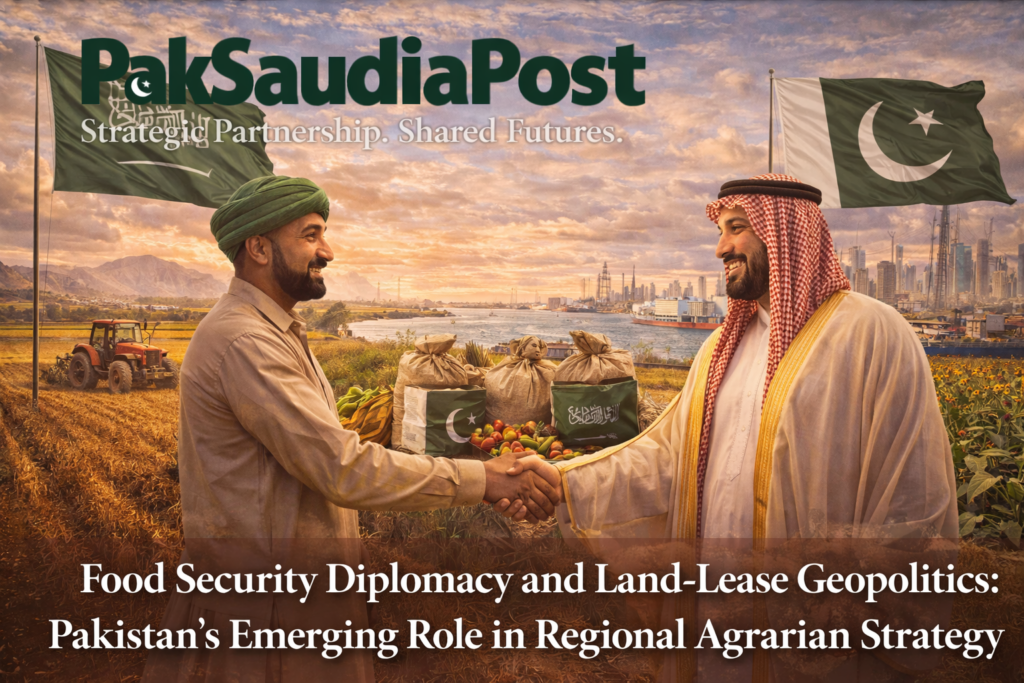
Food has emerged as a critical dimension of national security and geopolitical leverage in the twenty-first century. States with agrarian capacity increasingly find themselves courted by resource-dependent economies seeking stability in their food supplies. Pakistan, endowed with fertile lands, diverse agro-ecologies, and a strategic location bridging the Middle East and South Asia, is uniquely positioned to leverage its agricultural capacity as both an economic asset and a diplomatic instrument. The convergence of domestic food production, foreign investment, and land-leasing arrangements with countries such as Saudi Arabia presents opportunities and challenges. Properly structured, these engagements can enhance Pakistan’s food resilience, generate sustainable economic returns, and elevate its influence within regional food security architecture. Mismanaged, they risk creating dependency, social tension, and the commodification of critical national resources.
The genesis of Pakistan’s role in emerging food security diplomacy is rooted in the global scarcity of arable land and water resources. As population growth intensifies in the Gulf, Africa, and parts of Asia, countries with limited domestic production capabilities seek secure access to external agricultural capacity. Saudi Arabia, heavily dependent on food imports, has pursued land-leasing agreements in countries with arable land, aiming to stabilize domestic supply through controlled cultivation abroad. Pakistan, with its extensive irrigated plains and agronomic expertise, has become a natural partner. This context transforms agricultural engagement from a commercial transaction into a strategic instrument, integrating economic opportunity with regional diplomatic positioning.
Land-leasing agreements must be structured with foresight and safeguards that preserve domestic food security. Long-term leases, foreign investment in cultivation, and contractual frameworks for crop exports present inherent risks if national consumption priorities are subordinated to external demand. Pakistan’s policy architecture must ensure that a portion of productive land remains dedicated to domestic food supply, buffer reserves are maintained, and contractual obligations are balanced with national interest. Mechanisms for joint oversight, transparent reporting, and conditionality in investment agreements provide a framework that converts foreign engagement into a vehicle for strengthening, rather than undermining, domestic agrarian capacity.
Economic benefits of food security diplomacy extend beyond lease payments. Integrating foreign investment into Pakistan’s agro-industrial chain creates opportunities for technology transfer, mechanization, and productivity enhancement. Modern irrigation systems, precision agriculture technologies, and post-harvest storage facilities can be co-developed, generating employment, raising yields, and improving resource efficiency. By aligning foreign investment with domestic capacity building, Pakistan can transform traditional agriculture into a modern, export-oriented sector capable of supplying both domestic and international markets. This strategy converts external demand into a driver of structural agricultural modernization rather than mere rental income from leased land.
The security dimension of land-leasing agreements cannot be ignored. Large-scale foreign cultivation often entails protected enclaves, private security arrangements, and regulatory exemptions. While these are attractive to investors, they can create local tension, perceptions of inequity, and challenges to sovereignty. Pakistan must establish legal frameworks that delineate rights, obligations, and jurisdiction while ensuring local communities benefit directly from employment, infrastructure, and social development. Security frameworks must integrate federal, provincial, and local authorities to guarantee protection without compromising national control over strategic resources. Properly managed, such frameworks can enhance investor confidence and stabilize regional agricultural zones.
Food diplomacy intersects with broader foreign policy objectives. By supplying controlled agricultural capacity to Gulf states, Pakistan positions itself as a reliable partner in regional stability. This strategic role enhances Pakistan’s bargaining power in trade negotiations, energy cooperation, and security dialogues. It creates leverage for preferential access to investment, technology, and markets while strengthening bilateral relations. Pakistan’s capacity to act as a food security guarantor transforms agriculture into an instrument of statecraft, extending influence beyond conventional diplomacy.
Domestic food resilience must remain central to policy. While engaging with foreign partners, Pakistan must maintain strategic reserves, diversify crop portfolios, and strengthen supply chains to absorb fluctuations in domestic production or external demand. Investments in cold storage, logistics, and market intelligence enable timely distribution, prevent post-harvest losses, and stabilize pricing for domestic consumers. Integrating foreign engagement with domestic production safeguards national interest, ensuring that international collaboration enhances rather than compromises food security.
Strategic investment frameworks must incentivize both foreign and domestic participation in agriculture. Public-private partnerships, joint ventures, and conditional lease agreements can ensure that technology, capital, and expertise are effectively transferred while aligning with national objectives. Performance-linked contracts, crop-sharing models, and reinvestment of profits into local infrastructure generate multiplier effects, creating employment, boosting rural economies, and enhancing food production. Policy must ensure equitable distribution of benefits, preventing concentration of resources in the hands of external actors or local elites.
Water management is a critical component of food security diplomacy. Pakistan’s agriculture is heavily dependent on irrigation infrastructure, river flows, and groundwater management. Foreign investment in land cultivation must be harmonized with sustainable water use policies. Overextraction, unsustainable cropping patterns, and ecological degradation could undermine long-term productivity and national food resilience. Integrating foreign cultivation with modern water management practices, including drip irrigation, rainwater harvesting, and soil conservation, ensures that agricultural expansion is both economically productive and environmentally sustainable.
Industrial integration enhances the value proposition of food diplomacy. Agricultural production alone does not capture the full spectrum of benefits. Processing, packaging, storage, and transportation provide opportunities for value addition, employment generation, and export-oriented industrialization. By linking leased land cultivation with domestic agro-processing units, Pakistan can create vertically integrated supply chains that serve domestic, regional, and global markets. Such integration amplifies economic returns, stabilizes prices, and strengthens strategic autonomy by embedding foreign investment within national industrial frameworks.
Diplomatic coordination is essential to maximize benefits. Land-leasing agreements must be negotiated with clarity, foresight, and alignment with broader foreign policy priorities. Multilateral engagement, regional collaboration, and alignment with global food security frameworks increase legitimacy and reduce geopolitical risk. Pakistan can leverage its agricultural capacity to participate in regional initiatives, food corridors, and supply chain cooperation, establishing a leadership role in the emerging geopolitics of food security.
Human capital development reinforces the long-term sustainability of this strategy. Agricultural modernization, industrial integration, and foreign partnership require a skilled workforce. Training programs, vocational education, and research initiatives ensure that Pakistani citizens benefit directly from investment, technology adoption, and industrial growth. Skilled labor increases productivity, strengthens operational resilience, and enhances socio-economic stability in regions participating in food security diplomacy.
Environmental stewardship is critical. Expansion of agricultural production, whether domestic or foreign-managed, must consider soil fertility, biodiversity, and ecological balance. Sustainable land use practices, adoption of green technology, and monitoring of environmental impact ensure that food security diplomacy does not compromise natural resources. Sustainable practice enhances global credibility, aligns with international standards, and safeguards long-term agricultural productivity.
In conclusion, Pakistan’s engagement in food security diplomacy and land-leasing arrangements represents a strategic opportunity to convert agrarian capacity into economic leverage and regional influence. By structuring agreements that safeguard domestic production, integrate technology transfer, enhance industrial capacity, and promote human capital development, Pakistan can ensure that foreign engagement strengthens rather than compromises food resilience. Strategic management, legal safeguards, and environmental stewardship transform agriculture from a passive resource into a dynamic instrument of economic growth and statecraft. Through deliberate policy and forward-looking strategy, Pakistan can emerge as a regional food security guarantor, generate sustainable economic returns, and consolidate its role in shaping the geopolitics of agrarian stability.
A Public Service Message


