Smart Energy Logistics and Maritime Resilience Between Riyadh and Islamabad

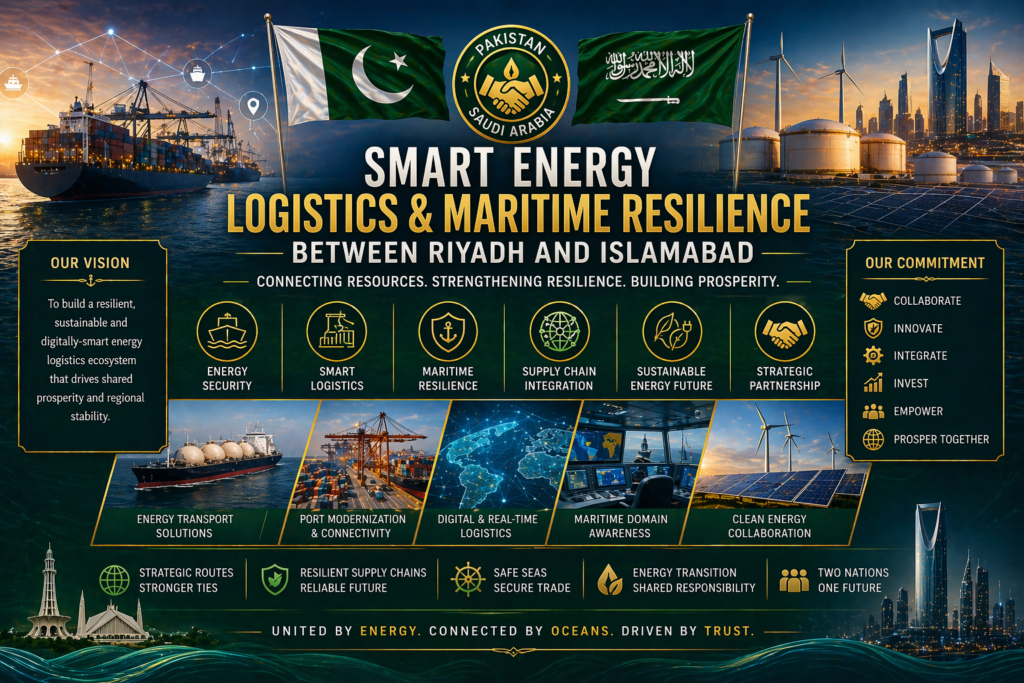
The emerging intersection of artificial intelligence, maritime security, and energy logistics is reshaping the strategic calculus of Gulf South Asian economic connectivity, particularly within the fragile corridors linking Saudi Arabia’s hydrocarbon export infrastructure and Pakistan’s import dependent energy economy. In an era characterised by heightened instability across maritime chokepoints, the vulnerability of sea based supply chains has become a defining feature of geo economic risk, where disruptions are no longer episodic anomalies but structural possibilities embedded within the architecture of globalisation itself. The increasing frequency of maritime insecurity, ranging from drone assisted interdictions to electronic navigation interference and regionalised conflict spillovers, has rendered traditional logistics models inadequate for the demands of contemporary interdependence.
Within this context, artificial intelligence enabled logistics systems are not merely efficiency enhancing tools but instruments of strategic resilience. Predictive analytics, machine learning based routing systems, and satellite integrated supply chain monitoring are increasingly capable of transforming maritime trade from a reactive system into a pre emptive architecture of risk avoidance. For Saudi Arabia, whose Vision 2030 framework is fundamentally dependent on the uninterrupted flow of hydrocarbons and petrochemical exports, and for Pakistan, whose macroeconomic stability is closely tied to predictable energy imports and maritime trade continuity through Karachi and Gwadar, the convergence of logistical vulnerability creates a shared strategic imperative.
From a dependency theory perspective, maritime logistics between Gulf exporters and South Asian importers reflects a historically asymmetric structure in which energy flows and capital accumulation have been concentrated in the Gulf while logistical dependency and external vulnerability have been disproportionately borne by South Asian economies. Pakistan’s reliance on imported energy and maritime transit routes has long embedded it within a structurally dependent position in global energy networks. However, the integration of AI driven logistics systems introduces a potential shift in this configuration by enabling peripheral states to participate more actively in the governance of supply chain intelligence rather than merely its consumption.
Yet dependency is not simply dissolved by technological adoption. It is reconfigured. The ownership of data infrastructure, algorithmic design, and predictive modelling systems becomes the new site of structural power. If Saudi Arabia and its technologically advanced partners control the core architecture of maritime predictive systems, Pakistan risks remaining a passive recipient of optimised routing decisions without influence over the underlying logic of risk assessment. Thus, the critical question is not whether AI is adopted, but who defines the epistemology of maritime risk within these systems.
Complex interdependence offers a more dynamic framework for understanding this transformation. Maritime trade between Saudi Arabia and Pakistan is embedded in a dense network of reciprocal dependencies spanning energy security, labour flows, remittances, port infrastructure, and financial stabilisation mechanisms. In such a system, disruption in one node generates cascading effects across multiple domains. The rise of AI enabled logistics platforms therefore represents not a unilateral enhancement of efficiency but a systemic recalibration of interdependence itself. States become mutually exposed not only through physical trade routes but through shared digital infrastructures that govern the movement of goods, insurance pricing, shipping risk assessments and port scheduling algorithms.
In this environment, maritime logistics evolves into a hybrid domain where economic governance and security architecture converge. Predictive AI systems are capable of integrating meteorological data, geopolitical risk indicators, naval movement patterns, and even social media sentiment analysis to forecast disruptions in real time. Such systems can theoretically reroute energy shipments away from high risk corridors before physical threats materialise, thereby transforming uncertainty into manageable probabilistic risk. However, this technological optimism must be tempered by recognition of systemic fragility. Algorithmic systems are only as reliable as the data inputs they receive, and in contested maritime environments data itself can be manipulated, degraded or strategically distorted.
Neo structuralism provides a further analytical dimension by highlighting the centrality of state led technological coordination in shaping developmental outcomes. Saudi Arabia’s Vision 2030 agenda exemplifies a neo structural approach to economic transformation, in which the state actively orchestrates diversification away from hydrocarbon dependency through investment in digital infrastructure, artificial intelligence ecosystems, and logistics hubs. Pakistan, while operating under fiscal constraints, has also begun to adopt neo structural impulses through targeted investments in port infrastructure, digital customs systems, and logistics modernisation initiatives linked to the China Pakistan Economic Corridor framework.
The convergence of these two trajectories suggests the possibility of a shared smart logistics architecture in which state directed investment is aligned with AI enabled optimisation of maritime trade flows. A Saudi Pakistan maritime intelligence platform could integrate port authority data, shipping insurance analytics, satellite surveillance inputs, and predictive risk modelling into a unified operational dashboard. Such a system would not only enhance efficiency but also function as a geo economic stabiliser in times of regional volatility.
Nevertheless, the deployment of AI driven logistics systems introduces profound governance challenges. The first is algorithmic opacity, whereby decision making processes embedded within predictive models remain inaccessible to policymakers, creating a form of technological black box governance. The second is asymmetry of data sovereignty, where one partner may disproportionately influence the classification of maritime risk due to superior data infrastructure or analytical capacity. The third is systemic over reliance on predictive systems, which may generate false confidence in algorithmic certainty within inherently uncertain geopolitical environments.
For Pakistan, these risks are compounded by infrastructural limitations in digital maritime governance and fragmented institutional coordination between shipping authorities, customs systems, and naval surveillance networks. For Saudi Arabia, the challenge lies in balancing rapid technological adoption with the creation of interoperable standards that allow partner states to meaningfully participate in system design rather than merely system usage. Without such balance, AI enabled logistics risks reinforcing hierarchical patterns of dependency rather than alleviating them.
Policy makers in both states must therefore prioritise the establishment of a bilateral maritime data governance framework that ensures transparency, auditability, and shared ownership of predictive logistics systems. This would involve the creation of joint data centres, harmonised cybersecurity protocols, and co developed algorithmic standards for risk classification. Additionally, investment in resilient physical infrastructure such as diversified shipping routes, redundant port facilities, and protected maritime corridors remains essential, as technological systems alone cannot eliminate geopolitical risk.
Ultimately, smart energy logistics represents a transformation in the very nature of maritime power. It shifts the locus of influence from control over sea lanes to control over information flows that govern those sea lanes. In this emerging order, Saudi Arabia and Pakistan face a shared strategic choice between reproducing traditional hierarchies of dependency or constructing a more integrated and resilient framework of digital maritime governance. The outcome will determine not only the efficiency of their trade relationship but the stability of their broader geopolitical alignment in an increasingly volatile maritime century.
A Public Service Message