
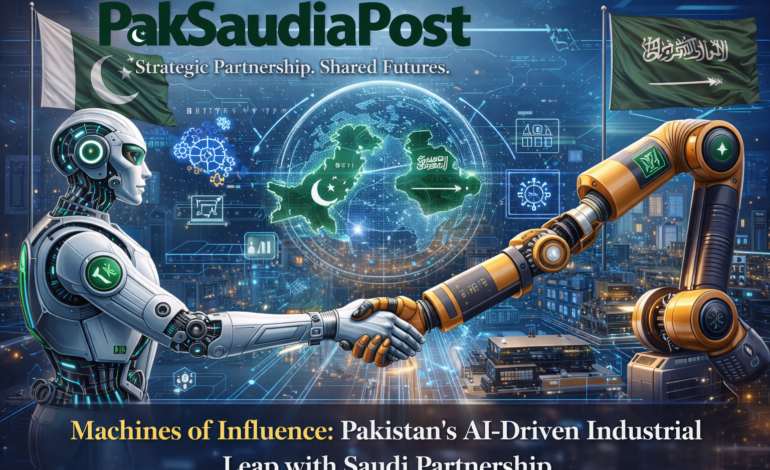
Machines of Influence: Pakistan’s AI-Driven Industrial Leap with Saudi Partnership


The global industrial landscape is undergoing a transformative phase driven by artificial intelligence, automation, and advanced data analytics. Traditional manufacturing paradigms are increasingly inadequate in a world where efficiency, precision, and predictive capacity define competitive advantage. For Pakistan, industrial modernization is not merely an economic necessity but a strategic imperative. Partnering with Saudi Arabia in AI-driven industrial initiatives offers a unique opportunity to leapfrog traditional development stages, attract Gulf capital, and integrate into regional high-value supply chains. Operationalizing this partnership requires clarity, measurable targets, and a strategic framework that ensures economic benefit, technological sovereignty, and diplomatic alignment.
One critical operational variable that can anchor Pakistan’s industrial transformation is the percentage increase in industrial output attributed to AI-driven automation. This variable provides a tangible measure of impact and enables policymakers to track progress in real time. By linking AI implementation directly to measurable output gains, Pakistan can ensure that industrial transformation is not abstract or aspirational but grounded in quantifiable economic impact. This variable also allows alignment with Saudi strategic objectives, as Gulf partners are keen to invest in initiatives that demonstrate measurable efficiency gains, scalability, and replicability across industrial sectors.
The primary strategic objective for Pakistan is to enhance industrial productivity while preserving strategic control over technology and capital flows. This entails deploying AI-enabled predictive maintenance systems, smart manufacturing protocols, and automated supply chain management tools in sectors such as energy, mining, textiles, and logistics. AI-driven systems can reduce operational costs, optimize resource allocation, and increase the overall throughput of industrial processes. Operational metrics such as output percentage gains provide a clear indicator of whether these interventions are translating into real economic benefits. This also allows for performance benchmarking across sectors and facilitates prioritization of investment and policy interventions.
A second strategic objective is the development of domestic technological capability and workforce competence. Industrial transformation cannot rely solely on imported AI solutions. Pakistan must cultivate local expertise in machine learning, robotics, and industrial analytics to ensure sustainable adoption and adaptation of advanced systems. Operationalizing AI-driven productivity gains requires not only hardware and software deployment but also the creation of a skilled workforce capable of managing, maintaining, and enhancing these systems. This ensures that the industrial transformation is both technically sustainable and strategically autonomous.
Policy levers available to Pakistan are diverse, spanning regulatory, technological, and financial dimensions. Regulatory frameworks must be updated to support AI adoption in industrial contexts, including standards for predictive analytics, automated quality control, and industrial data privacy. These frameworks should encourage experimentation within controlled parameters while ensuring alignment with national economic objectives. Operationalizing these levers involves defining clear performance metrics linked to industrial output increases and integrating them into monitoring frameworks.
Technological policy levers involve the creation of AI-enabled industrial clusters, public-private partnerships for innovation, and investment in domestic research and development. Pakistan can incentivize private sector adoption of AI solutions through tax credits, grants, and co-investment models with Saudi partners. AI integration can also be operationalized through pilot projects in targeted industrial zones, with performance measured through increases in production efficiency, reduction in operational downtime, and energy optimization. KPIs such as cost savings per unit of output, reduction in machine failure rates, and time-to-market improvements provide tangible measures of success.
Financial policy levers include strategic capital mobilization from Saudi partners. Gulf investment can be directed toward high-potential industrial sectors, enabling the adoption of state-of-the-art AI technologies without overburdening domestic resources. Hypothetical agreements could guarantee specific performance outcomes, such as a minimum percentage increase in industrial output, linked to phased capital disbursement. This ensures alignment of investment incentives with measurable industrial transformation outcomes. By mapping financial inputs to operational variables, policymakers can track return on investment and adjust deployment strategies as necessary.
Diplomatic engagement is central to operationalizing AI-driven industrial transformation. Pakistan must negotiate frameworks that balance Saudi capital involvement with national control over critical technology and industrial data. Joint governance committees, shared monitoring mechanisms, and clear dispute resolution protocols can ensure accountability while fostering trust. Operational metrics, such as AI-driven output percentage gains, serve as objective benchmarks for assessing the effectiveness of these diplomatic arrangements and provide a transparent basis for ongoing collaboration.
The economic rationale for prioritizing AI-driven industrial transformation is compelling. Traditional industrial models are resource-intensive, prone to inefficiency, and slow to adapt to market fluctuations. AI integration allows for predictive maintenance that reduces downtime, dynamic resource allocation that optimizes inputs, and automated quality assurance that minimizes waste. By operationalizing output percentage gains as a variable, Pakistan can quantify these benefits, make data-driven policy decisions, and demonstrate tangible results to investors and domestic stakeholders alike.
Strategically, AI-driven industrial transformation enhances Pakistan’s position within regional economic networks. Gulf nations, including Saudi Arabia, are seeking reliable partners capable of implementing scalable and replicable industrial solutions. By demonstrating measurable productivity gains, Pakistan establishes itself as a credible node in Gulf-linked industrial ecosystems. This operational success translates into diplomatic leverage, allowing Pakistan to negotiate favorable terms in other sectors such as energy, logistics, and technology transfer. Operational metrics such as industrial output gains serve as objective evidence of capacity, facilitating high-level discussions and long-term strategic planning.
Challenges to implementation are significant. Cybersecurity vulnerabilities, technological dependency, workforce skill gaps, and regulatory bottlenecks all pose risks to successful AI adoption. Industrial systems are particularly susceptible to cyber-attacks, which can disrupt production, compromise sensitive data, and create systemic operational risks. To mitigate these threats, Pakistan must invest in robust cybersecurity protocols, real-time monitoring systems, and contingency planning. Operational metrics allow early identification of inefficiencies or security breaches, enabling timely corrective action.
Institutional coordination is critical for operationalizing AI-driven industrial transformation. Ministries responsible for industry, technology, and finance must work in close collaboration, along with private sector stakeholders and Saudi partners. A centralized industrial innovation authority can oversee AI integration, monitor output gains, and coordinate investment deployment. By establishing clear accountability structures and linking operational metrics to policy levers, Pakistan can ensure that AI-driven transformation proceeds efficiently and strategically.
Capacity building is equally important. Industrial managers, engineers, and technical staff must be trained in AI applications, machine learning algorithms, and predictive analytics. Educational institutions should integrate AI-focused curricula to develop a pipeline of skilled professionals. Operationalizing productivity gains as a measurable variable allows policymakers to assess whether workforce training is effectively translating into industrial efficiency, providing a feedback loop for continuous improvement.
The long-term vision for Pakistan’s industrial transformation must integrate economic, technological, and strategic dimensions. Economically, the goal is to achieve measurable increases in industrial output and operational efficiency across key sectors. Technologically, Pakistan must develop domestic AI capability to ensure long-term sustainability and reduce dependency on foreign systems. Strategically, the aim is to leverage AI-driven industrial capacity to strengthen regional influence, attract Gulf investment, and integrate into high-value supply chains. Operational metrics, particularly output percentage gains, provide a clear framework for tracking progress toward these objectives.
Private sector engagement is central to success. Industrial firms must be incentivized to adopt AI systems, participate in pilot programs, and contribute to data-sharing initiatives that improve predictive models. Performance metrics such as efficiency gains, reduced operational downtime, and cost savings per unit produced provide tangible measures of private sector contribution. By linking these KPIs to policy incentives, Pakistan ensures alignment between national strategic objectives and industrial performance.
Diplomatic coordination with Saudi Arabia must address both operational and strategic considerations. Agreements should specify governance structures for technology deployment, performance metrics tied to output gains, and mechanisms for technology transfer. By embedding measurable KPIs into formal agreements, Pakistan ensures that strategic and economic objectives are aligned and that Gulf investment contributes directly to national industrial transformation.
Social and institutional challenges must also be addressed. Resistance to technological change, gaps in workforce literacy, and potential inequities in technology access can undermine implementation. Targeted training programs, phased adoption strategies, and inclusive policies can mitigate these risks. Operational metrics such as AI-driven output percentage gains provide objective data to identify underperforming sectors and guide corrective interventions.
The broader implications of AI-driven industrial transformation extend to economic modernization, technological sovereignty, and strategic resilience. Successful deployment enhances Pakistan’s industrial competitiveness, facilitates integration into Gulf-backed economic networks, and positions the nation as a credible partner for regional industrial initiatives. Operationalizing industrial output gains as a measurable variable ensures accountability, facilitates investment evaluation, and provides evidence-based guidance for policy adjustment.
In conclusion, AI-driven industrial transformation represents a defining opportunity for Pakistan-Saudi strategic collaboration. Operationalizing the partnership through measurable metrics such as industrial output gains ensures alignment of investment, policy, and technological deployment with national objectives. By integrating regulatory reform, technological infrastructure, workforce development, and diplomatic engagement, Pakistan can achieve a high-value role in regional industrial networks, attract Gulf investment, and modernize its industrial base.
The strategic imperative is clear. Pakistan must deploy AI systems, operationalize measurable output gains, and coordinate across institutional, private sector, and diplomatic channels. This is not merely a technological upgrade but a strategic pivot that enhances economic resilience, strengthens national sovereignty, and secures a long-term position within high-value regional supply chains. Effective execution will require visionary leadership, disciplined operational planning, and sustained collaboration with Saudi partners. If managed successfully, AI-driven industrial transformation will redefine Pakistan’s industrial trajectory and consolidate its role as a forward-looking, strategically agile, and economically resilient nation.
A Public Service Message


