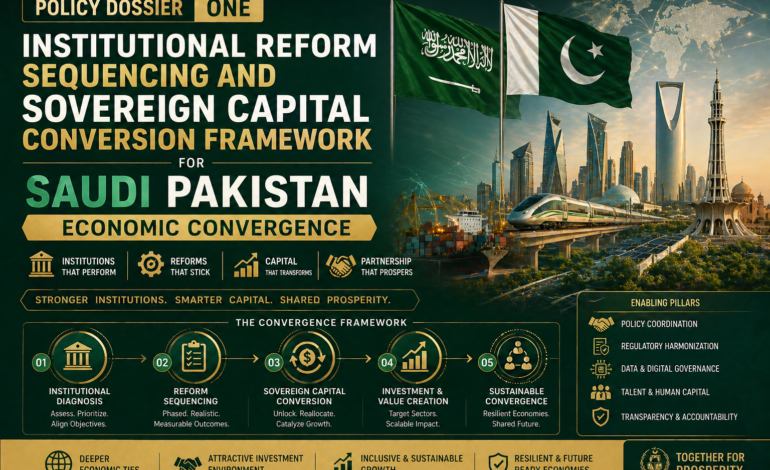
Policy Dossier One: Institutional Reform Sequencing and Sovereign Capital Conversion Framework for Saudi Pakistan Economic Convergence

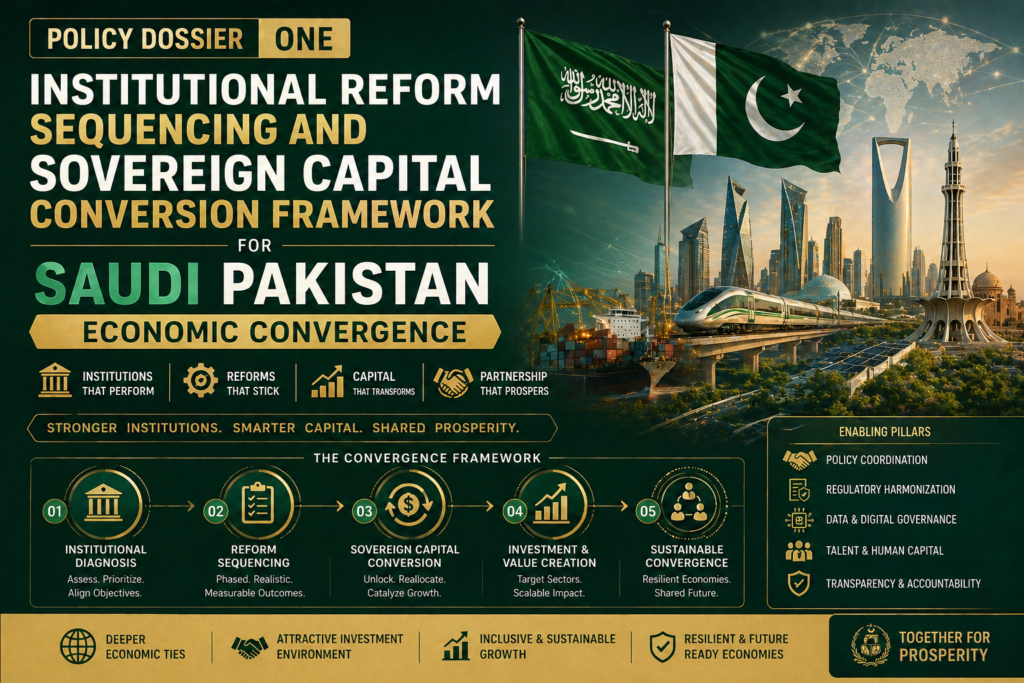
The evolving economic relationship between Saudi Arabia and Pakistan is entering a phase where symbolic diplomacy and episodic financial assistance are no longer sufficient to define the trajectory of engagement. The decisive variable now is whether Pakistan can transform itself into a jurisdiction that meets the operational expectations of long horizon sovereign investors, particularly those emerging from Saudi Arabia’s ongoing economic transformation agenda. The shift underway is not merely about capital availability but about capital discipline, governance certainty, and enforceable economic predictability. Within this context, Pakistan’s challenge is not attracting attention from sovereign funds but converting that attention into structurally secured investment flows that are insulated from political volatility, administrative fragmentation, and contractual ambiguity.
A think tank level evaluation of Pakistan’s readiness for sustained Saudi capital inflows must begin with a recognition that the current system is characterized by fragmented sovereignty over economic decision making. Authority over taxation, regulation, land allocation, energy pricing, and investment approvals is dispersed across overlapping federal and provincial jurisdictions, creating a governance environment where predictability is weak and transaction costs are high. For sovereign investors operating under strict fiduciary mandates and risk calibrated portfolio frameworks, such fragmentation is not a minor inefficiency but a structural deterrent.
In this environment, the first reform imperative is the establishment of enforceable legal continuity for sovereign contracts. Pakistan’s investment regime has historically suffered from policy reversals, regulatory reinterpretations, and weak arbitration enforcement. For Saudi capital, particularly under the diversification logic of its sovereign investment strategy, contract enforceability is not an administrative detail but the primary risk determinant. Without credible assurance that agreements will survive electoral cycles and bureaucratic transitions, long term capital deployment remains limited to short duration or politically mediated instruments rather than productive investment.
The second reform dimension concerns taxation predictability. Pakistan’s tax structure is not only narrow but unstable, characterized by frequent amendments, discretionary exemptions, and inconsistent enforcement. From the perspective of institutional investors, this creates uncertainty in net return calculations and complicates long term financial modeling. A Saudi sovereign investor evaluates taxation not only as a fiscal mechanism but as a signal of state coherence. A stable, transparent, and broad-based tax framework would therefore function as a reputational anchor in addition to its fiscal utility.
The third structural constraint lies in land governance systems. Land acquisition in Pakistan is deeply embedded in informal documentation practices, fragmented registry systems, and localized power structures. For large scale Saudi backed infrastructure, energy, or industrial investments, land clarity is essential. The absence of digitized, unified, and tamper proof land records increases both legal risk and project delays. In sovereign capital logic, time uncertainty is equivalent to financial loss, making land reform one of the most critical yet under addressed constraints.
Energy pricing represents the fourth reform axis. Pakistan’s energy sector suffers from circular debt dynamics, cross subsidies, and politically influenced tariff structures. This creates an artificial distortion between cost recovery and consumer pricing, undermining the financial viability of energy intensive investments. Saudi investors, particularly those operating in energy diversification and industrial downstream sectors, require pricing regimes that are economically rational and insulated from short term populist adjustments. Without energy pricing normalization, investment viability remains structurally compromised.
The fifth reform requirement is the consolidation of regulatory authority. At present, Pakistan’s regulatory environment is characterized by institutional multiplicity, where overlapping agencies create duplication, delay, and contradictory compliance requirements. From an investor standpoint, this creates a high friction operating environment. Saudi sovereign capital, increasingly guided by efficiency metrics and execution certainty, is unlikely to engage deeply in systems where regulatory navigation becomes a primary operational cost.
The sixth dimension involves dispute resolution credibility. International investors require confidence that commercial disputes will be resolved through predictable, transparent, and enforceable legal mechanisms. Pakistan’s arbitration environment, while formally structured, lacks consistency in enforcement outcomes. Strengthening independent commercial courts or arbitration frameworks aligned with international standards is essential for embedding investor confidence.
The seventh reform area concerns macroeconomic policy continuity. Frequent shifts in fiscal and monetary direction undermine investor expectations. Sovereign investors evaluate not only current policy but the probability of policy reversal. Pakistan’s historical reliance on short term stabilization measures has created an environment where long term policy credibility is discounted. A structured macroeconomic anchor framework agreed with strategic partners such as Saudi Arabia could partially mitigate this volatility perception.
The eighth constraint involves digital governance infrastructure. Investment ecosystems increasingly rely on digital verification systems, integrated databases, and real time compliance monitoring. Pakistan’s digital governance capacity remains uneven, limiting its ability to provide transparency at scale. For Saudi capital seeking integration into modernized portfolio ecosystems, digital opacity is a material disadvantage.
The ninth reform necessity is institutional memory preservation. Frequent administrative turnover erodes continuity in investment negotiations, leading to repeated renegotiation cycles. Establishing dedicated continuity cells for strategic economic partners would significantly reduce friction and improve investor confidence in long term engagement stability.
The tenth and most strategic reform is the creation of a unified sovereign investment facilitation architecture. This would function as a single point of coordination for all Saudi related investments, integrating fiscal, regulatory, legal, and operational approvals into a consolidated system. The absence of such an architecture forces investors to navigate fragmented bureaucratic channels, reducing efficiency and increasing uncertainty.
Across all ten reform domains, the underlying theme is not technical deficiency alone but systemic credibility deficit. Saudi Arabia’s evolving investment posture is increasingly defined by institutional rigor, return discipline, and geopolitical hedging strategies. Pakistan’s ability to align with this posture will determine whether engagement deepens into structural investment or remains confined to cyclical financial support.
A critical dimension often underappreciated is the role of perception in Gulf financial ecosystems. Pakistan is simultaneously viewed as a high potential frontier economy and a high volatility regulatory environment. This dual perception creates hesitation in capital deployment decisions. In sovereign investment logic, perception often precedes data. As such, reform is not only about changing economic fundamentals but about reshaping narrative credibility.
The success of Pakistan Saudi economic convergence therefore depends on synchronizing structural reform with narrative recalibration. Without demonstrable progress in enforceability, predictability, and institutional coherence, Pakistan risks remaining within the category of episodic financial dependency rather than graduating into sustained investment partnership status.
A Public Service Message