

Sacred Geographies and the Metaphysics of Civilizational Economy

The contemporary Saudi Arabian condition, when observed through the analytical aperture of civilizational theory rather than the conventional lexicon of political economy, discloses an intricate fusion of the sacred and the managerial, the metaphysical and the infrastructural, the archaic and the hypermodern. It
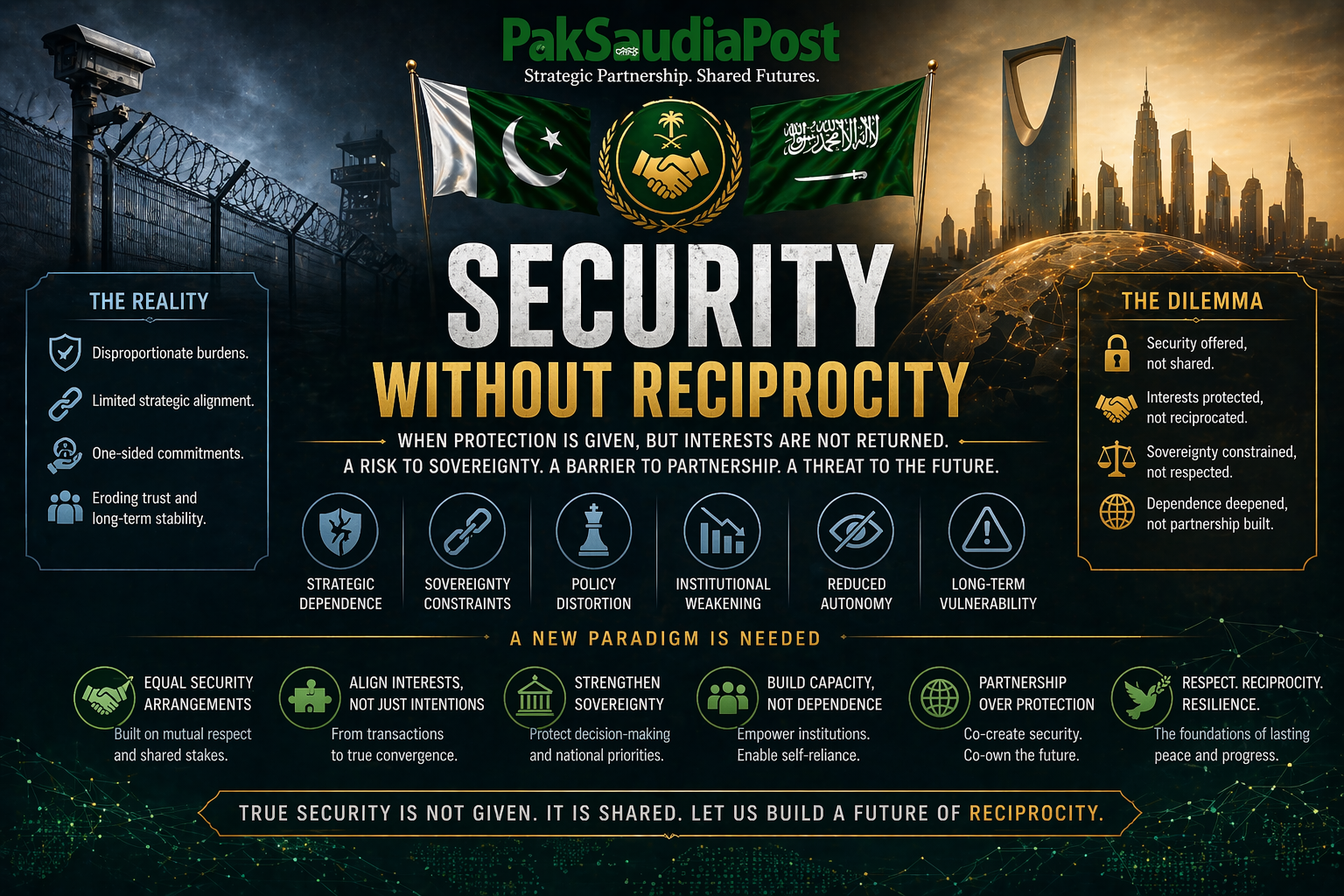
Security Without Reciprocity

The architecture of contemporary defence cooperation among economically unequal states exposes a deep philosophical inconsistency at the heart of modern security theory: the assumption that security is inherently mutual, even when the material conditions that sustain it are profoundly asymmetrical. In practice, security

Ethics of Patronage and Sovereignty
The moral and philosophical dilemma of external financial rescue in Pakistan cannot be reduced to the technical vocabulary of balance-of-payments support or cyclical IMF stabilization mechanisms. It belongs instead to a deeper genealogy of sovereignty itself, where the modern statesespecially in post-colonial formations,

Reservoirs of Influence: Historical Wealth Accumulation and Ethical Contours of Elites’ Practices
The historical trajectory of wealth accumulation by influential elites across the Arabian Peninsula offers a unique lens through which one may explore the intersection of economics, power, and ethics. These figures have not merely accumulated wealth in conventional terms; they have systematically constructed

Pakistan’s Tightrope: Iran–Saudi Oil Wars and Regional Realignment
Pakistan today stands at a complex crossroads in the Middle East, where regional rivalries, energy politics, and strategic realignments converge in ways that directly affect its security, economy, and foreign policy calculus. The ongoing rupture in OPEC plus agreements, intensified proxy conflicts, and