Pakistan Saudi Economic Statecraft Structural Convergence and Sovereign Capital Credibility Transformation 2026 to 2031

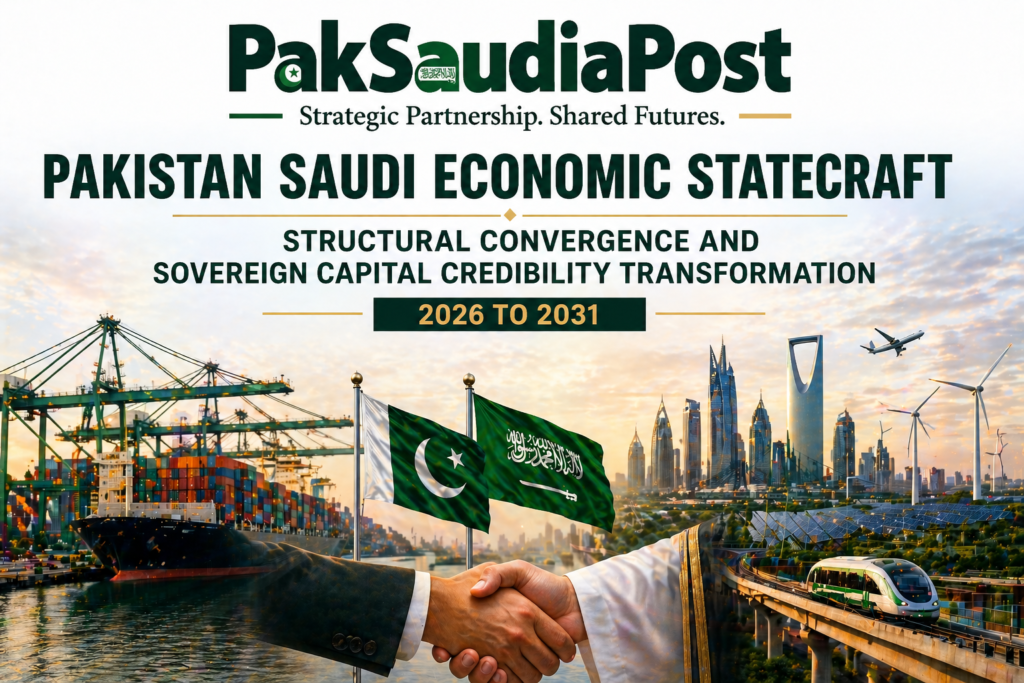
The emerging architecture of Pakistan–Saudi economic relations is undergoing a structural transition that cannot be adequately interpreted through traditional categories of aid dependence, episodic investment diplomacy, or symbolic geopolitical alignment. The deeper reality is that both states are now operating within a transformed global capital environment in which sovereign wealth is no longer deployed as liquidity support for allied economies but as a disciplined instrument of long horizon, governance sensitive portfolio construction. This shift is central to understanding why Pakistan is increasingly assessed not on conventional macroeconomic aggregates alone but on institutional credibility, enforcement reliability, and the predictability of its policy environment. The central hypothesis guiding this analytical framework is not investment attraction but state credibility conversion under sovereign capital reallocation regimes, where capital flows are determined less by political proximity and more by institutional trustworthiness under uncertainty.
At the global level, Gulf capital is undergoing a fundamental decomposition driven primarily by Saudi Arabia’s Vision 2030 transformation agenda. Sovereign wealth is increasingly being allocated toward governance secured, contract enforceable, and execution reliable destinations. This marks a decisive departure from earlier phases of sovereign investment behavior in which liquidity deployment and geopolitical stabilization were dominant considerations. In the current phase, investment decisions are increasingly filtered through institutional risk metrics, legal enforceability conditions, and long horizon return stability assessments. Within this recalibrated framework, Pakistan’s traditional advantages such as demographic scale, labor availability, and geographic positioning are no longer sufficient to guarantee large scale capital allocation. Instead, these attributes are now weighed against structural constraints in governance predictability and institutional coherence.
Pakistan’s central challenge lies in what can be defined as a structural credibility gap. This gap is not primarily financial in nature but institutional and systemic. It reflects the inability of the state to consistently convert policy intent into enforceable outcomes. Execution uncertainty remains high due to administrative fragmentation and overlapping regulatory jurisdictions. Policy discontinuity introduces volatility in long term planning assumptions, while fragmented regulatory sovereignty increases transaction costs and weakens investor confidence. These three factors operate in combination to create a compounding discount effect on Pakistan’s attractiveness for sovereign capital. In such an environment, capital does not withdraw entirely but becomes conditional, short term, and risk hedged rather than long term and development oriented.
Alongside this structural constraint is the emergence of what can be described as a narrative economy of risk perception. In contemporary sovereign investment systems, perception functions as a parallel valuation layer that often precedes formal financial analysis. Pakistan is increasingly positioned within Gulf financial discourse and global advisory ecosystems not purely on the basis of economic indicators but through reputational indexing systems that evaluate governance predictability, policy coherence, and execution history. This has resulted in a dual identity where Pakistan is simultaneously perceived as a high potential frontier economy and a high friction regulatory environment. The coexistence of these contradictory narratives generates hesitation in long horizon capital deployment, as sovereign investors tend to prioritize downside risk containment over upside potential in uncertain environments.
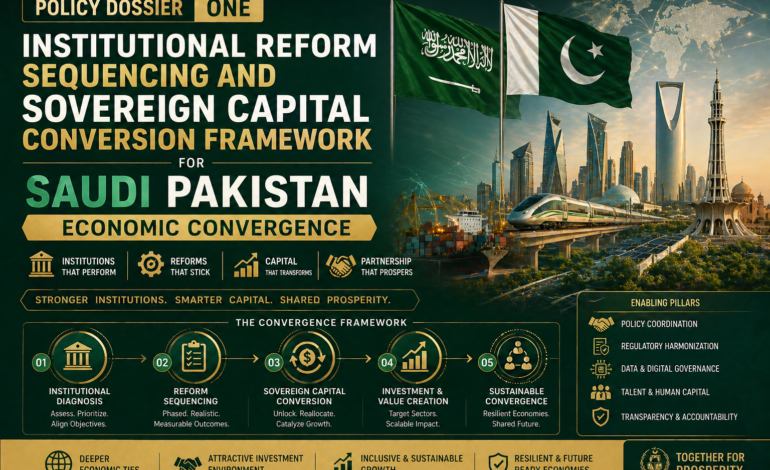
Within this analytical environment, Pakistan–Saudi economic relations must be understood as a convergence problem rather than a bilateral cooperation issue. The policy architecture emerging from this framework can be conceptualized through a set of interconnected structural questions that define both opportunity pathways and constraint zones. The first concerns whether Pakistan can achieve contract enforceability for sovereign capital. The central constraint here is legal fragmentation combined with land opacity and tariff distortion, all of which undermine predictability. The desired outcome is the transformation of Pakistan into a jurisdiction where sovereign contracts remain insulated from political cycles and administrative reinterpretation. Without this shift, large scale sovereign investment will remain structurally constrained regardless of diplomatic alignment.
The second dimension concerns whether bilateral relations can evolve from episodic engagement into algorithmic coordination. At present, engagement patterns are largely reactive and politically driven rather than systematized through measurable frameworks. The absence of a strong metrics culture limits the ability to convert diplomatic intent into operational outcomes. A more structured 2026 to 2031 convergence corridor would require clearly defined indicators across trade, investment, energy cooperation, and labor mobility, ensuring that bilateral engagement becomes performance based rather than symbolic.
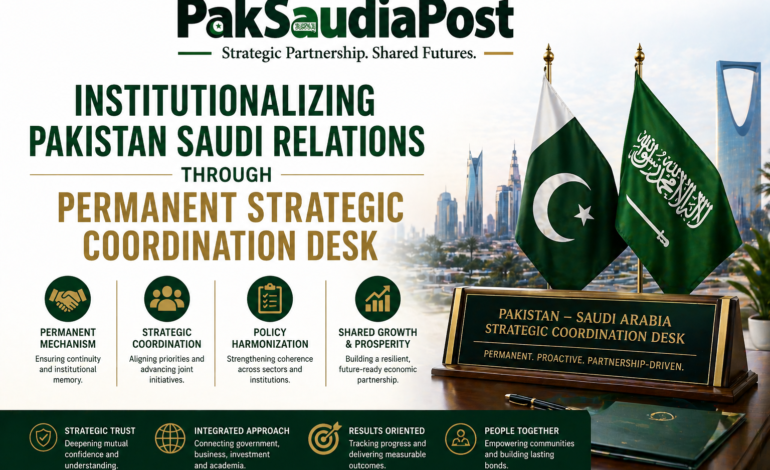
The third dimension relates to institutional design within Pakistan’s governance architecture. Investment engagement with Saudi Arabia currently requires navigation through multiple fragmented bureaucratic channels, including federal ministries, provincial authorities, and regulatory bodies with overlapping mandates. This fragmentation increases friction and reduces execution efficiency. A unified coordination mechanism dedicated specifically to Saudi related economic engagement would significantly reduce transaction costs and improve institutional coherence. Without such consolidation, Pakistan will continue to face delays in translating commitments into operational projects.
The fourth dimension concerns macroeconomic stability and whether Saudi inflows can structurally re rate Pakistan’s risk profile. At present, Pakistan’s macroeconomic structure is characterized by recurring external financing cycles and a weak export base. While Saudi capital can provide short term stabilization and liquidity support, its long term macroeconomic impact depends on whether it catalyzes export diversification and productivity enhancement. Without such structural changes, inflows risk reinforcing dependency cycles rather than generating sustainable stability. The desired outcome is a hybrid model where external capital stabilizes the macroeconomic environment while internal reforms expand export capacity and reduce structural vulnerability.
The fifth dimension involves Saudi Arabia’s potential role as an anchor investor capable of generating a sovereign signaling effect. In global capital markets, large sovereign investments function not only as financial inputs but also as reputational signals that influence the behavior of secondary investors. If Saudi Arabia commits to long term, structurally embedded investments in Pakistan, it could trigger a de risking effect that attracts additional foreign direct investment from other jurisdictions. However, this signaling effect is contingent upon Pakistan’s governance credibility and its ability to maintain consistent policy frameworks.
The sixth dimension addresses the failure scenario in which convergence does not materialize. In such a scenario, Pakistan faces the risk of capital substitution, where Saudi Arabia and other Gulf investors redirect their capital toward more institutionally predictable regions in Asia and Africa. This would not merely represent lost opportunity but a structural marginalization within emerging sovereign capital networks. In addition, Pakistan would risk reputational drift, where it becomes increasingly categorized as a perpetual stabilization dependent economy rather than an investment destination with structural growth potential.
The impact of these dynamics must be assessed across institutional, macroeconomic, and narrative dimensions. Institutionally, the most significant transformation would involve the restructuring of governance systems to meet sovereign capital expectations through enforceable legal frameworks, consolidated regulatory structures, and administrative continuity mechanisms. Macroeconomically, Saudi capital could stabilize external accounts and support infrastructure development, but only if accompanied by export expansion and productivity improvements. Otherwise, stabilization effects would remain temporary and cyclical. Narratively, Pakistan’s global financial identity could shift from a recurring adjustment economy to a more stable investment partner, but only if institutional reforms are visible and sustained over time.
A critical underlying insight is that sovereign capital is increasingly functioning as a signaling mechanism within global financial ecosystems. Saudi investment decisions are not isolated financial actions but part of a broader reputational network that influences how other investors perceive risk. This creates a multiplier effect in which successful Pakistan–Saudi convergence could unlock secondary capital inflows, while failure could reinforce negative risk perceptions. The strategic implication is that economic statecraft between the two countries is no longer purely bilateral but embedded within a global system of capital perception and allocation.
Ultimately, the Pakistan–Saudi economic relationship is transitioning from a transactional support model to a credibility-based capital architecture. The decisive variable is not the availability of capital but the capacity of the Pakistani state to absorb, enforce, and sustain it within predictable institutional frameworks. The next phase of this relationship will be defined not by diplomatic intensity but by structural alignment between sovereign capital expectations and state capacity realities. If alignment is achieved, Pakistan could reposition itself within emerging Gulf driven capital networks. If it is not, the relationship will remain confined to episodic financial stabilization without structural transformation.
A Public Service Message