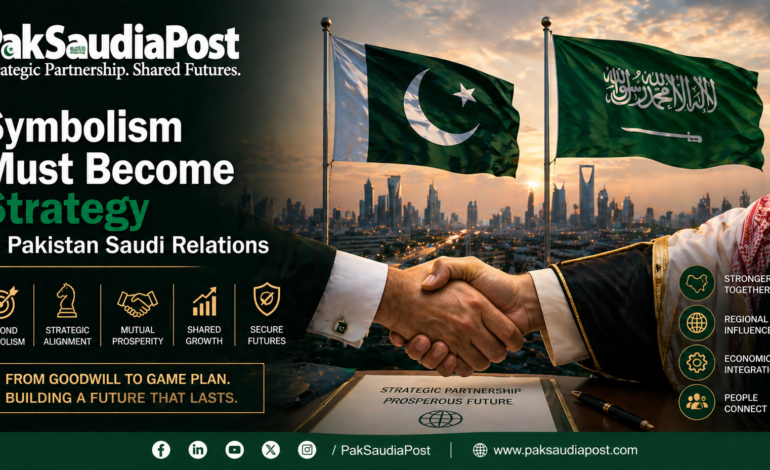
Pakistan Still Matters In Saudi Arabia Strategic Calculus


For much of the postwar era, Saudi Arabia’s security doctrine rested on a relatively simple premise. The kingdom relied on American power for external protection, oil wealth for internal resilience and selective regional partnerships for tactical flexibility. That architecture delivered stability for decades, even if imperfectly. Yet the Middle East of 2026 no longer permits such simplicity. American commitments are still substantial but more conditional. China has become economically indispensable. Iran remains both rival and negotiating counterpart. Israel’s wars have reshaped regional sentiment. Non state actors wield drones and missiles once monopolized by states. Energy markets are more competitive. Great power rivalry has entered every port, data cable and procurement contract. In this altered environment, Saudi Arabia is crafting a more multipolar security doctrine. The question is where Pakistan fits within it.
The easy answer is nostalgia. Pakistan trained Saudi personnel, maintained defense ties, supplied manpower and symbolized military reliability across several decades. Many in both countries still speak of the relationship in fraternal language, invoking history more readily than strategy. But nostalgia is not policy. The serious answer requires examining whether Pakistan still offers practical value to Riyadh at a time when the kingdom has more options, more money and more ambition than ever before.
Saudi Arabia’s strategic transformation is visible. It continues to purchase advanced systems from the United States while expanding industrial and technological partnerships with China. It courts Europe for investment and defence manufacturing. It studies Turkish drone success. It repairs relations with Iran without abandoning deterrence. It seeks domestic defence production rather than perpetual dependence on foreign suppliers. This is not alliance abandonment. It is hedging by a rising middle power.
Hedging changes the meaning of partnership. States no longer ask who their single protector is. They ask which partners can contribute specific capabilities across layered domains. America may remain crucial for advanced air defence, intelligence integration and strategic umbrella functions. China may matter for technology, infrastructure and industrial scale. Europe may matter for niche manufacturing and finance. Turkey may matter for unmanned systems and flexible defence exports. In such a matrix, Pakistan’s relevance depends on what distinctive functions it can still provide.
The first is military professionalism at scale. Pakistan’s armed forces remain among the largest and most experienced in the Muslim world. Decades of counterinsurgency, conventional planning, border management and operational training have produced institutional depth that cannot be improvised quickly. Saudi Arabia has modernized rapidly, but procurement alone does not create doctrine. Platforms require training cultures, command habits and experienced personnel. Pakistan can still offer training partnerships, officer exchanges and doctrinal support at a level many states cannot.
The second is strategic manpower elasticity. Saudi Arabia is investing heavily in nationalization and domestic capacity, but rapid transformation often creates temporary capability gaps. Pakistan has historically supplied skilled personnel across technical and security sectors. In a crisis, availability of trained human capital matters. Many wealthy states possess equipment but lack sufficient experienced operators, maintainers or planners. Pakistan remains relevant here if cooperation is modernized rather than treated as a relic labor pipeline.
The third is political legitimacy within the wider Muslim world. Saudi Arabia is custodian of Islam’s holiest sites, yet its regional leadership increasingly depends on practical diplomacy rather than symbolism alone. Pakistan, despite internal troubles, carries demographic weight, nuclear status and emotional resonance across many Muslim societies. Joint initiatives with Pakistan can carry political meaning beyond their material size. In moments of regional tension, legitimacy can be a strategic resource.
The fourth is deterrence psychology. Analysts often avoid speaking plainly about this, but it remains part of regional discourse. Pakistan is the only Muslim majority nuclear weapons state. No formal nuclear sharing arrangement exists, nor should speculative myths be mistaken for policy. Yet symbols influence strategy. Pakistan’s existence within the broader Muslim world has long shaped perceptions of strategic depth and prestige. Even when never operationalized, such perceptions carry psychological weight.
Still, these assets are not enough by themselves. Saudi Arabia in 2026 is not the Saudi Arabia of earlier decades. It is wealthier in ambition, more autonomous in outlook and less willing to sustain sentimental relationships that yield limited returns. Crown Prince era governance prioritizes deliverables. This means Pakistan cannot rely on memory. It must present measurable utility.
That challenge is sharpened by Pakistan’s domestic weaknesses. Economic fragility has become chronic. Repeated recourse to the IMF narrows policy flexibility. Political polarization weakens institutional continuity. Regulatory inconsistency deters long term investors. Elite competition often substitutes for national strategy. Saudi planners observe these realities closely. They will not anchor major security dependencies to a partner whose domestic direction appears uncertain.
Yet weakness in one domain does not erase value in another. Many states with unstable politics still possess useful strategic assets. Egypt’s economy struggles, yet its geography remains indispensable. Turkey’s domestic turbulence has not prevented military relevance. Pakistan’s problem is not absence of assets but under conversion of assets into coherent bargaining power.
Regional shifts also increase Pakistan’s potential usefulness. The Red Sea crisis demonstrated that maritime chokepoints can be disrupted by relatively modest actors using missiles and drones. Saudi Arabia therefore requires broader security networking from the Gulf to the Arabian Sea. Pakistan’s coastline, naval capacity and proximity make it a logical contributor to maritime resilience planning. This is more tangible than generic talk of brotherhood.
The Iran factor is equally important. Riyadh’s détente with Tehran reduced immediate tension but did not abolish strategic competition. Saudi Arabia needs partners able to understand and navigate Iranian behavior without escalating recklessly. Pakistan, sharing a border with Iran and maintaining working relations with Tehran, occupies a unique position. It can sometimes interpret, mediate or de risk situations in ways distant powers cannot. This balancing capacity may prove more valuable than overt alignment.
China’s rise adds another layer. Beijing now matters profoundly to both Riyadh and Islamabad. Saudi Arabia sees China as energy customer, investor and technology source. Pakistan sees China as strategic partner and infrastructure financier. Shared ties to Beijing can facilitate triangular cooperation in logistics, industry and selected security technologies. They can also create caution, as both states avoid becoming instruments in great power rivalry. Pakistan can serve as a bridge here if diplomatically agile.
The United States remains central despite frequent predictions of retreat. American bases, intelligence networks and weapons systems still underpin much of Gulf deterrence. Saudi Arabia knows this. But Washington’s priorities are increasingly global, not singularly Middle Eastern. Burden sharing and partner self-reliance are recurrent themes. This environment strengthens the case for diversified secondary partners. Pakistan does not replace America. It supplements a broader architecture.
Media narratives often miss this complexity. Western commentary tends to reduce Pakistan Saudi ties to remittances, emergency loans or conservative nostalgia. Pakistani media often portrays the relationship as automatic fraternity requiring little maintenance. Saudi media at times focuses more on investment headlines than strategic mechanics. All three narratives are partial. The real relationship is transactional, historical, adaptive and under institutionalized at once.
Social media further distorts perception. Viral clips of military parades, royal visits or ceremonial embraces create impressions of either grand alliance or empty theatre. Neither captures the patient, technical work through which modern partnerships are built. Security relevance today lies in training agreements, data links, maintenance contracts, cyber cooperation, joint exercises and interoperable planning. These do not trend online, but they matter.
There is also competition. Turkey offers successful drone industries and assertive diplomacy. Egypt offers geographic centrality and Arab political weight. Jordan offers professionalism and stability. The UAE offers technology, capital and expeditionary agility. Even India increasingly engages Gulf states through defence and economic channels. Pakistan cannot assume privileged access in a crowded marketplace of partners.
How then can Pakistan preserve and deepen relevance. First, professional military cooperation should be modernized around future warfare themes: air defence integration, drone countermeasures, cyber resilience, special operations and maritime domain awareness. Second, industrial collaboration should be explored where feasible, including maintenance, training simulators and selective co production. Third, strategic dialogues must move beyond ceremonial communiqués toward annual institutional planning. Fourth, Pakistan must improve its own economic credibility, because weak economies weaken strategic leverage.
Saudi Arabia too must calibrate expectations. Pakistan cannot be treated merely as reserve manpower or emergency symbolism. If Riyadh seeks a dependable long-term partner, it should invest in Pakistan’s productive sectors, education links and technological capacity. Security partnerships anchored only in military channels often plateau. Those supported by economic depth endure.
The Gaza war and its aftershocks also matter. Popular anger across the Muslim world has widened the gap between state interests and public sentiment in many countries. Saudi Arabia must navigate diplomacy, domestic legitimacy and regional reputation simultaneously. Pakistan, with its vocal public and symbolic standing on Muslim causes, can sometimes amplify positions or absorb pressures in useful ways. Again, legitimacy has strategic value.
None of this means Pakistan is indispensable. Saudi Arabia now has alternatives unimaginable decades ago. It can diversify suppliers, cultivate multiple powers and build domestic capabilities. But indispensability is the wrong metric. In multipolar systems, few partners are indispensable. The relevant question is whether they are useful, reliable and cost effective.
By that standard, Pakistan still matters. It offers trained institutions, geographic access, political symbolism, ties with China, channels with Iran, maritime relevance and historical familiarity. Those assets are real. But they depreciate if neglected. Pakistan cannot continue presenting itself as yesterday’s ally in tomorrow’s marketplace.
For Riyadh, the wisest approach is selective reinvestment. Not blind romanticism, not strategic dismissal. Use Pakistan where Pakistan adds value. Build institutional ties where returns are clear. Encourage reforms through commercially disciplined investment. Expand cooperation in domains where both sides face shared threats, especially maritime disruption, drone warfare and regional instability.
For Islamabad, the message is sterner. Saudi Arabia is no longer a benefactor to be periodically approached in moments of fiscal distress. It is an ambitious middle power choosing partners competitively. If Pakistan wants priority, it must deliver professionalism, predictability and projects that work.
The broader lesson reaches beyond two countries. The Muslim world often debates solidarity in emotional terms while neglecting the mechanics of power. Real influence comes from logistics, training, technology, finance and institutions. Pakistan and Saudi Arabia each possess elements the other lacks. Together they could create more than either can separately, if managed with realism.
Saudi Arabia’s strategic doctrine is changing because the world has changed. The age of singular patrons is fading. The age of layered partnerships has arrived. In that new grammar, Pakistan is neither obsolete nor guaranteed. It is a potentially valuable clause awaiting competent authorship. Whether it becomes central text or forgotten footnote depends less on history than on choices made now.
A Public Service Message