Energy Security Compact

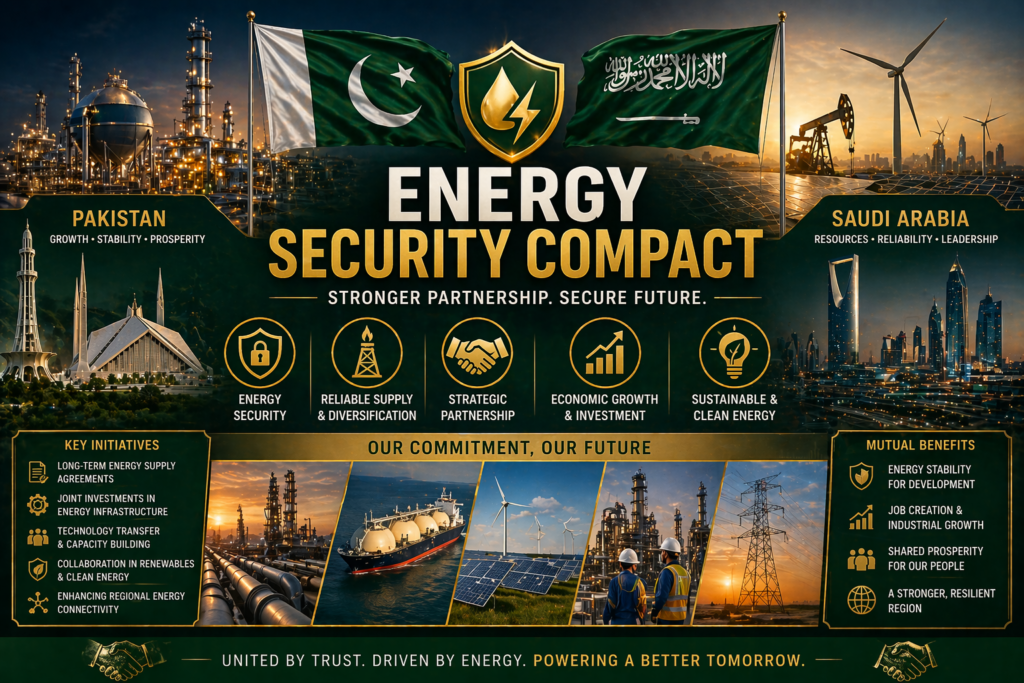
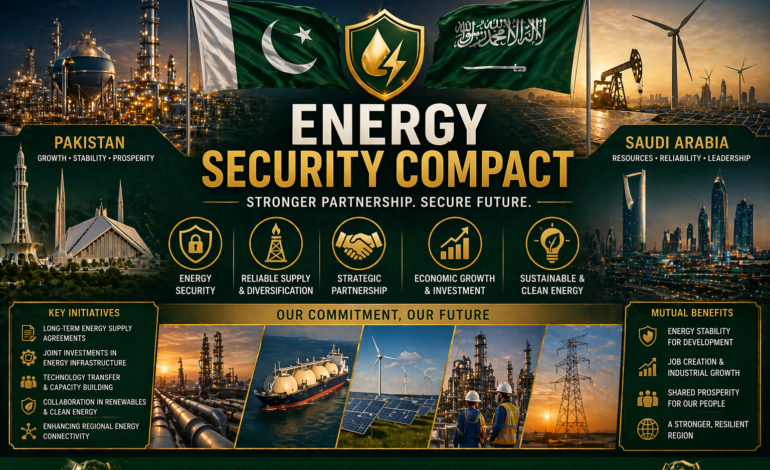
The question of energy security has emerged as the most structurally consequential dimension of Pakistan Saudi relations, not merely because it involves hydrocarbons and fiscal arrangements, but because it sits at the intersection of sovereignty, dependency, and geopolitical positioning. The proposed Energy Security Compact between Pakistan and Saudi Arabia must therefore be understood as more than a technical arrangement for oil imports or deferred payments. It represents an evolving attempt to institutionalise energy as a strategic instrument of interdependence within a rapidly shifting global energy order, where traditional supplier buyer hierarchies are being redefined by transition politics, fiscal volatility, and geopolitical fragmentation.
From a dependency theory perspective, Pakistan’s energy regime has historically been characterised by chronic externalisation of its structural inefficiencies. Persistent circular debt, weak domestic refining capacity, high transmission losses, and import dependent fuel consumption have created a condition in which external suppliers effectively stabilise internal governance failures. Saudi Arabia, as a dominant hydrocarbon exporter, has repeatedly functioned as a lender of last resort in energy form, extending deferred oil payments, concessional supply arrangements, and crisis-based relief packages. While such arrangements provide short term macroeconomic relief, they also reinforce a structural condition in which Pakistan’s energy security is externally mediated rather than internally generated. The proposed Energy Security Compact risks reproducing this dependency unless it is explicitly designed as a transition mechanism rather than a permanent subsidy structure.
However, dependency theory alone does not capture the evolving complexity of Saudi Arabia’s own strategic recalibration. The Kingdom is no longer simply an oil exporter operating within a static petro state logic. Under Vision 2030, Saudi Arabia is actively repositioning itself within a post oil global economy, investing in renewable energy, hydrogen futures, and downstream industrial diversification. This transformation introduces a new form of strategic calculation in which oil diplomacy becomes embedded within broader investment, technological, and geopolitical objectives. Consequently, Pakistan is not merely a recipient of energy flows but a potential node within Saudi Arabia’s emerging global energy investment network.
The Energy Security Compact, if designed with institutional foresight, could therefore serve as a hybrid mechanism integrating short term liquidity stabilisation with long term structural transformation. One of its core instruments would be preferential oil storage arrangements, whereby Pakistan provides strategic storage capacity for Saudi petroleum reserves within its coastal infrastructure. This would not only enhance Saudi supply chain resilience in times of maritime disruption but also reposition Pakistan as a geographically significant energy buffer between the Gulf and South Asian markets. Such a configuration aligns with complex interdependence theory, which emphasises that economic infrastructure increasingly functions as a channel of strategic influence rather than a neutral technical asset.
Yet this apparent mutual benefit conceals underlying asymmetries. Pakistan’s geographical advantage does not automatically translate into bargaining power unless supported by institutional capacity, regulatory stability, and infrastructural reliability. Without these, storage agreements risk becoming symbolic rather than functional. Moreover, the integration of strategic oil storage into Pakistan’s coastal zones introduces questions of security externalisation, particularly in a region marked by maritime instability and competing great power interests in the Arabian Sea and Indian Ocean corridors.
A second pillar of the Energy Security Compact involves deferred payment mechanisms for oil imports. Pakistan has periodically relied on such arrangements during balance of payments crises, effectively converting energy imports into quasi financial instruments. Institutionalising this mechanism could provide cyclical stabilisation, allowing Pakistan to smooth external shocks during periods of fiscal stress. However, neo structural economic theory warns that such arrangements can entrench import dependence if not accompanied by domestic energy sector reform. Deferred payments, while alleviating immediate liquidity pressures, may also delay necessary structural adjustments in pricing, efficiency, and governance of the energy sector.
For Saudi Arabia, deferred payment systems function not merely as financial concessions but as geopolitical credit instruments. They generate long term relational capital, binding recipient states into networks of economic obligation and strategic alignment. In this sense, energy diplomacy becomes a form of soft structural power, operating through financial temporality rather than coercive force. The challenge for Pakistan is therefore to ensure that deferred payment arrangements do not translate into asymmetrical policy constraints in other domains such as defence alignment or diplomatic positioning.
The third and most transformative dimension of the Energy Security Compact lies in renewable energy co investment. Here, the logic of dependency begins to shift toward a potential post dependency configuration. Pakistan’s chronic energy shortfall, combined with its high solar irradiation potential and underdeveloped wind corridors, creates a structural opportunity for renewable transformation. Saudi Arabia’s capital surplus and diversification agenda further align with such investments, particularly in solar farms, wind energy projects, and emerging hydrogen production technologies.
If properly structured, this dimension could represent a move from extractive energy relations to transformative energy partnership. Unlike fossil fuel trade, renewable energy investment requires long term infrastructural integration, technological transfer, and institutional coordination. This creates the possibility of what complex interdependence theory identifies as multiple feedback loops of mutual vulnerability and cooperation. In such a scenario, both states become jointly invested not merely in energy exchange but in the stability of shared infrastructural systems.
However, the success of this transition depends on Pakistan’s domestic regulatory and institutional capacity. Without transparent procurement systems, consistent tariff frameworks, and political stability, renewable energy investments risk becoming fragmented, inefficient, or captured by short term political interests. Neo structuralism again becomes relevant here, as it emphasises that external capital cannot substitute for internal institutional coherence. Saudi investment alone cannot resolve Pakistan’s energy crisis if structural governance deficits remain unaddressed.
Saudi Arabia’s internal considerations also shape the feasibility of this compact. The Kingdom’s energy transition strategy is driven by a dual imperative: maintaining global oil market influence while simultaneously investing in post oil economic futures. This creates a tension between short term revenue dependence on hydrocarbons and long term diversification into renewables and knowledge economies. Pakistan, in this context, becomes both a testing ground for external energy investments and a stabilising demand partner in traditional energy markets. The Energy Security Compact thus operates within Saudi Arabia’s broader strategic balancing act between legacy energy dominance and future oriented transformation.
Geopolitically, the compact also interacts with broader regional energy architectures involving China, Iran, and Central Asian states. Pakistan’s role as a corridor economy under the China Pakistan Economic Corridor introduces additional layers of infrastructural connectivity that may intersect or compete with Saudi energy routes. Similarly, Iran’s proximity and its own energy export potential introduce alternative supply dynamics that complicate exclusive bilateral energy arrangements. Complex interdependence theory suggests that such overlapping networks reduce the possibility of absolute dependency but increase the complexity of policy coordination.
Ultimately, the Energy Security Compact should be conceptualised as a transitional governance mechanism rather than a permanent structural fix. Its success will depend on whether it can evolve from a liquidity support system into a transformative energy architecture that simultaneously stabilises Pakistan’s fiscal vulnerabilities and advances Saudi Arabia’s diversification agenda. Without this transformation, the compact risks reinforcing historical patterns of asymmetric dependency under new institutional terminology.
The central tension remains unresolved. Energy cooperation between Pakistan and Saudi Arabia is simultaneously a stabilising necessity and a potential reproducer of structural imbalance. It is both a tool of sovereignty preservation and a mechanism of external influence. The outcome will depend not on the existence of the compact itself, but on the depth of institutional design, the discipline of implementation, and the willingness of both states to move beyond transactional energy diplomacy toward a genuinely integrated strategic energy partnership.
A Public Service Message