Corridors of Faith and Force: Recasting the Pakistan–Saudi Human Security Compact for Strategic Leverage

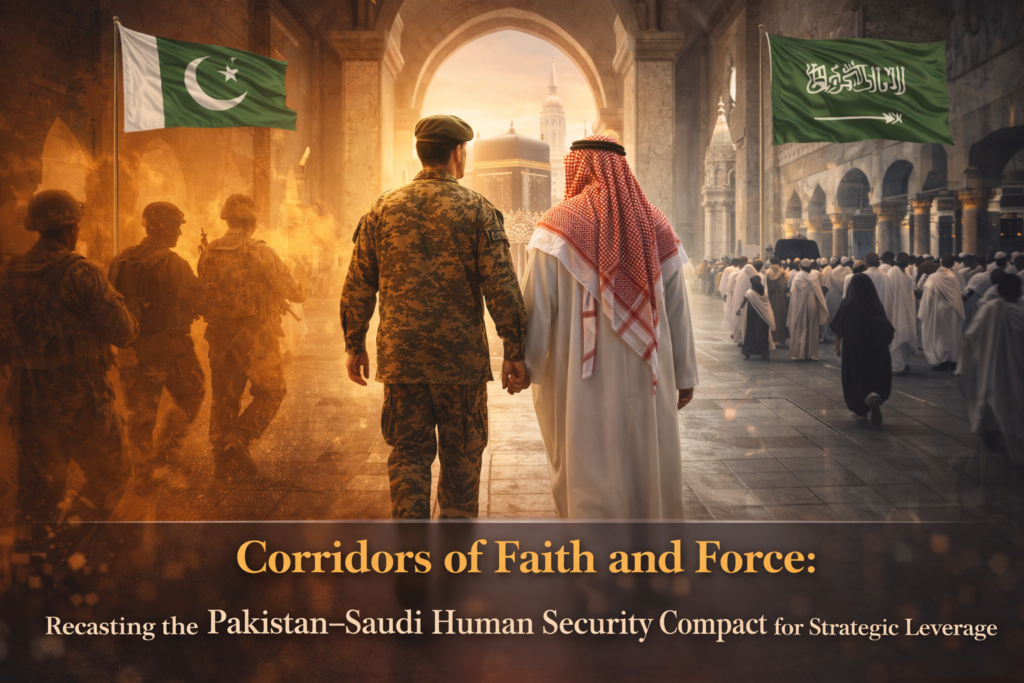
The movement of people has emerged as one of the most decisive yet under structured instruments of state power in the contemporary geopolitical order. It shapes economic resilience through remittance flows, reinforces diplomatic alignment through societal linkages, and enhances strategic depth through security cooperation. Within this expanding framework, the relationship between Pakistan and Saudi Arabia possesses a unique concentration of human connectivity that remains insufficiently institutionalized. Pilgrimage flows, labor migration, and defense cooperation operate in parallel rather than in integration, limiting their cumulative strategic impact. This fragmentation is no longer sustainable in an era where states that successfully structure human mobility gain disproportionate leverage across economic and geopolitical domains.
Pakistan stands at a critical juncture where it must transition from a passive manager of human flows to an active architect of a Human Mobility and Security Compact. This transition is not merely administrative. It is strategic in its intent and transformational in its implications. The central policy concern for decision makers is clear. Without a unified framework, Pakistan risks continued inefficiencies in pilgrimage management, underperformance in diaspora optimization, and a failure to translate security cooperation into broader strategic influence. The opportunity cost of inaction is significant, measured in lost remittances, diminished diplomatic leverage, and constrained regional relevance.
The pilgrimage dimension offers the most immediate and visible entry point for reform. Each year, large numbers of Pakistani citizens undertake religious journeys under Hajj and Umrah, forming one of the largest organized cross border movements in the world. Yet the current management structure is burdened by procedural inefficiencies, limited transparency, and inadequate technological integration. Policymakers must recognize that pilgrimage is not solely a religious obligation but a strategic interface between the state and its citizens, and between Pakistan and Saudi Arabia. The recommendation is unequivocal. Pakistan must implement a fully digitized pilgrimage governance system that integrates registration, quota allocation, biometric verification, and real time monitoring into a single platform.
Such a system would not only enhance efficiency but also establish credibility. It would reduce administrative leakages, eliminate discretionary distortions, and ensure equitable access. More importantly, it would signal to Saudi authorities that Pakistan is capable of managing complex human flows with precision and accountability. This, in turn, strengthens Pakistan’s negotiating position in securing favorable quotas and logistical arrangements. The pivot here is from a reactive administrative model to a proactive governance framework that treats pilgrimage as a strategic asset rather than a logistical burden.
The diaspora dimension introduces a deeper and more consequential policy challenge. Pakistani workers in Saudi Arabia constitute a critical pillar of the national economy through their remittance contributions. However, the existing framework governing labor migration is characterized by structural weaknesses, including limited skill development, inadequate legal protections, and fragmented institutional oversight. Policymakers must confront a fundamental reality. Remittances are not a byproduct of migration but the outcome of a structured ecosystem that determines the quality, security, and productivity of labor.
The strategic recommendation is to negotiate a comprehensive labor mobility accord with Saudi Arabia that prioritizes skill alignment, legal safeguards, and upward mobility. Pakistan must pivot from exporting low skilled labor to cultivating a workforce that meets the evolving demands of a transforming Saudi economy. This requires a coordinated national effort involving technical training institutions, certification bodies, and industry stakeholders. Skill mapping must be aligned with Saudi economic sectors undergoing expansion, including construction, technology, healthcare, and services.
In parallel, legal frameworks must be strengthened to protect workers from exploitation and ensure access to dispute resolution mechanisms. The establishment of dedicated labor facilitation centers within Saudi Arabia, supported by Pakistani diplomatic missions, can provide real time assistance and oversight. Financial integration must also be enhanced through digital remittance platforms that reduce transaction costs and increase transparency. These measures collectively elevate the economic contribution of the diaspora while reinforcing its security and dignity.
The defense and security dimension of the corridor represents the most strategic yet underdeveloped component. Pakistan and Saudi Arabia have a long history of defense cooperation, encompassing training programs, joint exercises, and strategic consultations. However, this cooperation remains compartmentalized, disconnected from the broader framework of human mobility. Policymakers must recognize that security is not an isolated domain but an enabling condition for all forms of cross border movement.
The recommendation is to integrate defense cooperation into the Human Mobility and Security Compact through the establishment of joint coordination mechanisms that align security protocols with migration and pilgrimage flows. This includes intelligence sharing on potential threats, coordinated response frameworks, and the development of secure transit systems. Such integration enhances the safety of pilgrims and workers while reinforcing bilateral trust.
This dimension also acquires greater significance in the context of trilateral engagement involving Hakan Fidan and the broader alignment with Türkiye. Pakistan has the opportunity to position itself as a central node within a trilateral security architecture that extends beyond traditional defense cooperation into coordinated human security management. The pivot here is from bilateral security arrangements to a broader strategic configuration that amplifies Pakistan’s regional relevance.
Operationalizing the Human Mobility and Security Compact requires the establishment of measurable indicators that guide policy implementation and evaluation. Pilgrimage efficiency can be assessed through processing times, transparency indices, and user satisfaction metrics. Diaspora performance can be measured through remittance growth, skill level distribution, and labor retention rates. Security integration can be evaluated through the frequency of joint exercises, intelligence sharing effectiveness, and incident response capabilities. These metrics provide policymakers with a structured framework for continuous improvement.
The broader impact of this compact extends across economic, social, and strategic domains. Enhanced remittance flows contribute to fiscal stability and foreign exchange reserves. Improved labor conditions strengthen social cohesion and national confidence. Integrated security cooperation enhances deterrence and regional stability. Collectively, these outcomes reinforce Pakistan’s capacity to navigate a complex geopolitical environment with greater resilience and influence.
Predictively, the successful implementation of this framework could reposition Pakistan as a leading architect of human mobility governance within the Islamic world. Remittance flows could achieve greater stability and growth, reducing dependence on volatile external financing. The elevation of labor standards could enhance the global competitiveness of Pakistani workers. The integration of security cooperation could position Pakistan as a pivotal actor in regional stability frameworks.
However, the realization of this vision requires confronting entrenched institutional challenges. Fragmentation across ministries, regulatory inconsistencies, and limited coordination mechanisms have historically undermined policy effectiveness. The central recommendation is the creation of a high level interministerial authority with the mandate to oversee the Human Mobility and Security Compact. This body must possess both the authority and the capacity to align policies, resolve conflicts, and ensure implementation.
Technological adoption is equally critical. Digital platforms must be deployed across all dimensions of the corridor, from pilgrimage management to labor tracking and financial transactions. Data analytics should inform decision making, enabling policymakers to anticipate trends, identify vulnerabilities, and optimize outcomes. This technological integration transforms the corridor into a dynamic and responsive system capable of adapting to changing conditions.
Leadership commitment remains the decisive factor in this transformation. Policymakers must move beyond incremental adjustments and embrace a comprehensive strategic vision. This requires sustained political will, coordinated institutional action, and continuous monitoring. Clear timelines, defined responsibilities, and measurable targets are essential to ensure accountability and progress.
In conclusion, the Pakistan–Saudi Human Mobility and Security Compact represents a strategic imperative rather than a policy option. It offers a pathway to convert human connectivity into a structured instrument of national power. By embedding high level policy reforms, aligning institutional frameworks, and leveraging technological capabilities, Pakistan can pivot from a position of reactive management to one of strategic orchestration.
Anchored in its enduring partnership with Saudi Arabia and reinforced by emerging regional alignments, Pakistan possesses the capacity to redefine the contours of bilateral engagement. The challenge lies not in identifying opportunities but in executing a coherent and disciplined strategy. In a world where the movement of people shapes the trajectory of states, those who structure this movement with precision and foresight will command influence. Pakistan must position itself among them.
A Public Service Message