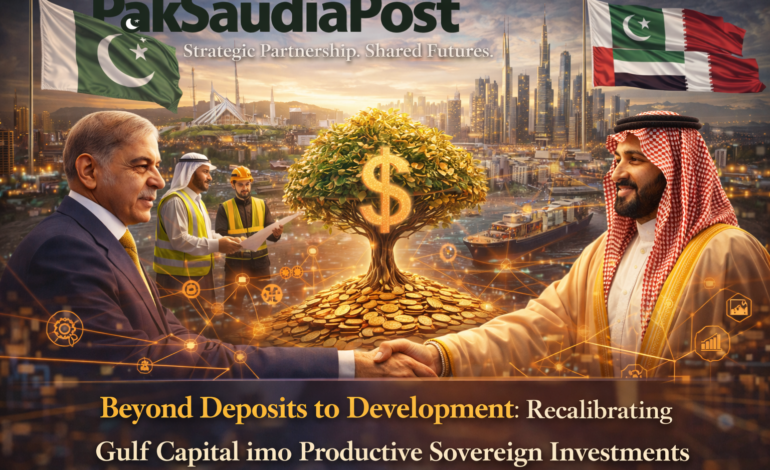
Beyond Deposits to Development: Recalibrating Gulf Capital into Productive Sovereign Investments

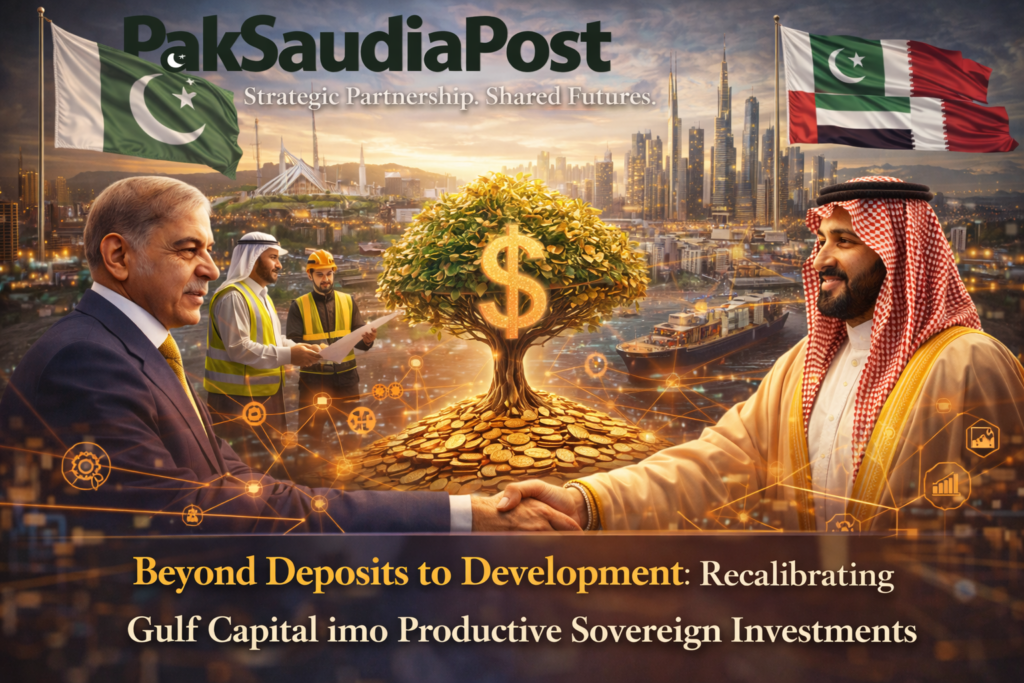
The structural fragility of Pakistan’s external financing model has long been masked by episodic inflows of bilateral support, often extended in moments of acute fiscal stress and withdrawn once temporary stability is restored. The recent decision to repay high cost deposits to the United Arab Emirates underscores a deeper systemic dilemma. Liquidity injections, while politically expedient, do not resolve underlying distortions within Pakistan’s economic architecture. They defer adjustment, perpetuate dependency, and constrain sovereign policy autonomy. In contrast, the evolving engagement with Saudi Arabia presents a strategic inflection point. It offers Pakistan the opportunity to recalibrate its economic diplomacy away from transactional bailouts toward a paradigm of productive, asset backed, and sovereignty enhancing investment flows.
This transition is neither cosmetic nor incremental. It requires a fundamental reconfiguration of how Pakistan conceptualizes external capital. Deposits parked within the central bank, often at non concessional rates, constitute passive liabilities. They neither generate domestic productive capacity nor catalyze structural transformation. Their opportunity cost is profound. They inflate the illusion of stability while silently compounding fiscal vulnerability. The alternative lies in converting such flows into equity driven, sector specific, and performance linked investments that embed foreign capital within Pakistan’s real economy.
The alignment with Vision 2030 is central to this transformation. Saudi Arabia is itself undergoing a profound economic metamorphosis, seeking to diversify away from hydrocarbon dependence and deploy capital globally in pursuit of strategic returns. This convergence of interests creates a rare window for Pakistan to position itself not as a recipient of financial relief but as a destination for long horizon sovereign investment. The challenge lies in designing a framework that aligns Saudi capital with Pakistan’s developmental imperatives while safeguarding national economic sovereignty.
A Pakistan Saudi Economic Transformation Framework must therefore be conceptualized as a structured policy architecture rather than an ad hoc arrangement. At its core, it should prioritize sectors with high multiplier effects and strategic relevance. Energy, mining, logistics, and industrial manufacturing emerge as primary candidates. These sectors possess the capacity to absorb large scale investment, generate employment, and enhance export competitiveness. More importantly, they align with Saudi Arabia’s outward investment strategy, creating a symbiotic relationship rather than a donor recipient dynamic.
The energy sector exemplifies the potential of such alignment. Pakistan’s chronic energy deficits have long constrained industrial productivity and economic growth. Saudi investment in refining capacity, storage infrastructure, and renewable energy projects can address these constraints while securing long term returns. Joint ventures in refining not only reduce import dependence but also create value addition within the domestic economy. Similarly, investments in solar and wind energy resonate with Saudi Arabia’s own transition toward sustainable energy, reinforcing policy coherence between the two countries.
The mining sector offers another avenue for transformative engagement. Pakistan’s untapped mineral resources, including copper, gold, and rare earth elements, represent a latent source of wealth. However, the development of this sector requires significant capital, advanced technology, and robust governance frameworks. Saudi sovereign funds, with their financial depth and global experience, are well positioned to bridge this gap. By structuring investments as equity rather than extractive concessions, Pakistan can ensure that value is retained domestically while sharing risks and rewards with its partner.
Logistics and connectivity form the third pillar of this framework. Pakistan’s geographic location provides a natural advantage as a transit hub linking South Asia, Central Asia, and the Middle East. Investments in ports, rail networks, and special economic zones can unlock this potential, transforming Pakistan into a orbit for regional trade. Saudi participation in such projects not only enhances their viability but also integrates Pakistan more deeply into emerging trade corridors.
The operationalization of this framework requires rigorous metrics to ensure accountability and effectiveness. One critical indicator is the ratio of deposits to foreign direct investment. A successful transition would see a steady decline in reliance on short term deposits and a corresponding increase in long term equity inflows. Another metric is sectoral allocation, ensuring that investments are directed toward high impact areas rather than low productivity ventures. Return on investment, measured not only in financial terms but also in employment generation and export growth, provides a comprehensive assessment of impact.
Fiscal implications are equally significant. Equity based investments do not impose the same repayment obligations as debt, thereby reducing pressure on Pakistan’s balance of payments. They also generate tax revenues and foreign exchange earnings, contributing to fiscal stability. Over time, this shift can create a virtuous cycle, where increased economic activity attracts further investment, reinforcing growth and resilience.
The strategic dimension of this transition cannot be overstated. Economic dependency constrains policy autonomy, limiting a state’s ability to pursue independent strategic objectives. By contrast, a partnership based on mutual investment fosters interdependence rather than dependency. It creates shared stakes in economic success, aligning incentives and enhancing trust. For Pakistan, this translates into greater strategic flexibility, enabling it to navigate a complex geopolitical landscape with confidence.
However, the transition from deposits to development is not without risks. Governance challenges, regulatory uncertainty, and political instability can undermine investor confidence. To mitigate these risks, Pakistan must undertake institutional reforms that enhance transparency, streamline decision making, and ensure policy continuity. This includes the establishment of dedicated investment facilitation units, the simplification of regulatory procedures, and the enforcement of contractual obligations.
Another critical consideration is the preservation of national interest. While foreign investment is essential for development, it must not come at the cost of economic sovereignty. پاکستان must therefore adopt a calibrated approach, balancing openness with prudence. Strategic sectors should be governed by clear guidelines that protect national assets while allowing for meaningful foreign participation. This balance is essential to ensure that the benefits of investment are widely distributed and sustainable.
The geopolitical context further amplifies the importance of this policy shift. The global economic order is undergoing a process of fragmentation, with capital flows increasingly influenced by strategic considerations. In this environment, Pakistan’s ability to attract and retain investment depends not only on economic fundamentals but also on its geopolitical positioning. A strong and structured partnership with Saudi Arabia enhances Pakistan’s credibility as an investment destination, signaling stability and alignment with a major regional power.
Predictively, the successful implementation of this framework could transform Pakistan’s economic trajectory. Saudi origin foreign direct investment could expand exponentially, replacing episodic financial support with sustained capital inflows. This would not only stabilize the economy but also accelerate structural transformation, enabling Pakistan to move up the value chain and reduce its reliance on low value exports.
The implications extend beyond economics into the social and political domains. Increased investment in key sectors generates employment opportunities, reducing poverty and enhancing social stability. It also strengthens the الدولة by expanding its fiscal capacity, enabling greater investment in public services and infrastructure. This holistic impact underscores the transformative potential of the policy.
The role of leadership in driving this transition is paramount. Strategic vision must be complemented by operational execution. Policymakers must move beyond rhetoric and commit to concrete actions that signal seriousness of intent. This includes the negotiation of comprehensive investment agreements, the establishment of joint oversight mechanisms, and the continuous monitoring of progress.
In conclusion, the recalibration of Gulf capital from deposits to development represents a strategic imperative for Pakistan. It is a shift from vulnerability to resilience, from dependency to partnership, and from short term relief to long term prosperity. The convergence with Saudi Arabia and its transformative agenda under Vision 2030 provides a unique opportunity to operationalize this vision.
This is not merely an economic adjustment but a redefinition of Pakistan’s engagement with external capital. It demands intellectual rigor, policy coherence, and institutional discipline. If executed effectively, it has the potential to reshape Pakistan’s economic landscape, enhance its strategic autonomy, and position it as a credible and competitive player in the global economy.
A Public Service Message